Get Full Government Meeting Transcripts, Videos, & Alerts Forever!
Get email alerts on the Budget topic
No spam. Unsubscribe anytime.
Waukesha School District hears preliminary 2025-26 budget; CFO forecasts 3.77% levy increase
Summary
At a Sept. 10 public hearing the Waukesha School District presented a preliminary 2025-26 budget that assumes an $11,650 per-student revenue authority, a projected 2% enrollment decline and a 3.77% tax levy increase; no public speakers signed up.
The Waukesha School District held its annual preliminary budget hearing on Sept. 10, 2025, during which the district’s chief financial officer summarized the draft 2025-26 budget and a projected 3.77% increase in the property tax levy. Mr. Clark, the district’s chief financial officer, presented enrollment projections, state funding changes and a timeline for finalizing the budget and levy in October.
The hearing “is to give the public a chance to provide some feedback on the status of the budget for this year,” Mr. Clark said, describing the process as having “one’s transparency and accountability” purpose as well as the administrative need to approve an interim budget so the district can continue operations.
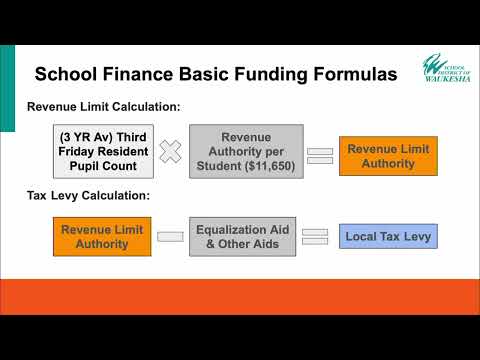
Nut graf: Why it matters — The district’s final tax levy will depend on state equalization aid that the Wisconsin biennial budget and Department of Public Instruction (DPI) estimate; changes to that aid can shift costs to local property taxpayers. The district presented scenarios showing that the same revenue limit authority can produce different levy outcomes depending on the amount of state aid awarded.
Key details from the presentation
- Revenue authority per student: Mr. Clark said the district’s revenue limit authority for the upcoming year is $11,650 per resident student, an increase of $325 per student from the prior year. That revenue limit calculation represents about 80% of the district’s operational budget, he said.
- Enrollment: The district projects a resident pupil count decline from 10,996 in 2024–25 to 10,854 for the upcoming year (a projected 2% decrease based on the third-Friday pupil count methodology). Mr. Clark noted the difference between resident pupil counts used for finance and on-site enrollment figures used in other district planning.
- Special education funding: The state increased the reimbursement rate that counts toward special education costs. Mr. Clark said the state’s reimbursement moved from 33% to 42% for fiscal 2025–26 and will move to 45% in 2026–27; the district is budgeting an effective reimbursement rate of 39% based on prior-year actuals and the way reimbursements are calculated against last year’s budgeted figures.
- Debt and levy impact: Mr. Clark noted the district is scheduled to pay off all outstanding debt on April 1, 2026, and that the district’s prior debt payoff strategy is expected to reduce future debt-service levy amounts. The preliminary budget as presented shows a 3.77% overall tax levy increase compared with the prior year, a change Mr. Clark traced chiefly to a $5.9 million projected decrease in equalization aid from DPI estimates.
- Funds and assumptions: Mr. Clark said fund 39 is budgeted with $2,350,000 in revenue and approximately $11.3 million in expenditures for the current year; those fund 39 lines are expected to be zero next year. The preliminary assumptions include an assumed 5% property valuation growth (the CFO observed that assumption may change as final valuations are reported).
Timeline and next steps
Mr. Clark outlined the remaining schedule: the district’s third-Friday pupil count on Sept. 19; an updated near-final budget presentation to the district committee (noted in the transcript as “FNF”) on Oct. 6; property valuation reporting between Oct. 1–15; DPI’s final equalization aid figures on Oct. 15; and board approval of the final budget and tax levy in late October.
Public comment and meeting close
No members of the public signed up to speak at the hearing. The presiding board member noted, “Seeing no speakers, that will conclude our preliminary budget hearing for this evening,” and the meeting moved on without public testimony.
The district’s CFO closed by noting the preliminary budget complies with Wisconsin revenue-limit legislation and that figures are based on the best information available in early August; he reiterated that the district will update numbers once DPI and property valuation data are finalized in October.
Ending: The board will return to the preliminary numbers after DPI and local property valuation information is received in October, when the community can expect a final budget and levy for formal approval.