Get Full Government Meeting Transcripts, Videos, & Alerts Forever!
Get email alerts on the Opioid Settlement Grants topic
No spam. Unsubscribe anytime.
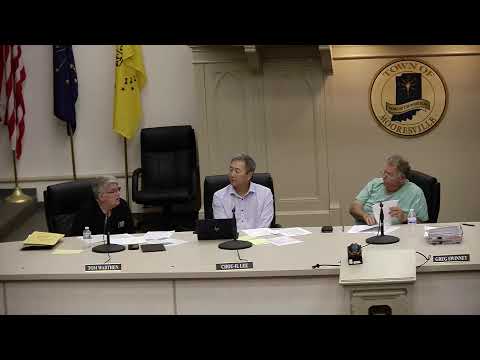
Kendrick Foundation asks Mooresville council to partner on local opioid-settlement grant making
Summary
Keeley Wright of the Kendrick Foundation asked the Mooresville Town Council to consider partnering on local opioid-settlement grant making and on pursuing a state dollar-for-dollar match program, emphasizing prior county grant distribution and a community-driven prioritization process.
Keeley Wright, executive director of the Kendrick Foundation and leader of the Morgan County Mental Health Task Force, asked the Mooresville Town Council on Sept. 16 to consider partnering in future local opioid-settlement grant rounds and to support potential state match applications.
Wright said the Kendrick Foundation coordinated distribution of the county's first round of opioid-settlement funds and that the foundation awarded more than $1 million to 11 local organizations over two years. “We awarded 11 organizations over 1,000,000 for 2 years,” Wright told the council, adding that the group used a transparent, competitive process and community input to set priorities.
Wright described the task force’s application process, including requiring applicants to submit budgets and an action plan that identifies which abatement strategies from Exhibit E they would implement. “They have to, submit with their proposals an action plan and clearly identify which of the strategies they are implementing from Exhibit E,” Wright said. She said applicants could show cost-sharing in their budgets and that the work group encouraged cost sharing.
Council members asked for clarification about how much of awarded dollars go directly to program services versus administrative costs. Wright said applicants must submit budgets showing how requested local opioid funds would be used and that the grants should fund the activities stated in the approved budgets. “A 100% of it should be going towards the budget based on whatever they proposed,” Wright said, adding that many funded activities were abatement strategies.
Wright said the task force is considering applying for a state opioid-settlement dollar-for-dollar match grant; the application windows include an Oct. 6 deadline for prevention and transportation strategy areas (up to $150,000 each) and a later deadline for recovery residence capital (up to $500,000). She said the match application would be submitted by a county service provider, with the task force offering letters of commitment from local governments to match if awarded.
Council members expressed interest in collaborating but said they needed time to consider financial commitments and logistics. Town officials discussed the possibility of council members communicating with Kendrick Foundation staff between meetings and the council later agreed to let staff and council members follow up individually to explore options for a partnership and potential matching commitments.
Wright emphasized that her immediate ask was for partnership and collaboration rather than a specific dollar figure. “It’s more about the collaboration than the dollar amount,” she said.