Lifetime Citizen Portal Access — AI Briefings, Alerts & Unlimited Follows
Manatee County outlines multi‑year push to expand Sun Trail, county connectors
Loading...
Summary
County public‑works staff presented a status update on the county’s trails master plan, saying some regional segments have partial funding and outlining a phased construction approach. Commissioners pressed for accelerated local funding and clearer timelines.
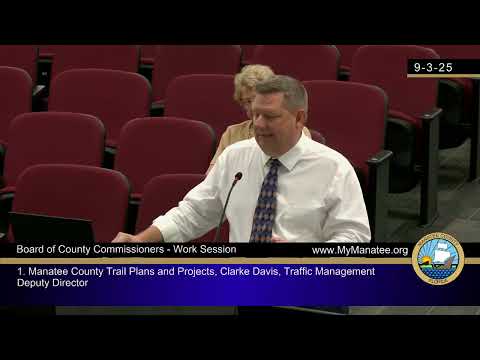
Manatee County public‑works staff on Wednesday presented a status update on county trails plans and projects, saying the county is transitioning responsibility for trail construction to public works and is pursuing a mix of developer partnerships, state Sun Trail designation and federal grants to build regional and connector trails.
The presentation, led by Clark Davis, deputy director of public works, distinguished regional “Sun Trail” segments from county and connector trails and said the Sun Trail generally requires 12‑foot, hard‑surfaced, ADA‑accessible paths while the county’s master plan targets 15‑foot regional trails and 8–12 foot connectors. “For purposes of this presentation, we’re talking about trails as infrastructure you can use for making trips,” Davis said.
County planning and engineering staff showed maps of the Gateway Greenway/Sun Trail alignment running north–south through the county and identified several projects in production or design: a Bourneside Boulevard segment being built under agreement with Schrader Manatee Ranch (SMR); a Rye Preserve to State Road 64 connection (estimated locally at about $4 million for the Waterline‑to‑Rye segment); the Palmetto Trail Network middle section (partially funded by approximately $2.9 million in federal community project funds); and a Lincoln Park connection and pedestrian bridge that staff estimate could cost $8–$10 million for construction.
Why it matters: commissioners pressed staff for a clearer, faster program after years of planning with limited construction. Commissioner Cruz repeatedly urged accelerating local funding to move projects from plans to shovels, saying the trails are a cost‑effective alternative to costly road expansion. “At some point this board needs to say what’s the best use of our dollars,” Cruz said. Several commissioners urged staff to return with concrete budget options (status quo, accelerated, and “hyperdrive”) that show timelines, costs and tradeoffs.
What staff said: Davis and project staff said some Sun Trail segments are already partially committed or built but may not meet current width standards, and noted a lag in the state maps that understates local commitments. He said the county will work with the Florida Office of Greenways and Trails and FDOT on updates and that PD&E (project development and environmental) work will be required for federally funded segments like the Manatee Avenue corridor. “As soon as you start building any infrastructure with Federal funds, you have to jump through the NEPA hurdle and…that’s a project development environmental study,” Davis said.
Funding and delivery: staff described three procurement/funding streams: public‑private/ developer partnerships (reimbursement or impact‑fee credit, for example the Bourneside build by SMR), federal community project funds (roughly $2.9 million targeted for Palmetto Trail segments plus other smaller awards), and FDOT/MPO programs (including transportation alternatives and Sun Trail grant opportunities with typical caps and matching requirements). Commissioners and staff discussed using the county’s multimodal portion of impact fees to accelerate projects; staff said those revenue sources and specific local allocations could be part of a capital‑plan proposal for FY2026.
Debate and concerns: commissioners pressed for (1) an inventory of pinch points where 12–15 foot widths are not feasible, (2) prioritized, “executable” project chunks that can move to design and construction quickly, and (3) specific dollar figures for accelerated options. Charlie Hunsicker, who has directed earlier trail planning efforts, told the board that a trail master plan existed in 1999 but was not funded and that prior grant offers were sometimes declined when field conditions made the required match uneconomic: “We put in our application… When it was determined from Florida Power and Light that that was not gonna be possible, we said we’ll simply build our trail alongside the road… In order to honor the $500,000 commitment, it was gonna cost us another almost $3,000,000 to accept it.”
Operational next steps: staff said they will (a) update maps with Sun Trail/FGTS data and local commitments, (b) work with FDOT/MPO to complete PD&E for corridors that are candidates for federal transportation alternatives funding, (c) assemble 30–60% design packages for priority segments so the county can seek construction dollars, and (d) return with FY2026 capital options showing accelerated funding scenarios.
The takeaway: staff framed the remaining work as largely implementation (design, right‑of‑way, PD&E and construction). Commissioners widely supported accelerating the program and asked staff to return with defined funding scenarios, expected timelines and tradeoffs so the board can decide how much local money to commit versus continued reliance on state and federal grants.