
Hampton police and school security outline SRO role, ALICE training and safety measures
Get AI-powered insights, summaries, and transcripts
Subscribe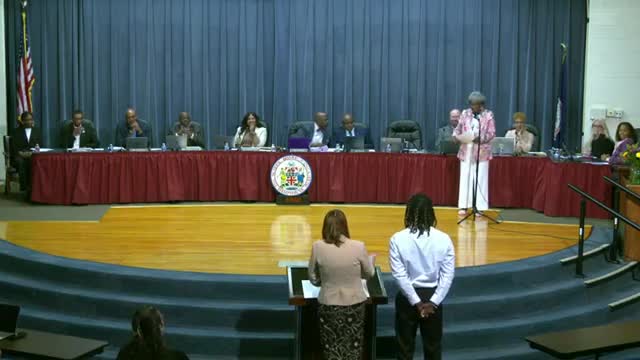
Summary
School resource officers and district security staff reviewed the SRO role, training requirements and security measures including ALICE training, metal detectors, Raptor check-ins and K‑9 searches.
School resource officers from the Hampton Police Division and the district’s security supervisor briefed the Hampton City School Board on Sept. 3 about the SRO (school resource officer) program, training and site-level safety measures used across the division.
Master Patrolman Brian Thurston, identified as a school resource officer with the Hampton Police Division, described the SRO "triad" of duties — law enforcement, law‑related education and role‑model mentoring — and said the unit’s work is intended to support "student success." Thurston outlined curricula and programs SROs deliver, including the Virginia Rules curriculum from the state Attorney General’s office, and described school-based programs such as Operation Prom, Keep the Peace (a court‑ordered juvenile diversion program) and newer efforts like Learning with Lex (a reading program featuring a canine partner) and Young Men of Distinction (a life-skills group run by an SRO).
Thurston noted state requirements for SROs and said the Commonwealth’s administrative code requires a minimum of two years of certified law enforcement experience and completion of school resource officer training through the Virginia Department of Criminal Justice Services.
Security supervisor James Bailey summarized district measures in place at schools: locked exterior doors with visitor check-in via the Raptor system (which screens for sex-offender status), camera systems, radios and routine/targeted K‑9 searches in cooperation with American K‑9 Interdiction. Bailey said the district uses walkthrough metal detectors to screen students and guests, conducts frequent drills (lockdown and fire drills) and has trained 19 new elementary-school security officers who began in late July. The district also completed an ALICE (Alert, Lockdown, Inform, Counter, Evacuate) Train‑the‑Trainer course and is moving to a new safe‑school hotline number.
Board members asked for more detail about Operation Prom; Thurston described interactive demonstrations the SRO unit uses, such as "fatal vision" goggles that simulate impairment and videos of real incidents, to illustrate the risks of impaired driving. Trustee comments praised the partnership between the police and the school division and noted that the ALICE training had been emotionally impactful for some participants.
No changes to SRO assignments or district security policy were adopted during the meeting; the presentation was informational and board members were invited to attend future training sessions.