Get Full Government Meeting Transcripts, Videos, & Alerts Forever!
Get email alerts on the Police Accountability topic
No spam. Unsubscribe anytime.
Senate committee advances 'No Secret Police Act' to bar masked enforcement in California
Summary
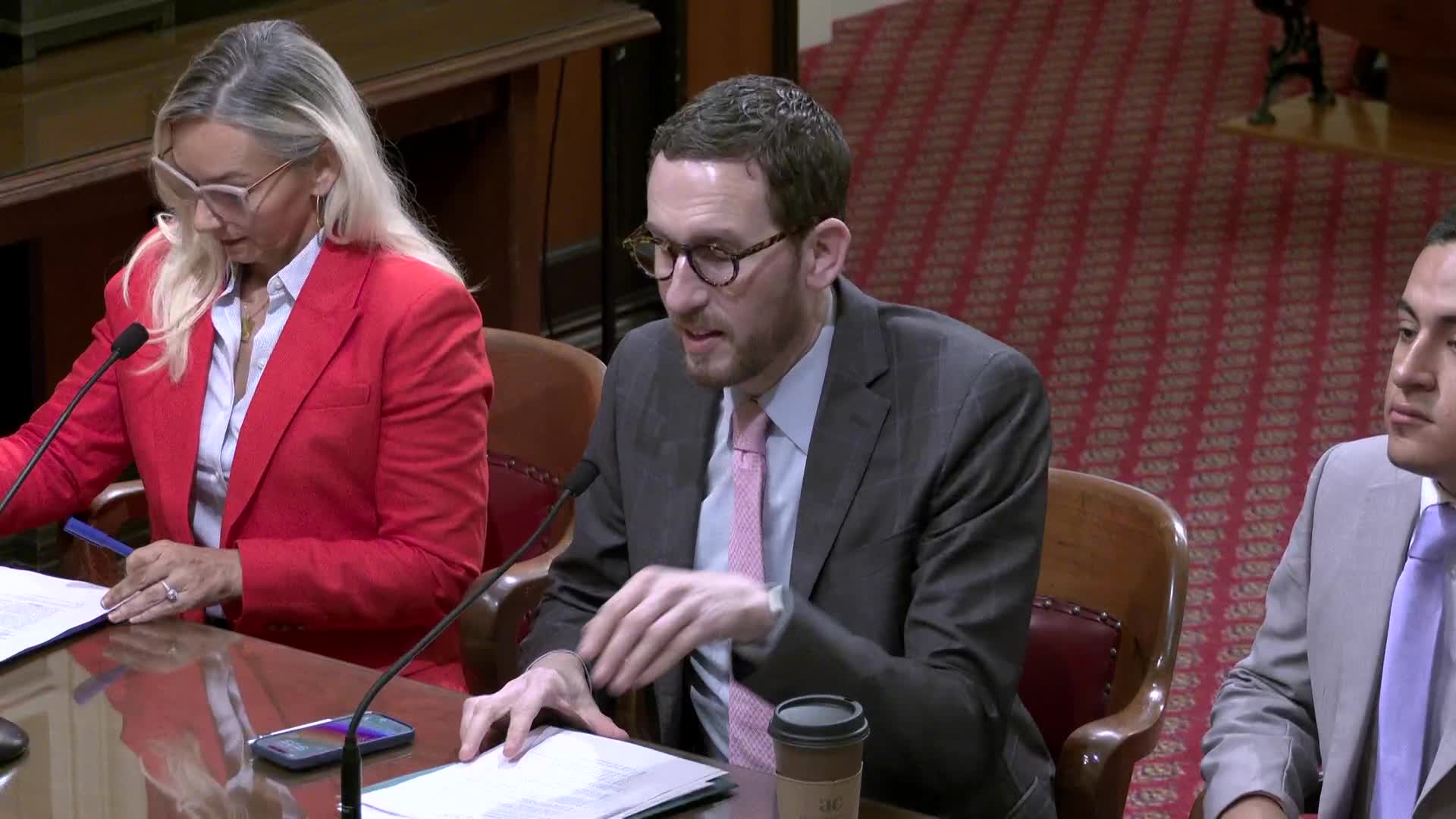
Senator Wiener, author of Senate Bill 627, told the Senate Standing Committee on Public Safety on Sept. 11 that SB 627 — the "No Secret Police Act" — would prohibit local and federal law enforcement from concealing their faces while conducting operations in California, with specified exemptions for medical and safety gear, certain undercover operations and SWAT teams.
Senator Wiener, author of Senate Bill 627, told the Senate Standing Committee on Public Safety on Sept. 11 that SB 627 — the "No Secret Police Act" — would prohibit local and federal law enforcement from concealing their faces while conducting operations in California, with specified exemptions for medical and safety gear, certain undercover operations and SWAT teams.
The bill’s sponsor said the measure would require law enforcement agencies to maintain and publicly post a written policy about facial coverings and would create two enforcement mechanisms: a criminal offense (described in committee debate as a "wobbler"/"wobblet" for violations) and a civil cause of action, including statutory damages for certain torts. “SB 6 27 prohibits local and federal law enforcement from covering their faces while conducting operations in the state of California with various exemptions around medical and health masking, certain undercover operations, SWAT team, and so forth,” Senator Wiener said.
SB 627’s nut graf: supporters said the bill is intended to protect community trust and public safety by making it possible for civilians and local authorities to identify officers; opponents said the measure’s exemptions and its treatment of immunity and liability are vague and could expose local officers and small agencies to lawsuits.
Supporters testified that masked, unidentifiable agents — and alleged impersonators — have sowed fear in immigrant communities. Christine Sotto Deberry, executive director of Prosecutors Alliance Action, said SB 627 is a "common sense safeguard" and argued the bill preserves legitimate safety equipment while targeting opaque concealment used in alleged abusive enforcement actions. Hector Pereira, political manager for the Inland Coalition for Immigrant Justice, described calls to his group's rapid-response hotline from community members too fearful to report crimes to local police because they cannot tell who is an officer.
Opponents included representatives of statewide law enforcement organizations. Jonathan Feldman of the California Police Chiefs Association and David Missagny for PORAC said the bill’s exemptions are vague and that the liability and immunity language risks stripping officers of long-standing defenses and indemnification. Feldman warned that terms such as "active undercover" or broadly phrased health-and-safety exceptions are undefined and may not cover routine protective equipment or exigent situations. “Any claim that the exemptions in 6 27 are sufficient is misinformed and misleading,” Feldman said.
Committee members pressed the author and witnesses on details, including deadlines for agencies to adopt policies and whether the bill would apply to federal agents in practice. The sponsor said the bill applies to federal law enforcement operating in California and cited constitutional scholars’ views that state law can apply to federal employees acting outside protected functions. The author and several members agreed to continue technical discussions and to consider a letter to the journal or subsequent cleanup language to clarify ambiguities raised in testimony.
Action: the committee moved and approved SB 627 on a 5–1 vote, advancing the bill out of committee. The committee discussion and votes were recorded on the hearing transcript.