Get Full Government Meeting Transcripts, Videos, & Alerts Forever!
Get email alerts on the Budget And Finance topic
No spam. Unsubscribe anytime.
HRA staff present follow‑up to 2026 budget; commissioners press for clearer spending plans and reporting cadence
Summary
Deputy Director Green and PED staff answered commissioners’ follow‑up questions on the proposed 2026 HRA budget, data systems and program spend‑downs. Commissioners asked for more frequent, detailed budget‑to‑actual reporting, clarification of fee waiver and downtown investment proposals, and updates on several programs.
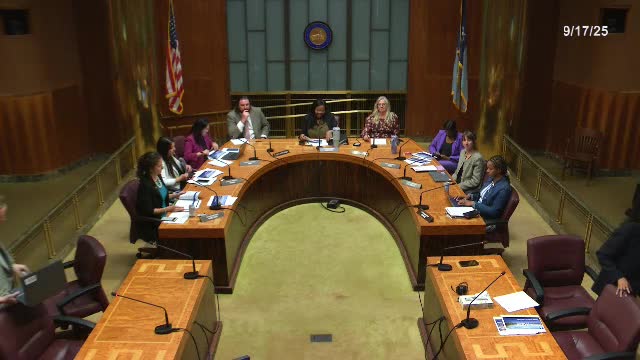
HRA and PED staff used the meeting to respond to Commissioner questions about the agency’s proposed 2026 budget, spending to date in 2025 and follow‑up data requests. Deputy Director Green and other staff discussed reporting cadence, unspent allocations, program launches and planned investments; commissioners repeatedly asked for clearer, more timely budget‑to‑actual data and more specific implementation plans.
Green said PED’s initial budget‑to‑actual presentation covered activity processed through June 30 and recommended adopting a reporting cadence of twice a year (midyear and year‑end) for final actuals, while acknowledging commissioners’ requests for more frequent, project‑level spend‑down figures. She said there are about $2,000,000 in transfers out that the board had asked to see detailed breakdowns for and that staff would work with the Office of Financial Services (OFS) to provide those details.
Commissioners asked for current spend‑down figures for 2025 allocations. On the office‑to‑housing fee waiver program (proposed as a larger pool for 2026), Green and other staff said the $1,000,000 allocated in 2025 has not yet been spent; the administration proposes additional funding of $5,000,000 in 2026 (composed of $3,500,000 in LAHA funding and $1,500,000 in Housing Trust Fund, per staff discussion), but staff noted the funds are intended as project‑ready incentives and that many downtown projects operate on multi‑year financing timelines.
Commissioners raised alternative uses of unspent funds and requested options that could move dollars more quickly for smaller or earlier‑stage projects. Staff suggested one incentive: amending the Qualified Allocation Plan (QAP) to reduce required long‑term affordability periods for some tax‑credit deals to encourage downtown investment, and said the $5,000,000 could be structured as a flexible bucket (fee waivers, infrastructure support, affordable‑unit incentives) rather than a single tool.
Staff also provided updates on several programs and allocations: down‑payment assistance has spent about $480,000 with $1,240,000 reserved for 2025 and is scheduled to reopen Sept. 22; emergency rent assistance is preparing for launch pending final technical integrations with treasury and OTC; Catholic Charities‑related reimbursements were discussed and staff said departments had incurred roughly $578,000 in related expenses that will require OFS transfers; Power of Home had $300,000 allocated in 2025 (not yet spent) and staff expect the program to launch next month; and inheritance fund allocations (Rondo and Westside) were described as reserved amounts under a $1,000,000 2025 allocation, with $100,000 earmarked for Rondo and $240,000 reserved for Westside Flats to date.
Several commissioners urged staff to provide more granular, up‑to‑date project spend‑down reports, asked for clarity on which budgets (city, HRA, ARP) hold particular program dollars, and requested follow up meetings to refine how proposed downtown incentives would be structured. Deputy Director Green and budget staff agreed to provide further detail on transfers, the August month‑end close once available, and planned annual spending plans for major line items.
No budget vote occurred at the session; staff said the follow‑up information is intended to inform the board’s subsequent vote on the maximum levy and the 2026 budget.