Get Full Government Meeting Transcripts, Videos, & Alerts Forever!
Get email alerts on the Zoning And Land Development topic
No spam. Unsubscribe anytime.
Allentown council advances comprehensive zoning and subdivision code rewrite, sets public hearing for Oct. 15
Summary
City planning staff presented a multi-year, citywide rewrite of the zoning ordinance and subdivision and land development ordinance; council set a public hearing for Oct. 15 and slated the measures for subsequent enactment, with an effective date of Jan. 1 if adopted.
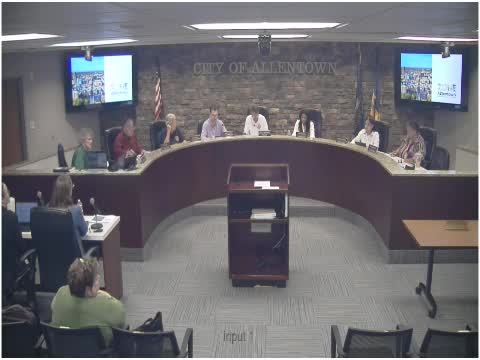
City Council held a special meeting to review a proposed, citywide rewrite of Allentown’s zoning ordinance and subdivision and land development ordinance, receiving a detailed presentation from Jennifer Gomez, the City of Allentown planning director, and setting a public hearing for Oct. 15 at 6 p.m. Council members voted by voice to place the measures on the public hearing calendar and scheduled enactment to follow if the city proceeds.
The proposal would repeal the current zoning code and subdivision regulations (bills described as Bill 69 and Bill 70 in the meeting) and replace them with a consolidated, modernized zoning ordinance and a new subdivision and land development ordinance. Gomez described the package as a “multi‑year effort” intended to align zoning with the Vision 2030 comprehensive plan, to be “context sensitive,” housing‑supportive, walkable, employment‑friendly, and more predictable to administer. She said the draft includes an effective date of Jan. 1 to allow time for staff training and to let nearly completed permit applications be reviewed under the current rules.
Why it matters: the draft would change permitted building types, revise the zoning map, create form‑based building standards, introduce new incentives for affordable housing and adaptive reuse, add park‑dedication requirements, update parking and bicycle parking rules, and add landscape and tree preservation standards. The rewrite is large enough that staff and consultants described it as an initial code adoption (treated as if it were a first‑time adoption), with a continuing commitment to annual review and future amendments based on community feedback.
During her presentation, Gomez summarized key elements the code would do: replace some commercial districts with mixed‑use districts to allow housing above commercial space, add accessory dwelling unit provisions with owner‑occupancy and parking conditions, create adaptive reuse standards with design requirements and bonuses tied to affordable units, permit regulated lane houses only on existing lots (with an explicit prohibition on creating new lane‑house lots), and require master planning for very large projects (defined in the draft as five acres or more). She said the draft also preserves industrial land and limits oversized warehouses to certain locations to protect employment uses.
Gomez described the affordable‑housing incentive structure and how bonuses would work: the height bonus tied to affordable housing applies for building types with five or more units and requires that 20% of those units be affordable to qualify for certain bonuses. She said other incentives — for projects with four or fewer units — exist but do not include the height bonus. On the effective date and implementation timeline, she said: “we put in the code an effective date of January 1,” giving developers and staff time to transition and letting near‑complete applications proceed under the existing rules.
Public comment and technical questions focused on several areas. Robert Almonte, policy lead for the Blue Zones Project Allentown, asked about a change in the draft’s advertising setback for tobacco and alcohol from 500 feet in an earlier draft to 300 feet in the current draft, and whether that reduction was driven by state or federal requirements. Planning staff said the distance was changed to match applicable state or federal requirements, and the zoning supervisor noted other tools — including limits on the amount of floor area devoted to tobacco sales, window‑transparency requirements and possible public health code changes — could be used to address local concerns about advertising and proximity to schools and playgrounds.
Nicholas Brocic, who described several professional affiliations including research advising at George Washington University, supported the rewrite and singled out a change in the household definition in Section 66139. He read the revised language as allowing “Up to 4 adults of any relationship and and their minor children,” and said the change was intended to reflect modern household arrangements and protect children who otherwise could be rendered invisible under older language. Planning staff clarified that zoning changes do not override the building code: occupancy and square‑footage requirements would still be enforced.
Craig Beavers, speaking for the Allentown City Planning Commission, reiterated the commission’s recommendation to approve both the proposed zoning ordinance and the subdivision and land development ordinance. Gomez also noted that the Lehigh Valley Planning Commission had provided a favorable letter, saying Allentown “positions zoning as a proactive tool for economic sustainability and quality of life.”
Council members asked questions and voiced concerns on subjects that would be tracked in future amendments: mechanisms to ensure affordable units built as part of incentive packages are actually constructed (deed restrictions and conditional approvals were discussed), how accessory dwelling units would be managed, the interplay with historic‑district rules (historic‑district regulations are in a separate chapter and a separate inventory and process is underway), and whether the parking standards go far enough in reducing auto dependence. One speaker urged additional reduction of parking minimums; another council member noted the city expects to continue revising the draft as real‑world issues arise.
Formal action: a council member moved, and Councilmember Mota seconded, a motion to set a public hearing on the proposed zoning ordinance and the subdivision and land development ordinance for Oct. 15 at 6 p.m., with enactment to follow at a subsequent council meeting. The motion passed by voice vote; no opposition was recorded.
The next steps listed by staff are: public notice and the Oct. 15 public hearing, continued outreach and potential minor amendments, and, if adopted, an ordinance effective Jan. 1. Gomez and staff emphasized the draft is not final law until adopted and that significant map or height changes would require repeating parts of the review process.
Votes at a glance
- Motion to set public hearing on the zoning ordinance and subdivision and land development ordinance for Oct. 15 at 6 p.m., and to schedule enactment at the following council meeting: Passed by voice vote; no opposed votes recorded (motion seconded by Councilmember Mota).