Get Full Government Meeting Transcripts, Videos, & Alerts Forever!
Get email alerts on the Economic Development topic
No spam. Unsubscribe anytime.
Developer seeks 20-year TIF for 405-unit Dixie Cup redevelopment in Wilson
Summary
Skyline Investment Group and the Northampton County IDA presented a tax-increment financing (TIF) plan to Northampton County’s finance committee for the long-stalled Dixie Cup site in Wilson, asking taxing bodies to pledge 100% of incremental taxes for 20 years to support roughly $26 million in bond proceeds toward the $185 million redevelopment.
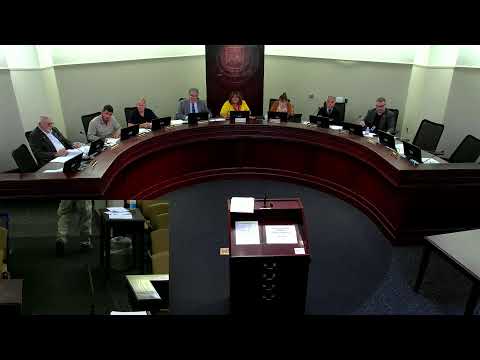
Skyline Investment Group representatives told the Northampton County Finance Committee that they plan to convert the vacant Dixie Cup manufacturing plant in Wilson into about 405 residential apartments and are asking taxing bodies to participate in a tax-increment financing district that would dedicate 100% of the tax increment to repay bonds for 20 years.
“Redeveloping the old Dixie Cup manufacturing facility in Wilson, to provide to convert it into, 405 residential apartments,” developer counsel Jonathan Cox said. Cox said updated financing assumptions produced an estimated $26,000,000 in bond proceeds, down roughly $2,000,000 from earlier estimates because of a higher interest-rate assumption and an updated state common level ratio that lowered assessed value.
The developer’s team described a two-series bond structure in which the larger Series A issue would fund public-infrastructure-eligible work (the team estimated roughly $15,000,000 for those items) and a smaller Series B issue (approximately $5,000,000) would fund improvements that, under the federal tax code, are not treated as public infrastructure. Cox said bond proceeds would fund a debt-service reserve (underwriter requirement ~10%), and cash flows in the plan rely on a projected post‑completion assessed value (the plan cites a net market value used in the analysis of about $147,000,000).
Developer Brian Barti told committee members the project is costly and tight on financing. He said Skyline is contributing equity, pursuing historic tax credits and HUD financing, and that “there's a $60,000,000 equity gap that needs to be provided for.” On affordable housing, Barti said the developer will pay $1,100,000 into a low-income housing fund in lieu of building 41 below‑market units on site. “We're contributing, the $1,100,000 to the low income housing fund, to offset the 41 units of of affordable housing,” Barti said.
School and borough officials who spoke said their bodies have adopted resolutions to participate in the TIF process. Wilson Borough Council President John Burke and Wilson Area School District representatives said they support the plan; school board president Judy Herbstreith told the committee the district voted unanimously to participate. Cox said the Northampton County Industrial Development Authority (IDA) finalized the plan and that the county must follow the TIF Act process: a 30‑day public‑hearing notice, a public hearing (Cox said the notice for an October 16 hearing ran this week), and a three‑week waiting period after the hearing before council may enact an ordinance. Cox said a first reading of the ordinance was slated for the next county council meeting and that council could not consider enactment until November 6.
Committee members pressed the developer and its counsel on affordability, the term length, debt sizing, developer experience and contingency planning. Critics on the committee warned a long TIF term delays full tax receipts to the taxing bodies; supporters said the site has been vacant for decades and remediation and adaptive reuse are costly. Barti and his team repeatedly said the financing model would not “close” without the TIF structure as presented.
No formal vote on the TIF plan occurred at the finance-committee meeting. Committee members were given the plan and counsel’s explanation and were advised the statutory public‑hearing step has been advertised. Cox also said the IDA’s draft cooperation agreement and customary legal documents will be circulated for review as bond sizing and underwriting details are finalized.
Why it matters: The project targets remediation and reuse of a long‑vacant, contaminated industrial site and—if completed—would add hundreds of market‑rate apartments and increased tax revenue over time. The county and its taxing bodies must weigh the upfront public assistance sought (20 years of incremental taxes) against long‑term economic and community changes, including potential effects on local housing affordability.
What's next: Cox said the IDA has approved the plan and that a public hearing will follow the 30‑day notice period; the county will hold a first reading of the ordinance before county council could vote on enactment after the statutorily required waiting period.