
St. Mary’s County planning commission discusses consolidating future land‑use categories, creating Lexington Park district
Get AI-powered insights, summaries, and transcripts
Subscribe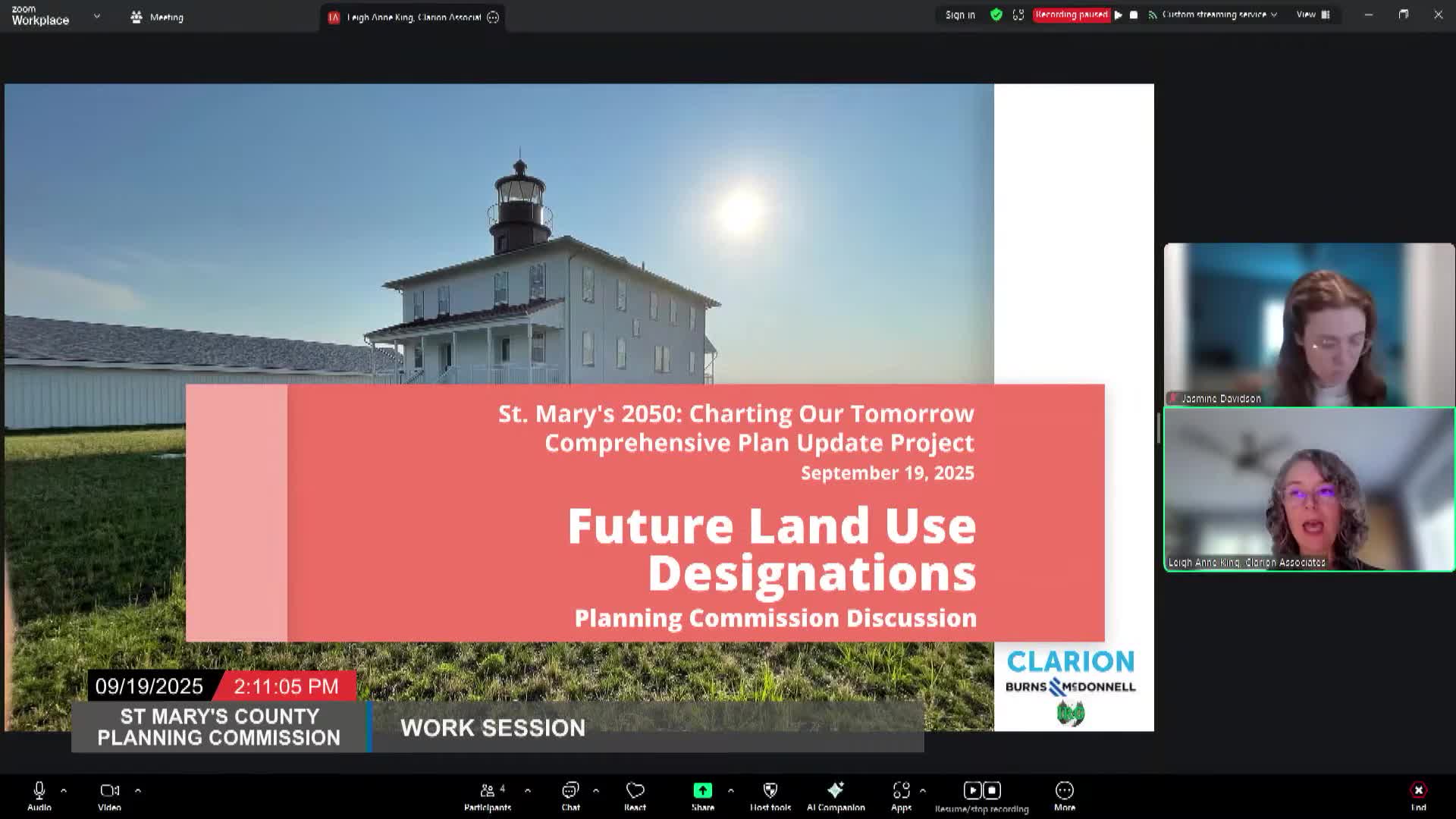
Summary
At a Sept. 19 work session the St. Mary’s County Planning Commission and consultants reviewed proposed consolidations and a new Lexington Park Development District designation for the county’s comprehensive plan update, and asked county legal staff to advise on how the changes would align with the existing zoning ordinance.
ST. MARY'S COUNTY, Md. — The St. Mary’s County Planning Commission on Sept. 19 reviewed a package of proposed changes to the comprehensive plan’s future land‑use map intended to simplify categories and to create a single designation for the Lexington Park Development District.
Consultant Leanne King opened the discussion by placing the map changes in the comprehensive‑plan process and noting the limits of the document. "This comprehensive plan process will not make any direct changes to your comprehensive zoning ordinance," King said, adding that the update can include recommended zoning changes for later implementation.
The consultant team proposed consolidating several existing land‑use categories into broader labels and removing two categories. Key recommendations discussed were: - Merge “rural preservation” and “rural residential” into a single rural preservation designation, with critical‑area protections handled as overlays rather than separate land‑use classes. - Combine “residential low density transitional” and “residential low density” into a single residential low‑density category, retaining critical‑area protections as overlays. - Consolidate “rural commerce” and “crossroads commercial” into a single rural commerce designation. - Merge “public lands” and “open space” into one category (proposed label: public lands), while clarifying that privately owned open space and regulatory open‑space requirements would be treated distinctly in the plan text. - Delete the standalone “nonprofit institutional” and “tidal wetlands” categories from the future land‑use map, noting tidal wetlands remain protected and mapped elsewhere in the plan. - Add a new single land‑use designation for the Lexington Park Development District (LPDD) that would reference the existing LPDD master plan as the detailed guidance for that geography.
Clarion Associates planner Jasmine Davidson summarized the rural preservation recommendation: "Both rural preservation and rural residential are meant to have rural character, and both allow for low density single family homes." The consultants said combining like categories should streamline planning and reduce the need for frequent map amendments for minor differences.
Planning commissioners and county staff raised two recurring concerns. First, several commissioners asked how differences between the updated comprehensive plan map and the county’s zoning ordinance would be handled during the expected lag between plan adoption and any subsequent zoning map revisions. Deputy County Attorney John Sterling Houser told the commission he would provide a formal recommendation on the legal approach, including options such as language in the plan that phases implementation or makes adoption contingent on later zoning updates. "I have a better answer for you this time next week," Houser said during the meeting.
Second, some commissioners pressed for clearer documentation linking each proposed future‑land‑use label to the existing zoning districts that would apply, so the commission can see how changes would operate in practice. Staff agreed to produce a chart that maps proposed land‑use categories to current zoning districts and to circulate that before later meetings.
Commissioners also debated the LPDD proposal. Consultants said designating the whole Lexington Park master‑plan area with a single FLUM label and referencing the LPDD master plan would streamline review and allow future LPDD updates to be incorporated by reference without a full comprehensive‑plan amendment. Commissioners asked whether other town or development districts (for example, Leonardtown or Charlotte Hall) might later seek similar treatment if small‑area master plans were prepared for them.
The meeting included extended discussion about public engagement and whether the comprehensive‑plan outreach had reached a representative sample of county residents. Staff described additional outreach steps they plan to take, including in‑person contact at grocery and market locations and an open online comment form on the county comprehensive‑plan web page.
No formal votes or ordinance actions were taken at the work session. Commissioners requested written legal guidance about how to sequence plan adoption and zoning map updates and asked staff and the consultant to return with a mapping table that pairs proposed FLUM categories to the county’s current zoning districts.
Next steps: staff and Clarion Associates will (1) secure legal guidance from the county attorney’s office on how to align plan and zoning updates, (2) prepare a chart linking proposed land‑use categories to existing zoning districts, and (3) continue public engagement ahead of draft plan release later this year. The commission’s next meeting is scheduled for Sept. 24 to discuss water and sewer service areas and growth areas.