Get Full Government Meeting Transcripts, Videos, & Alerts Forever!
Get email alerts on the State Auditor Oversight topic
No spam. Unsubscribe anytime.
Utah State Auditor Tina Cannon stresses independence, warns against SB 37 accounting change
Summary
Utah State Auditor Tina Cannon outlined the auditor—s role overseeing state and local finances, described recent fraud findings and a large data breach, and warned that proposed legislation she calls SB 37 would create government accounting problems if enacted.
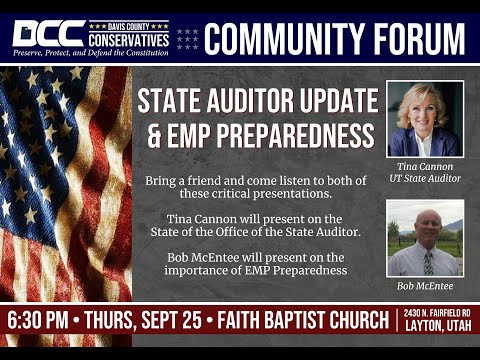
Utah State Auditor Tina Cannon told a Davis County Conservatives forum on Oct. 2 that her office exists to provide independent oversight of state and local finances and to make public the data taxpayers need to hold government accountable.
Cannon, elected last year, emphasized the independence of the auditor—s office and said audits identify gaps, explain why they matter and recommend fixes. "In order for audit to be effective, it has to be independent," Cannon said. She described the office—s responsibilities as auditing federal funds, state government, counties, cities, school districts, special districts and higher education.
Cannon said the office uncovered an embezzlement of about $188,000 in Iron County planning and zoning and that earlier cases she reviewed included a county manager who took about $1.5 million. She also said a recent data-privacy review identified an "egregious breach" affecting about 2,500,000 Utahns; the report is being held 60 days to avoid exploitation.
Cannon cautioned against a package of legislative changes—widely discussed this year and referred to in her remarks as SB 37 and companion HB 2—that would move certain locally earmarked property tax revenue into state control and, she said, "launder" the local restrictions. Cannon said she and her staff consulted the Governmental Accounting Standards Board and advised the governor—s office that the change would violate governmental accounting standards and produce material findings on financial statements. After those discussions, the governor vetoed the version she described, but Cannon said lawmakers are trying again and the auditor—s office will apply accounting standards regardless of political pressure.
Cannon urged residents to use transparent.utah.gov, the auditor—s public data portal, to review local and state spending and to bring questions to the office—s hotline. She described Transparent Utah as a consolidated resource where users can compare per-pupil spending, revenue sources for districts, and other dashboards created with local input.
Cannon also described a recent dispute with the Capitol Preservation Board and state legislative leaders over the physical location of the auditor—s public-facing office in the Capitol rotunda. Cannon said language to move or remove the auditor—s office from the rotunda was placed into legislation on short notice and then considered by the board and the legislature; she said the board did not follow open-meetings notice requirements and that she has 90 days from the date of that meeting to pursue legal remedies. "When you belittle and demean the state auditor and the work of the state auditor, you demean and you belittle my employees and the work that we do," Cannon said.
Cannon said the office audits the annual single audit for all federal funds going into the state and is completing a Medicaid audit due to be released in the coming weeks. She described resource constraints: the auditor—s office has about 51 staffers and oversees roughly 1,800 governmental entities and approximately $100,000,000,000 in spending and assets, and she said she has requested more budgeted staff to perform complex fraud and financial audits.
Audience members asked whether the auditor has oversight of charter schools (Cannon said yes) and about school fees; Cannon said court decisions and state guidance limit how fees may be used and that the auditor—s office has audited school fees and higher-education fee structures.
Cannon closed by inviting the public to the auditor—s Transparent Utah office in the Capitol and to use the portal and training sessions. She said the office would continue to report where accounting or governance practices fall short and that those reports are tools for voters to hold officials accountable.
Cannon also said her office would publish forthcoming audits in the weeks after the forum and that the public and media should watch for those releases.
Tina Cannon is the Utah State Auditor.