Get Full Government Meeting Transcripts, Videos, & Alerts Forever!
Get email alerts on the Education Standards topic
No spam. Unsubscribe anytime.
Jamestown schools outline shift to standards‑based learning as board adopts 2025–26 strategic plan
Summary
Jamestown Public School teachers and administrators described the district's move to priority standards and standards‑referenced reporting; the board approved the 2025–26 strategic plan, several policies and tuition agreements in voice votes.
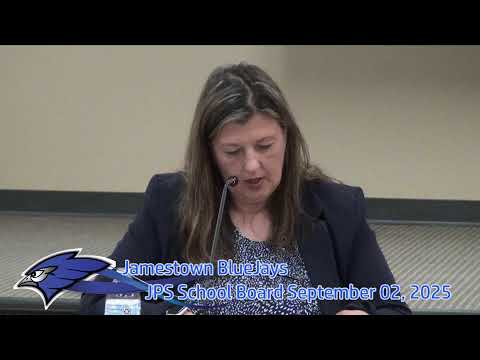
Jamestown Public School teachers told the school board on Sept. 2 that the district is moving toward standards‑based learning and reporting — using a set of “priority standards” and proficiency scales so students, teachers and families see specific learning targets — and the board approved the district's 2025–26 strategic plan and related documents.
The presentation opened with teachers from elementary through high school describing a three‑to‑four proficiency scale tied to North Dakota State Standards and saying the district's primary goal is “100% of courses and grade levels reporting proficiency on priority academic standards by 2027,” according to Jennifer Gall, middle school librarian, who led much of the presentation. “This isn't necessarily new. We've been working with standards for decades,” Gall said, adding the district aims to make learning expectations “guaranteed and viable” across buildings.
The plan, teachers said, centers on clarity: priority standards narrow the curriculum away from a “mile wide, inch deep” approach and give teachers specific proficiency scales and student‑friendly “I can” statements. Toni McEntire, an English instructor at Jamestown High School, said the high school is keeping conventional letter grades while adding standards‑referenced reports so families see both conventional averages and where a student stands against the priority standard. “Along with that report, you're getting this standardized report, where you're getting your scores in relation to the standard,” McEntire said.
Why it matters: district leaders said standards‑referenced reporting should let teachers target instruction and interventions more precisely and show which specific skills a student has or lacks instead of hiding gaps in an aggregate average. Administrators and teachers described classroom practices that include formative checkpoint assessments, reteach days and small‑group work tied to proficiency scales.
Board members asked detailed follow‑ups about parent communication, grading transitions and support for students who enter higher grades without prior mastery. Board member Jason questioned how parent‑teacher conferences will change and whether a level 2 will be perceived as “below average.” McEntire and other teachers responded that the district is working to help families understand the scale is standards‑referenced, not norm‑referenced, and that “we've got all year to get to a 3,” a presenter said.
Superintendent Dr. Luck tied the board education item to the board's broader work on measurable goals. He described the district's updated 2025–26 strategic plan as focused and condensed to avoid “goal fatigue,” with an emphasis on clearer metrics and a dashboard for progress monitoring. “We really wanted to consolidate goals,” Dr. Luck said during his report.
Votes at a glance
- Consent agenda (routine approvals): Motion by Steve (board member); second by Aaron (board member). Voice vote: approved. (no roll‑call tallies provided in the record)
- Approval of 2025–26 strategic plan, strategic plan dashboard and strategic plan progress monitoring & board education annual plan: Motion by Steve (board member); second by Owen (board member). Voice vote: approved.
- Approval of recommended policies (first reading ABAA school district organization plan; first reading ACCB protection for student victims of offenses; second reading ACG child safety liaison work group and mandatory training; amended BCBA public participation and BCBA‑E form): Motion by Aaron (board member); second by Steve (board member). Voice vote: approved.
- Approval of 2025–26 tuition agreements (Montpelier, Yellowstone, Medina, Jamestown): Motion by Jamie (board member); second by Jason (board member). Voice vote: approved.
Discussion vs. decisions
The meeting separated education content from formal actions: the teachers' presentation and the board's Q&A comprised discussion and capacity‑building tied to strategic goals; the board then took formal votes to adopt the strategic plan, accept policy readings and approve tuition agreements. The transcript records the motions, seconds and that each was approved by voice vote; no roll‑call tallies are listed in the record.
Implementation and next steps
Administrators said the district will continue to phase in priority standards and proficiency scales building‑by‑building and grade‑by‑grade. Teachers reported many subject teams are at different stages: some departments have identified all priority standards; others are piloting single standards or single units this year. The district aims to publish all grade‑level or course priority standards by the start of the 2026–27 school year, and to have all courses reporting proficiency by 2027. Superintendent Dr. Luck said the approved strategic plan will use a dashboard and progress monitoring at the board's second monthly meeting to track those metrics.
Additional items in the meeting
The superintendent's written report included K–5 enrollment counts and a note that the district is consolidating some elementary sections and buildings; the report thanked staff involved in registration and international teacher recruitment. The superintendent also highlighted the Angel Fund, which supports student needs including unpaid meal balances and food pantries, and invited donations through Central Office.
The board thanked presenters for the board education session and signaled continued follow‑up: further board education and progress monitoring tied to the strategic plan are planned for upcoming meetings.