Get Full Government Meeting Transcripts, Videos, & Alerts Forever!
Get email alerts on the County Governance topic
No spam. Unsubscribe anytime.
Solano County supervisors approve multiple routine and contract actions, including Vallejo policing agreement and ARPA reallocation
Summary
At its September meeting, the Solano County Board of Supervisors approved a set of consent items and separate actions including a one-year supplemental law enforcement agreement with the city of Vallejo, the county administrator employment contract, and reallocation of unspent ARPA funds to a radio interoperability project.
The Solano County Board of Supervisors voted unanimously on several agenda items Tuesday, approving a one-year supplemental general law enforcement services agreement with the city of Vallejo, reallocating unspent American Rescue Plan Act (ARPA) funds to a radio interoperability project, and adopting an employment agreement for the incoming county administrator, among other routine items.
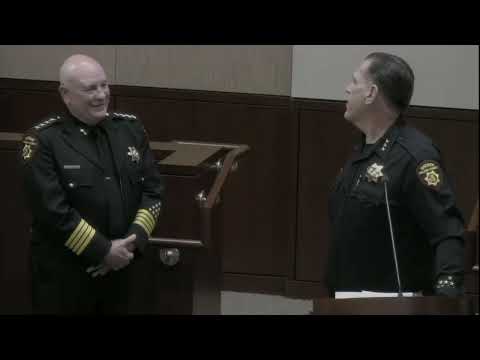
The board also adopted ceremonial resolutions, including a retirement proclamation for Sheriff Thomas A. Ferrara and a proclamation naming the county’s Centenarian Week. Several consent calendars and special-district items were approved by 5-0 votes. The board held public comment on a conservatorship complaint and received presentations on state county advocacy and broadband/digital equity investments funded with ARPA dollars.
Key votes taken by the board included unanimous approvals for the Vallejo supplemental law enforcement contract; reallocation of eligible, unspent ARPA funds to offset non-ARPA costs for a radio interoperability contract; and the four-year employment agreement for Ian Goldberg to serve as Solano County administrator from Sept. 30, 2025, through Sept. 29, 2029. The board also adopted updates to the English Hills transportation impact fee program and approved an updated fee structure aligned with state law governing accessory dwelling units (ADUs).
Board members and city leaders from Vallejo spoke in favor of the policing agreement during public comment. County staff described ARPA project expenditure status (about $72 million spent of $86 million reported through June 30) and outlined how unspent or returned funds may be reallocated under Treasury guidance if they were originally obligated by Dec. 31, 2024.
The board recessed directly to closed session after regular business; no reportable action was announced at the meeting’s end.
Votes at a glance - Supplemental law enforcement agreement with the city of Vallejo: approved 5-0. Motion and second recorded; formal action to authorize the county administrator or designee to finalize side letters with the deputy sheriffs’ association as needed. - Reallocation of eligible unspent ARPA funds to radio interoperability: approved 5-0. Motion to reallocate roughly $1.1 million of eligible ARPA funds to offset non‑ARPA costs in the county’s Motorola contract and free general funds for the next phase (anticipated towers in Dixon and Rio Vista). - Employment agreement for county administrator (Ian Goldberg): approved 5-0; four-year term beginning Sept. 30, 2025; disclosed starting salary $365,340. - English Hills transportation impact fee update and revised fee structure to align with state ADU law: approved 5-0. - Consent calendars and special‑district consent items: approved 5-0.
No item on the regular calendar failed. Several items remain in progress, notably ARPA-funded broadband projects with CPUC and federal BEAD funds that the county reported are paused or pending at higher levels of government.
Ending The board scheduled its next regular meeting for Oct. 7, 2025, at 9 a.m. in the same chambers. Several supervisors were appointed to two informal ad hoc committees — focused on hospital impacts and shipbuilding policy — for quicker staff consultation when time-sensitive regional issues arise.