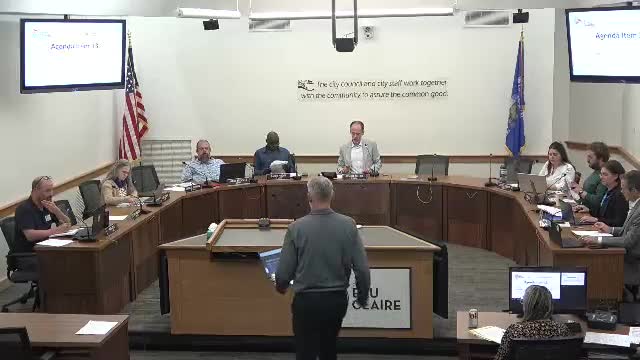
Eau Claire council adopts Land Development Ordinance updates and a 25% park impact fee
Loading...
Summary
The council approved several Century Code/LDO updates and amended the 2025 fee schedule to adopt a park impact fee at 25% of the assessed level; staff said fees cannot be used for maintenance or staffing but can offset capital debt service.
The Eau Claire City Council on Sept. 23 approved amendments to the Land Development Ordinance (Title 17) and related code updates, and adopted changes to the 2025 schedule of fees and licenses that include a park impact fee set at 25 percent of the study’s assessed level.
The council unanimously approved the LDO-related ordinances and the fee-schedule amendment after a presentation by planning staff. Planner Noel walked council through the fee assessment, historical context from a 2008 study, and capital costs the city has incurred. Staff said the recent 10-year capital investment in the park system exceeded $9.5 million and that projected capital needs included roughly $3.7 million tied to basic park services; the Cannery Neighborhood Park project was cited as nearly $3 million.
Why it matters: The park impact fee is intended to generate revenue for park capital needs associated with new development. Staff emphasized that the fee may not be used for routine maintenance or staffing; instead, it can offset debt service on capital projects, which could free general-fund dollars for maintenance and operations.
Council discussion and amendment: Council Member Schoen moved an amendment to set the park impact fee at 25 percent of the assessed level; Council Member Mboga seconded. Schoen said she was “torn” about the fee level because the parks department is understaffed and fees cannot be used for maintenance or staffing, and she supported 25 percent as a cautious starting point that can be re-evaluated annually. Council members discussed the trade-offs between higher fees to fund capital versus the city’s capacity to operate new amenities. The amendment passed unanimously, 7–0, and the fee schedule with the 25 percent park impact fee was adopted by a 7–0 vote.
Other technical details: Staff reported that the draft fee schedule included a proposed tree fee-in-lieu of $100 (to be retained in the fee schedule) and that subdivision agreements may continue to require land dedication in lieu of a fee in certain cases. Planner Noel noted the new LDO reduces the typical land dedication requirement from 15 percent to 10 percent in some situations, providing flexibility to require on-site park improvements instead of a fee.
Votes and next steps: The council adopted the LDO amendments and the fee schedule amendment by unanimous roll call. Staff said the park-impact fee and other fees will be part of annual budget and zoning implementation discussions; the fee level may be revisited during future budget cycles.
Ending: Staff materials and the full impact-fee assessment contain the detailed per-unit cost calculations council reviewed; council directed staff to proceed with implementation consistent with the revised code and fee schedule.