Get Full Government Meeting Transcripts, Videos, & Alerts Forever!
Get email alerts on the Education Legislation topic
No spam. Unsubscribe anytime.
Broward board trims and clarifies 2026 legislative platform; ESE camera language draws public comment
Summary
School board members reviewed a draft 2026 state and federal legislative platform, discussed narrowing priorities, and heard public comment urging removal of an opt‑out for audio‑visual recording in self‑contained ESE classrooms.
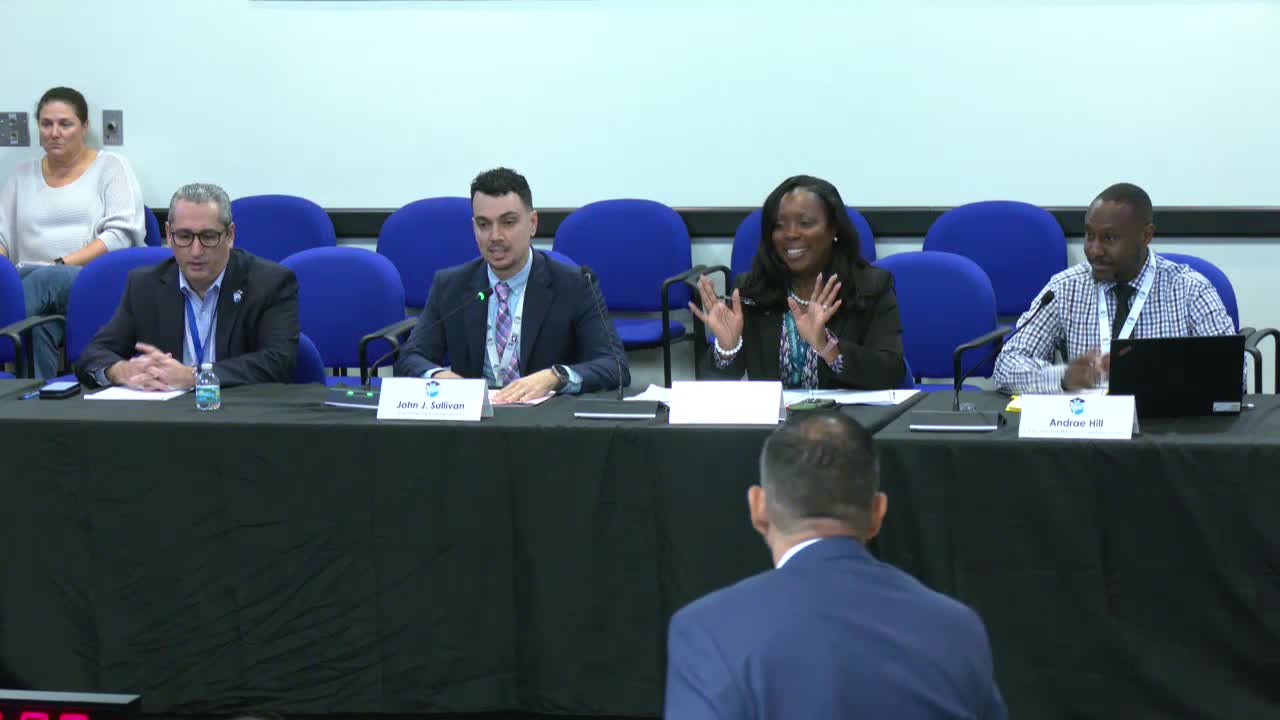
School Board members reviewed a draft 2026 state and federal legislative platform in a workshop session and asked staff to refine priorities, narrow the list for clearer advocacy, and return with a revised draft for formal board consideration.
Staff presented a concise platform covering state budget and finance, academic excellence, school safety and wellness, and local control over facilities. Board members urged trimming and prioritizing items to reflect likely legislative levers and to make the platform easier for legislators and staff to use during the session. Board member comments stressed focusing energy on a small number of achievable, measurable goals.
During public comment, Anna Corujo, vice chair of the district’s ESE advisory board, urged that the platform’s language on audio‑visual recording in self‑contained exceptional student education classrooms be rewritten so it does not include an opt‑out. Corujo cited the three‑year pilot for HB 149 and argued the recording provision was intended as a safety enhancement and that routine opt‑outs would weaken protections. “HB 149 was very explicit in the sense that it was a safety and security measure,” Corujo said.
Board members discussed options and legal context. General counsel Marilyn Batista said she had discussed the matter with the Department of Education’s general counsel, and the board agreed to pursue clarified statutory language: adding a specific exception permitting audio‑visual recording in self‑contained ESE classrooms as a safety enhancement, rather than language that would require an opt‑out process. Members also asked staff to explore whether a Department of Education rule could accomplish the change without awaiting statutory amendment.
Other items raised in the legislative discussion included support for the federal Alyssa’s Act (standards for emergency response and threat assessment), a proposal to seek legislative permission to redirect leftover state funds from the demolition and rebuild of Marjory Stoneman Douglas High School toward an off‑campus memorial, and a general call from some board members to “level the playing field” by requiring comparable accountability for any school receiving public funds.
The board directed staff and the district’s lobby team to prepare a revised legislative platform that incorporates the discussed edits and to bring it back for a vote at an upcoming board meeting so staff and the district’s lobbyists can begin advocacy work before legislative committee season begins.