Get Full Government Meeting Transcripts, Videos, & Alerts Forever!
Get email alerts on the Education Student Feedback topic
No spam. Unsubscribe anytime.
Student advisers tell Broward board they want more CTE, better Wi‑Fi and earlier vaping education
Summary
A representative group of Broward County students told the school board at a quarterly feedback session that career-focused programs, faster Wi‑Fi, more counseling availability and student‑led anti‑vaping outreach would make school more engaging and safer.
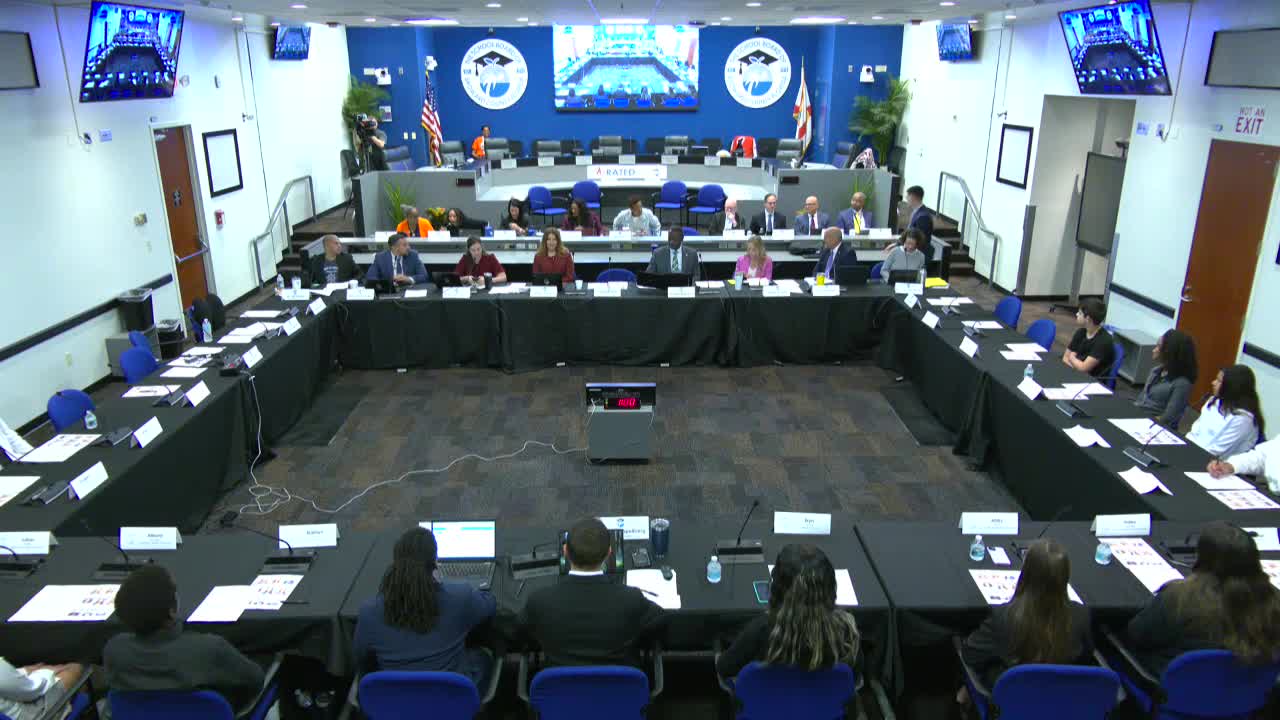
A representative group of students from Broward County Public Schools told the School Board of Broward County during a quarterly feedback session that career‑focused programs, reliable Wi‑Fi and more accessible counseling were among top priorities for improving student engagement and safety.
Student adviser Landon Sperberg, who opened the student portion of the meeting, said he represents the district’s roughly 250,000 students and outlined a roughly 80‑minute student agenda. “I have the distinct honor of representing our 250,000 BCPS students,” Sperberg said.
Students described successful career and technical education programs — such as medical academies, aviation and dual‑enrollment pathways — as critical draws. Ethan Rodriguez, a senior at the College Academy at Broward College, described access to college professors and campus clubs that allow students to publish research: “We have access to professors at the college who will assist us in conducting and publishing research in junior high school journals.” Several students said such programs can be competitive; one Cypress Bay student said a selective medical program admits “about 40 to 80 kids” from a much larger applicant pool.
On school safety, students said vaping remains a problem and that traditional adult‑led assemblies have limited influence. Multiple students recommended student‑made public service announcements and peer‑to‑peer outreach as more persuasive. One student said assemblies and posters are “boring” and urged a deeper approach that addresses underlying causes such as mental health.
Students also called for clearer, easier anonymous reporting tools and for adults to be more visible and identifiable on campus. Several cited “see something, say something” campaigns but said concern for retaliation keeps some from reporting; students suggested more prominent anonymous reporting channels and student safety councils as possible solutions.
Mental‑health and counseling access drew repeated attention. Students praised tutoring programs, mentoring initiatives such as Mentoring Tomorrow’s Leaders (MTL), and after‑school homework help, but several high‑school students described long waits for counselor appointments and reported that counselors are sometimes pulled into scheduling and other duties.
On facilities and resources, students pointed to persistent problems with Wi‑Fi, aging equipment and inconsistent air conditioning in some buildings. Gym and field conditions, limited textbook availability and the need for up‑to‑date lab and instructional technology were also raised. Multiple students said new devices were coming to the district.
Board members and the superintendent thanked the students and said staff would compile an after‑action report for cabinet review. Superintendent Howard Hepburn and other district leaders noted recent follow‑up after a prior student session and said the district had acted on issues raised previously.
The board did not take formal votes at the student session. Members and staff said they would work with student leaders and school administrators to follow up on specific recommendations, including student‑led vaping PSAs, efforts to improve Wi‑Fi and further examination of counselor staffing ratios.