Get Full Government Meeting Transcripts, Videos, & Alerts Forever!
Get email alerts on the Land Use topic
No spam. Unsubscribe anytime.
Commission accepts EAR report for comprehensive plan update amid public debate over proposed forest road alignments
Summary
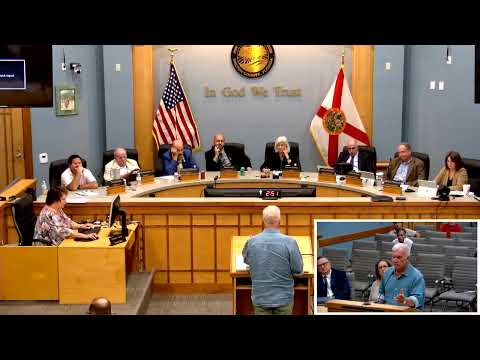
Walton County commissioners accepted a consultant Evaluation and Appraisal Report (EAR) to guide comprehensive-plan updates, but public comment and commissioners’ questions focused on whether suggested new connector corridors through Point Washington State Forest should remain in county planning materials.
The Walton County Board of County Commissioners accepted an Evaluation and Appraisal Report (EAR) prepared by DPZ/CivicDesign that outlines recommended updates to the county’s comprehensive plan and proposed next steps for drafting text and land-development changes.
The EAR is a state-mandated review used to evaluate comp-plan elements and recommend amendments; staff said the report will inform text-based amendments and subsequent land-development-code updates. County planning and consultant staff described the report as a starting point: staff will work with departments and stakeholders to translate the EAR recommendations into draft plan amendments and ordinances, then return to commissioners for formal public hearings and state review.
Commissioners and the public focused on transportation recommendations in the draft report. Several public commenters and conservation advocates asked the board to remove three proposed connector roads from the EAR’s planning maps: a North–South connector between County Road 30A and U.S. 98, an East–West bypass across the southern portion of Point Washington State Forest, and a North–South connector between U.S. 98 and State Road 20. Speakers said those corridors would fragment conserved lands and traverse environmentally sensitive wetlands inside state-managed forests and parks.
"These lands were expressly set aside by the state of Florida for conservation and recreation purposes," said Celeste Cobena, a public commenter, urging removal of the proposed forest alignments. Audubon and other speakers described potential habitat fragmentation and urged the board not to include forest-road alignments in the county’s planning documents.
Consultants clarified that the EAR as presented is a recommendation report and that detailed alignments and layouts are not being adopted at this meeting. "The specific location of where these roadways is not part of the recommendation report," planning staff said, and staff told the board that map-level proposals will be refined or removed based on further coordination with state agencies before any map amendment is transmitted.
A motion to accept the EAR with an added directive to incorporate an updated recreational element (to align with concurrent internal studies) was moved, seconded and discussed. Staff and consultants said they will take the board’s policy direction, revise the maps and text recommendations as requested, and return with draft text amendments and a transmission package for state review. Commissioners emphasized that accepting the EAR does not itself change zoning or adopt alignment maps; any comp-plan text changes and LDC amendments will return to the board for formal adoption and state transmittal.
Public commenters on both sides urged the board to act: some residents supported improved connectivity to relieve congestion on Highway 98 and County Road 30A while conservation groups said connectors through state forest land should be removed from county planning documents. The board did not adopt any new roadway alignments at the meeting and directed staff to refine the EAR-based recommendations and to follow up with state agencies and the public during the drafting phase.