Get Full Government Meeting Transcripts, Videos, & Alerts Forever!
Get email alerts on the Watershed Funding topic
No spam. Unsubscribe anytime.
Water management district seeks $22.5 million for watershed grants; board debates role in policy advocacy
Summary
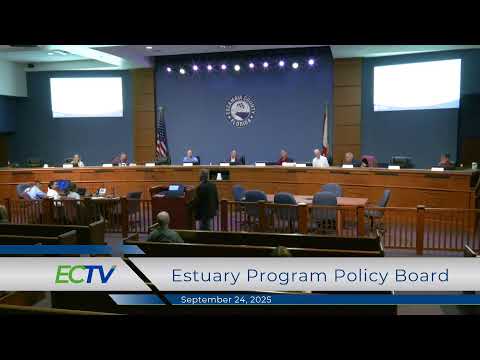
Daryl Boudreaux of the Northwest Florida Water Management District outlined a legislative request at the Sept. 24 Pensacola Bay Estuary Program board meeting seeking $22.5 million for a Watersheds Partnership grant program plus $2.5 million for program management.
Daryl Boudreaux of the Northwest Florida Water Management District outlined a legislative budget request to fund a Watersheds Partnership Program and urged regional partners to review draft subbasin priorities.
"What we are doing is working with estuary programs. We're going to be meeting with each county," Boudreaux said, describing planned outreach and public meetings to choose priority subbasins for targeted projects.
The district is proposing a one-time legislative budget request of $22,500,000 to seed a grant program and $2,500,000 to fund administration and management of that program. Boudreaux said the intent is to identify prioritized subbasins within each major watershed and use objective metrics across three focus areas — water quality, water supply and habitat restoration — to guide a call for projects. He estimated that, if the request is funded and spread across seven priority subwatersheds, the initial round would yield roughly $3 million per watershed.
The proposal builds on the district's Surface Water Improvement and Management (SWIM) planning framework. Boudreaux described the SWIM plans as high-level watershed guides and said the partnership program aims to move planning to a more detailed subbasin level where implementable projects — for example, stormwater controls or septic-to-sewer conversions — can be identified and funded.
Why it matters: board members said the district request would target recurring problems — stormwater, failing septic systems and habitat decline — and could reduce long-term restoration costs if deployed on prioritized subbasins. Boudreaux framed the request as front-loaded investment to avoid much larger expense later: "If we do some investments upfront, we can reduce the amount of investments it's going to take to keep our quality of life," he said.
Public outreach and timing: Boudreaux said the district will hold public meetings to present draft subbasin prioritizations and collect local input; he referenced a tentative meeting at the Santa Rosa County Auditorium on Oct. 8 to solicit feedback and verify the date. He also said the district will prepare subbasin work plans that document root causes and specific projects to address those causes, then issue a call for projects if funding is approved.
Board discussion on advocacy and policy role: the board then discussed how the estuary program should engage with legislative and regulatory matters. Several board members cautioned that the program has historically been nonregulatory and that advocacy should follow clear internal guidance. "I think we have to be careful and judicious when we start talking about getting involved with policy and advocating for legislation one way or the other," said a board member during the discussion. Other members suggested a process — staff briefings followed by a board vote or a formal letter of support — when the program is asked to endorse legislation or funding requests.
Examples mentioned during the discussion included support for the water management district's partnership request and funding for local restoration projects such as Carpenter Creek. Board members also raised local concerns such as derelict vessels and sewage discharges from larger vessels; those items were discussed as possible topics where the program's technical staff could contribute information to policy discussions without the board taking an immediate advocacy position.
Next steps: staff and the chairman agreed to draft a policy recommendation for how the estuary program will evaluate and respond to requests to advocate for funding or policy changes, and to return to the board for approval at a future meeting.
Ending: The board did not take a formal vote on the watershed partnership request at this meeting. Members encouraged continued coordination among counties, the water management district, and congressional delegations to advance funding and administrative enrollment matters.