Get Full Government Meeting Transcripts, Videos, & Alerts Forever!
Get email alerts on the Mental Health Community Support topic
No spam. Unsubscribe anytime.
York City leaders convene community debriefing; health, police and faith groups outline 24/7 crisis supports
Summary
Community leaders and service providers gathered in York City for a public debriefing to help residents process recent violent incidents, share mental-health resources and urge neighbors to connect and check on one another.
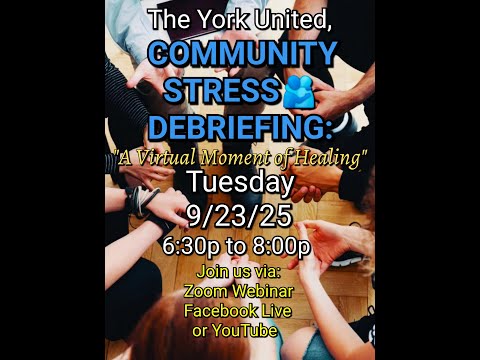
Commissioner Michael Muldrow of the York City Police Department convened a public debriefing to help community members process consecutive traumatic events and to connect residents with local mental-health and crisis resources.
Muldrow opened the session by describing the meeting’s purpose: “Tonight’s about coming together. Tonight’s about putting our titles and our differences and our ideologies aside and just being here for one another,” he said, outlining a model he described as the community equivalent of a “critical incident stress debriefing.”
The gathering included school staff, faith leaders, health providers and county mental-health officials who discussed how to recognize grief and acute distress, how to support people who are isolating, and where to refer residents for immediate help. Laura Edwards, supervisor of student services for the York City School District, said she’d seen children respond with “so much resilience and so much compassion,” and that adults should try to emulate that example: “They were stronger than the adults in the building,” she said.
Providers described existing, no-cost crisis options and how to use them. Michelle Prossen of WellSpan summarized START, a walk-in behavioral health program, and said the county-funded crisis line and mobile crisis team operate 24/7. Tiffany Klieser, forensic mental-health director for York Adams MH/IDD, said her office helps connect people to services and that staff can assist with navigating payment and insurance barriers.
Key local contacts and services cited during the event included: - START walk-in crisis (Loretta Claiborne Building on George Street) — walk-in hours and offices: Monday–Thursday 8 a.m.–8 p.m., Friday 8 a.m.–4 p.m.; office phone (717) 356-5060; mobile/crisis line (24/7) (717) 851-5320. - York Adams MH/IDD (connector services): (717) 771-9618. - Co-responder program (WellSpan/York City): Jenny Breneman shared that she can be reached by calling 911 and asking for a co-responder or by phone/text at (717) 586-8665; email jbreneman8@wellspan.org or jbreneman@yorkcity.org. - Commissioner Muldrow and other leaders also encouraged residents to use local community centers such as Friends & Neighbors in York’s Beacon (Duke Street) and online resources like inclusivetherapists.com (crisis/warm-line resources).
Speakers emphasized practical steps that neighbors, co-workers and agencies can take: be intentional about checking on people, form nonjudgmental support groups, offer short-term follow-up ("heart check-ins") after a crisis contact, and use existing community connectors to address basic needs that can block access to care (housing, food, insurance navigation). Prossen urged validation of feelings and prompt referral when distress interferes with daily life: “If you’re getting to that point where things are getting in your way of your daily living, there’s people that can help 24/7,” she said.
Faith leaders and community volunteers called for action beyond conversation: several participants urged churches and neighborhood groups to bring supports outside of institutional walls and to treat small acts of recognition — a hello in the grocery store, a delivered meal, a card — as meaningful interventions.
The event included a virtual component. Chastity Frederick moderated online comments and read viewers’ questions and observations, including calls for clearer navigation of services and appreciation for local responders. Multiple participants urged reducing stigma around seeking help and encouraged service providers to be transparent about the limits and costs of care; Klieser and others acknowledged that billing and eligibility can be complicated but said offices exist to help residents navigate those systems.
Organizers framed the meeting as both immediate support and the start of an ongoing practice. “I hope we continue to unite like this and let this become the new standard,” Muldrow said near the close of the event. He also said, “I hope we never have to do this again,” adding that the only reason that would be true is if the community never again suffered similar trauma.
The meeting did not include formal votes, motions or policy decisions; participants identified next steps informally: share contact information, expand outreach to people who are isolated, and encourage neighbors and institutions to adopt regular check-ins and referral pathways.
For residents who need immediate assistance, speakers repeated the START/mobile crisis phone number (717-851-5320) and the York Adams MH/IDD main line (717-771-9618). Co-responder contacts and local chaplains also offered to accept calls and texts for follow-up and support.