Get Full Government Meeting Transcripts, Videos, & Alerts Forever!
Get email alerts on the Student Cell Phone Policy topic
No spam. Unsubscribe anytime.
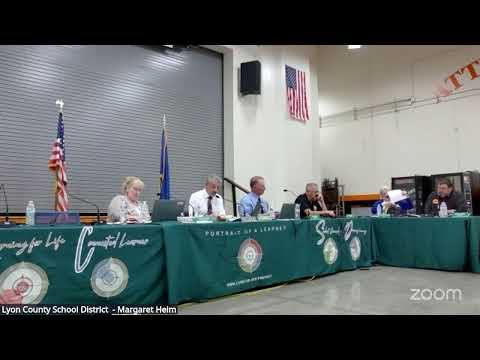
Lyon County trustees table proposed districtwide student cell‑phone policy after hours of public comment
Summary
Trustees for the Lyon County School District on Tuesday put the board’s proposed revisions to the district’s cell‑phone policy on hold after extended public comment and debate among board members, administrators and law‑enforcement staff.
Trustees for the Lyon County School District on Tuesday put the board’s proposed revisions to the district’s cell‑phone policy on hold after extended public comment and debate among board members, administrators and law‑enforcement staff.
The proposed policy, presented as a first reading, would have tightened rules for student possession and use of personal electronic devices during the school day and specified progressive disciplinary steps for repeated violations. After public testimony from current students, parents, teachers, school resource officers and principals — many urging changes to the proposed disciplinary steps or asking that the district give the new rules more time to work — board members voted to table the proposal and directed staff to revise it for a future meeting.
Why it matters: Trustees said they want a clearer, operational policy that principals can apply consistently across grades and buildings. Speakers at the meeting argued both that phones are a classroom distraction that harms learning and social development and that the draft policy’s proposed penalties (including multiday confiscation and long suspensions) were excessive or legally problematic. District administrators said some schools already use restrictive practices that appear to be reducing in‑school phone incidents; others said high‑school open‑campus logistics and work obligations complicate a one‑size‑fits‑all rule.
What happened at the meeting: Students and parents offered specific examples. Jasmine Adalgo Gates, a junior at Silverstage High School, described classroom impacts and proposed charging stations as a less punitive alternative: “I agree that phone usage in class is a distraction. However, the proposed consequences are respectfully too extreme and could foster the habit of students lying to authority figures,” she said. Several teachers and principals urged the board to rely on restorative approaches and progressive interventions rather than immediate exclusionary discipline. Sean McMacken, dean of students at Silverline Middle School, told trustees the school’s existing approach — a monitored lockbox for confiscated phones with parental pickup — reduced daily confiscations from double digits to very few.
Law enforcement cautioned about legal risk. Sgt. Mark Kosack, SRO supervisor, told the board that seizing and holding a student’s phone can legally amount to theft or larceny if the district cannot document consent or a lawful basis and if the device is held for an extended period. “It is a crime to keep somebody’s phone from them at all,” he said, and raised concerns about long multi‑day holds specified in the draft policy for repeat violations.
Board reaction and next steps: After lengthy discussion the board voted to table the proposed policy and return it as a first reading on Oct. 28 at Sutro Elementary School (District 6). Trustees set interim direction: they asked staff to meet with principals and law counsel, to consider less exclusionary disciplinary steps (removing long‑term suspension and multi‑day confiscation in initial drafts), and to collect model school policies (including the Silverland Middle School approach) for the board to review. The board also set an internal process for trustee input: each trustee may submit up to two suggested questions or edits by Oct. 17 for staff to vet and consolidate.
What remains unresolved: The board did not adopt any changes Tuesday. Questions remain about whether a uniform district policy should apply identically to K–8 and 9–12 campuses given open‑campus high schools, work‑based learning that requires student devices, and different extracurricular needs. Trustees and staff agreed to reconvene with revised language and with input from school leaders before any final vote.
Votes and motions: Trustees voted to table the proposed policy for further revision and to return it as a first reading on Oct. 28 (motion passed; vote recorded in minutes).