
Gaston County orders demolition of unsafe house at 3014 Birchfield Lane after inspectors document more than 30 code violations
Get AI-powered insights, summaries, and transcripts
Sign Up Free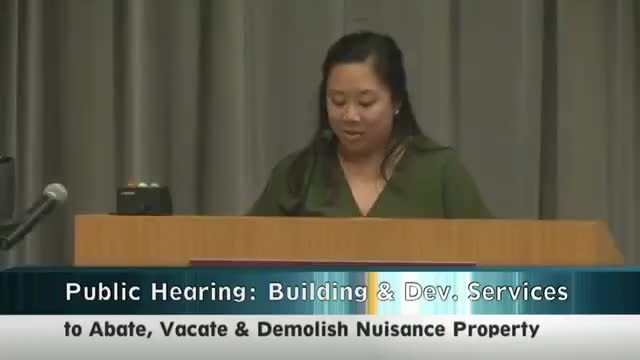
Summary
After inspections found more than 30 minimum-housing violations and no successful appeals, the Gaston County Board of Commissioners unanimously approved an ordinance allowing the county to abate, vacate and demolish the dwelling at 3014 Birchfield Lane in Gastonia.
The Gaston County Board of Commissioners unanimously approved an ordinance on the evening of the board’s September regular meeting authorizing county staff to abate and demolish structures at 3014 Birchfield Lane in Gastonia after an administrative hearing found the property unfit for human habitation.
The county’s planning and zoning director, Jana Kemberlou, told the board staff found “over 30 minimum housing violations” at the property and that code enforcement had conducted multiple inspections. Kemberlou said staff attempted repeated outreach, that the homeowners did not attend the administrative hearing, and that the final date to appeal the hearing order had passed.
“The administrative hearing details were sent to the property owners; however, no one attended on their behalf,” Kemberlou said. She told the board staff estimated more than $47,000 in repairs would be required to bring the structures into code compliance and that, under the county ordinance, a structure is considered dilapidated when repair costs exceed 50 percent of the tax value.
Kemberlou said staff documented repeated problems at the site, including exposed wiring, removed interior walls, lack of functioning water, missing light fixtures and piles of debris dumped behind the house. She said county staff recorded more than 50 photographs during a July inspection and that neighbors have repeatedly complained to county departments and law enforcement.
“Since February 2023 our department has processed six code enforcement cases on this property and completed more than 27 inspections,” Kemberlou said, adding that the county had paid more than $33,500 last summer to clean up the site during prior enforcement work.
Commissioners asked whether the structures were occupied; Kemberlou said the granddaughter had moved out and the grandson had been removed from the home, and there were no legal residents currently living at the address. Commissioners also asked about the presence of a detached outbuilding; Kemberlou said the site includes a detached garage or storage structure in addition to the primary dwelling.
A county official moved to accept the violation order and the board then voted to adopt the ordinance permitting demolition and abatement. The board instructed staff that any costs incurred to abate the property would be placed as a lien against the parcel and collected as provided by county policy.
Several commissioners and members of the public discussed how the county would carry out demolition work. One attendee suggested the structure could be used for controlled fire-department training; county staff and other commissioners said modern rules and structural instability make that unlikely and that the county’s landfill contractor would likely remove the materials. Kemberlou said the county intends to publish a formal request for proposals for abatement work in accordance with procurement rules.
The ordinance applies only to this parcel and follows the county’s minimum-housing enforcement process: inspection, notice, an administrative hearing and, if the property is not brought into compliance, a board-adopted ordinance authorizing county abatement. Kemberlou told the board staff performed an inspection the day of the meeting and noted no changes since the previous inspection.
The board voted unanimously to adopt the demolition ordinance; the county will place any abatement costs as a lien on the property and proceed with a competitive contracting process for demolition work.
The county’s administrative record for the case, including the inspection report and photographic evidence, is in the staff packet for this meeting and was entered into the record during the public hearing.
For residents, the county emphasized that abatement orders are an enforcement tool after attempts to secure voluntary compliance; staff said they prefer to avoid displacing residents but that the code’s remedial process sometimes results in demolition when repair is impracticable.