Get Full Government Meeting Transcripts, Videos, & Alerts Forever!
Get email alerts on the Waste Diversion topic
No spam. Unsubscribe anytime.
Littleton stewardship board backs South Metro waste-diversion plan, debates 'single hauler' wording
Summary
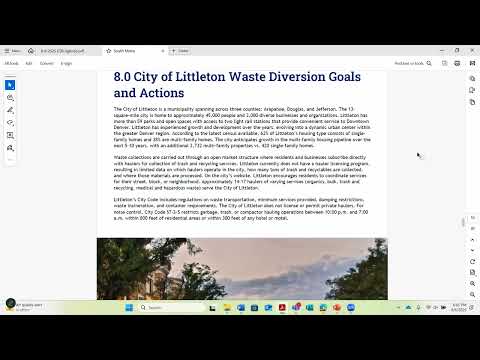
Littleton’s Environmental Stewardship Board reviewed a draft letter of support for the South Metro Waste Diversion Plan and discussed whether to recommend “single hauler” or use alternate terms such as “contracted” or “organized collection.” The board emphasized equity, access to composting and recycling, and coordinating with neighboring cities.
The City of Littleton Environmental Stewardship Board reviewed a draft letter of support for the South Metro Waste Diversion Plan and discussed recommending an organized, citywide approach to residential recycling and composting while debating whether to use the phrase “single hauler” or less loaded alternatives.
Board members said the plan could increase access to recycling and composting, reduce the number of trucks on neighborhood streets and support the city’s greenhouse gas goals, but they disagreed on messaging and implementation details the city should recommend to Littleton City Council.
Board members emphasized equity as a reason to back the plan. Members said consistent curbside recycling and composting—services many residents currently pay extra for or lack, particularly residents in multifamily housing—would likely raise participation and remove materials from the waste stream that currently go to landfills. The draft support letter specifically highlights improved access for residents who do not now have regular recycling or composting service.
The group debated terminology. Some members favored the straightforward phrase “single hauler,” saying a single contract can make reimbursement and measurement easier and reduce truck miles. Others warned that “single hauler” is politically sensitive and suggested alternatives such as “contracted collection,” “organized collection,” or “organized/contracted collection (single hauler).” The board discussed a compromise to use a primary term with the alternative in parentheses to reduce confusion while remaining clear about policy preference.
Board members discussed implementation options the plan describes and how they affect Littleton’s authority. They noted that the consultant’s recommendations include large infrastructure and regional coordination items that will require collaboration with neighboring municipalities (Centennial, Englewood, Sheridan and others) and possibly state-level programs. The board reiterated that any formal adoption or operational changes must be brought to City Council for approval and that the letter should not be read as a binding commitment to implement a particular contracting structure.
Other practical points the board flagged for the letter and for future council consideration included: that the South Metro plan is an 81-page regional document; elements of it (including some regional recommendations) may need more time to coordinate across jurisdictions; and that state-level producer-responsibility programs could affect how quickly municipalities access funding for recycling services. Board members suggested the letter emphasize that adopting the plan would help Littleton access funding streams, preserve small-town character by reducing truck traffic, support the Safer Streets Littleton initiative by reducing vehicle miles, and reduce noise and odor impacts from multiple haulers.
The board agreed to refine the draft, emphasizing equitable access to recycling and composting, clarifying that the board’s letter expresses support but does not commit the city to specific implementation steps, and to circulate a revised version to the full board for additional edits before sending it on to council staff. The timing for council consideration was reported to have shifted to October, allowing more time for regional coordination and final edits to the letter.
Minor items discussed during the meeting included a brief update that Littleton will join Colorado Communities for Climate Action and that the city has adopted the 2024 International Energy Conservation Code and Colorado model solar/electric codes effective Aug. 1 (noted as background), and an announcement that Diana Tripp will start as Littleton’s Grounds, Open Space and Natural Resources manager.