Get Full Government Meeting Transcripts, Videos, & Alerts Forever!
Get email alerts on the State Budget topic
No spam. Unsubscribe anytime.
Senate budget committee advances AB 105 and 16 trailer bills; SB 158 cleanup held after objections
Summary
The Senate Budget Committee on Aug. 20 advanced AB 105 (a budget bill‑junior) and most companion trailer bills, approving initial appropriations tied to Proposition 4 and allocating GGRF and other funds for transit, air quality and wildfire response, while holding a key SB 131 "cleanup" trailer (SB 158) after senators and advocates said it failed to deliver promised environmental and labor protections.
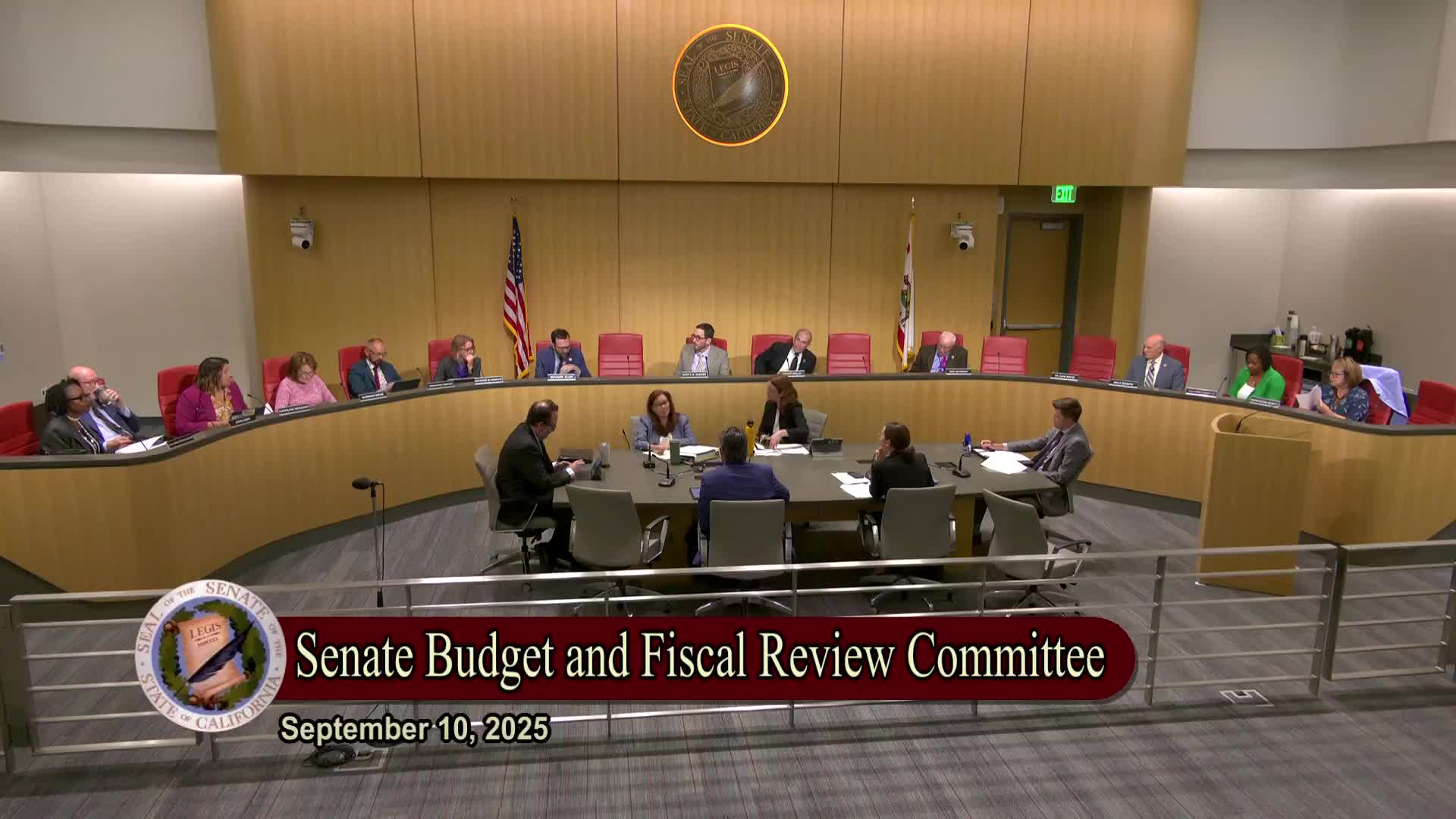
The Senate Committee on Budget and Fiscal Review on Aug. 20 advanced AB 105, the budget bill-junior that amends the 2025 Budget Act, and most of the companion trailer bills; one high-profile trailer (SB 158, the follow-up "cleanup" to SB 131 / advanced manufacturing language) was removed from consideration after objections from several senators.
AB 105 and the trailer package add a net general‑fund increase “just under $70,000,000,” committee members were told, and appropriate initial allocations tied to voter-approved Proposition 4 (the Safe Drinking Water, Wildfire Prevention, Drought Preparedness, and Clean Air Bond Act of 2024). The Department of Finance summarized remaining details the administration says are needed to implement June budget agreements and to respond to recent federal policy changes (identified in the hearing as “HR 1”).
Why it matters: The package moves substantial bond and grant money into implementation and contains policy changes that members said should have seen more legislative vetting. Senators from both parties voiced concern about the speed of the process and the absence of promised changes to the advanced manufacturing exemption created by SB 131. Committee action advances appropriations and regulatory authority that will determine how billions in climate and resilience funding are deployed statewide.
Key facts and allocations
- General fund net change above the June budget: just under $70,000,000 (Department of Finance presentation). - Proposition 4 (bond act) initial appropriations in the package: roughly $3,200,000,000 for bond‑eligible purposes (water, wildfire resilience, coastal resilience, nature‑based solutions, parks and outdoor access, and clean air projects). - Greenhouse Gas Reduction Fund (GGRF) amounts called out: $540,000,000 for 2025–26, including $368,000,000 for transit and intercity rail capital and $100,000,000 for implementation of the Community Air Protection Program (AB 617). - Transit assistance direction: AB 105 requires the Department of Finance, in consultation with the California State Transportation Agency, to examine loans or other financing options to support Bay Area local transit agencies and separately to examine options for Los Angeles entities. Committee members stressed urgency, saying Bay Area operators may be forced to cut service without timely action.
Major trailer bills and policy points discussed
- AB 144 (Health): Adjusts statewide immunization policy to preserve state options if federal guidance changes; creates an Abortion Access Fund and authorizes support for gender‑affirming care coverage; includes an exemption for certain medical providers to support the 2028 Olympic and Paralympic Games in Los Angeles.
- AB 146 (CalFresh/HR 1 response): Gives the Department of Social Services flexibility to implement IT changes to reduce payment error rates and avoid federal penalties tied to HR 1; establishes a county complaint resolution process for jurisdictions that opt into state‑administered housing/homelessness program funds. Committee witnesses and staff said the administration is still awaiting federal guidance on HR 1 and that the budget includes planning funding for implementation.
- AB 149 (Resources / Golden mussel prevention): Adds invasive mussel prevention measures and an increased fee; includes CEQA exemptions and emergency regulatory authority for climate‑bond programs related to the Olympics; includes wildfire and regional project directions tied to Prop 4 appropriations.
- AB 151 (Child care MOU): Implements a memorandum of understanding with Child Care Providers United (CCPU) including stabilization payments and a parity package through 07/01/2028.
- AB 153, AB 154 (Transportation, CEQA, pilot programs): Grant local transit operators authority to operate charter bus service for the 2026 World Cup pilot; CEQA exemptions for certain Air Resources Board rules; a pilot to increase mobile driver license app participation and other transportation‑related adjustments.
- AB 155 (California Civic Media Program): Creates a California Civic Media Fund under GO‑Biz with a $10,000,000 General Fund seed to support local and community journalism and an advisory board.
- AB 156 (Labor): Changes related to union dues deduction, Fair Labor Standards Act implementation for home care workers, and related firefighter and pension payments.
- AB 161 (MOU ratifications): Ratifies multiple collective bargaining agreements (California Association of Professional Scientists and others).
- AB 162 (Elections): Implements timing and certification changes for a November 4, 2025 special election and appropriates funds for a final cost report.
Controversy: SB 131 follow‑up (SB 158 / AB 145)
Multiple senators and public commenters pressed for stronger “cleanup” language for the advanced manufacturing CEQA exemption created by SB 131. Senator Blake Spear said he would not support the narrow follow‑up (SB 158) before the committee, arguing it “does not include environmental protections for habitat for protected species” that he and others had been promised. Senator Menjivar, Senator Smallwood Cuevas and others likewise said the package before the committee fell short of floor commitments to address labor standards, tribal consultation and protections for biologically sensitive habitat.
Chair Weiner and Department of Finance staff said the Senate had put its broader proposal (printed as AB 145) into the public domain; the administration and the Assembly prefer to take more time in the fall. The committee removed SB 158 from today’s votes and the chair said further negotiations will continue in the fall. Several environmental, environmental‑justice and tribal advocates testified in public comment that the measures set out so far do not meet promised protections.
Transit funding urgency
Several Bay Area senators and transit stakeholders urged faster agreement on state support for Bay Area operators. Committee members repeatedly said the package’s language requires the Department of Finance to examine loans or financing options, but that operators need timely assurance to avoid service reductions. The chair said the administration has signaled a willingness to continue talks over the fall; several senators warned that agencies are planning now and could begin cutting service without near‑term clarity.
Food and safety‑net changes tied to HR 1
Committee discussion repeatedly returned to HR 1 (federal legislation identified in testimony as driving CalFresh and Medi‑Cal changes). DOF staff described 1‑time technical assistance funding and planning positions to help Department of Health Care Services and other agencies prepare for federal work‑requirement implementation; senators pressed for follow‑up funds to support affected Californians. The committee included county‑directed aid for CalFresh and a $20,000,000 set aside for food bank support in response to federal changes, but members and advocates urged more targeted emergency food relief to lawfully present immigrants who will lose access to benefits.
Wildfire and workforce provisions
Prop 4 allocations and wildfire spending drew repeated praise and questions. The package includes funding targeted to wildfire preparedness and community resilience; the committee also advanced statutory language (in AB 149 and related items) clarifying CalFire hiring and an intent to transition many seasonal firefighter positions to permanent classifications. Public safety and firefighters’ union witnesses supported the language.
Votes at a glance (committee action)
- AB 105 (Budget bill‑junior): Motion to due‑pass — approved by the committee and advanced. - AB 144 (Health trailer): Motion to due‑pass — approved and advanced. - AB 146 (CalFresh / HR 1 response): Approved and advanced. - AB 147, AB 148, AB 149, AB 151, AB 153, AB 154, AB 155, AB 156, AB 157, AB 159, AB 160, AB 161, AB 162 (trailer bills listed in the hearing): Committee motions to due‑pass were carried for the items called and votes recorded on the public roll; those bills were advanced for floor action. - SB 158 (SB 131 follow‑up/cleanup): Removed from consideration at today’s hearing (no committee vote); chair said it was being held for further work with the Assembly, the governor and stakeholders.
Discussion, direction and next steps
Discussion points: committee members expressed widespread frustration with the timing and process for major policy changes embedded in budget trailer bills; many said they had minutes or hours to review complex package language. Multiple senators stressed the need to complete promised SB 131 cleanup work over the fall, and several urged more transparency on Prop 4 allocations and geographic concentration of bond spending.
Direction given: the committee voted to advance AB 105 and the trailer bills taken up today, while holding SB 158. AB 105 includes direction for DOF to examine loan/financing options for Bay Area and Los Angeles transit agencies and appropriations and statutory language to begin implementation steps for HR 1 response and Prop 4 programming.
Formal outcomes: the committee advanced the package items called; SB 158 was held for further work.
Ending: Committee members and dozens of public commenters urged senators and budget staff to use the interim to refine implementation details, to provide more transparent accounting for Prop 4 allocations by geography, and to continue negotiations on the SB 131 follow‑up so promised environmental and labor protections are realized in future legislation.
Selected direct quotes (from hearing)
- Senator Blake Spear: "SB 158, as it's before us today, does not include environmental protections for habitat for protected species despite the fact that habitat for protected species language is the standard protection that's been added to CEQA exemptions and ministerial processes that waive CEQA review."
- Department of Finance (Theresa Calvert, program budget manager): "The first bill is AB 105, the budget bill junior, which makes changes to various 2025 budget act items... including the HR 1 response, the greenhouse gas reduction funds discretionary allocations, and the climate bond allocations."
- Chair Weiner: "The senate put in print a b 1 45, which is the senate's proposal, for cleanup to SB 131... It is in print. It's online. People can look at it. It will help protect environmentally sensitive locations, require certain labor standards, and narrow the definition of advanced manufacturing."
- Senator Durazo on HR 1 response: "I was thinking more along the lines as to what we're gonna do to provide support for the Californians who are gonna be impacted by HR 1…right now, we don't have specific ways that we were planning to help."
Sources: hearing transcript and on‑the‑record testimony from Department of Finance and Legislative Analyst Office staff, committee roll calls, and public comment submitted in the hearing record.
Votes and formal roll call tallies are recorded in the committee minutes and the legislative roll call for each bill; committee staff said missing implementation details and further negotiated language will be pursued in the fall and may return on the floor or in subsequent hearings.