Get Full Government Meeting Transcripts, Videos, & Alerts Forever!
Get email alerts on the Capital Projects topic
No spam. Unsubscribe anytime.
Financial advisers tell Rockbridge supervisors county can absorb recreation center debt without immediate tax spike
Summary
Davenport presented a financing analysis for a proposed $14.5 million recreation center and replacement tennis courts, showing scenarios that would keep key debt ratios within county policy and dilute 2027 tax impact using $4 million in available cash.
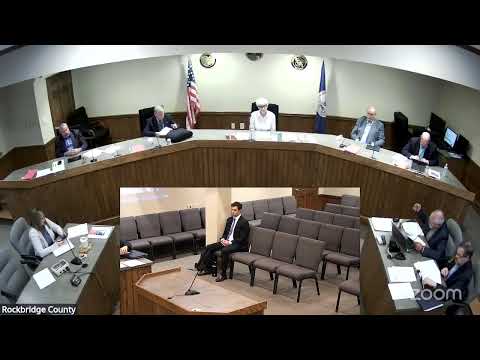
Davenport & Company financial adviser David Rose told the Rockbridge County Board of Supervisors on Sept. 22 that the county is on “solid financial footing” and that the county could add debt for a proposed recreation center near Rockbridge County High School without breaching its debt policies.
Rose said the consultants modeled a project cost of about $14.5 million — $13 million for the recreation center and $1.5 million as a placeholder for replacement tennis courts — and ran two borrowing scenarios. One used $4 million of county cash to reduce the principal to be borrowed; the other used the $4 million as a debt-service reserve to smooth payments. Under both 20-year, level-debt scenarios at a modeled 5% interest rate, the county’s debt ratios remain within its stated policies, Rose said.
The takeaway, Rose said, was that if the board layers the borrowing strategically and uses the $4 million either to reduce principal or as a reserve, the county would not need an additional tax increase in fiscal 2027. “That’s the takeaway here for this board,” he said, adding his firm believes the county’s credit profile would likely allow borrowing below 4% in current markets.
Board members asked clarifying questions about the permanence of any equivalent tax impact and about the source and use of the $4 million. Rose confirmed the estimated per‑penny revenue assumption used in the analysis (approximately $330,000 per penny) and said the modeled “equivalent impact” in fiscal 2027 was about 2.3–2.5 pennies under the scenario that reduced principal, but that using the $4 million strategically could “shave the peaks” so that no equivalent increase would be needed in 2027.
Rose emphasized the analysis was conservative: it did not assume external contributions from the City of Lexington, grants, or interest earnings on the reserve. He described the presentation as educational and noted no action was requested at the Sept. 22 meeting.
The consultant team included Tyler Smith and David Rose of Davenport; county staff identified the project and provided the scope and cost assumptions. County staff said the Spectrum Design study presented earlier (in a joint meeting with the school board) includes site plans and a construction cost estimate, and that the project as currently presented would eliminate the high-school tennis courts unless replacement courts are funded separately.
The board took no formal action and directed staff to continue reviewing the analysis and options in advance of capital budget and CIP decisions.
For the public record, Rose said Davenport’s work assumed a conservative growth in assessed value and conservative interest-rate assumptions for cash-flow modeling; he added that an official county credit rating has not been sought but could lower future borrowing costs if pursued.