Get Full Government Meeting Transcripts, Videos, & Alerts Forever!
Get email alerts on the Traffic Safety topic
No spam. Unsubscribe anytime.
Council discusses speed limits and traffic safety; directs staff to review prior studies and bring proposals
Summary
Council members debated revising speed limits on several Pleasant View streets, discussed accident data at 600 West and Alberta, and asked staff and police to assemble existing traffic studies and provide counts and recommendations for individual road segments rather than adopting a blanket change.
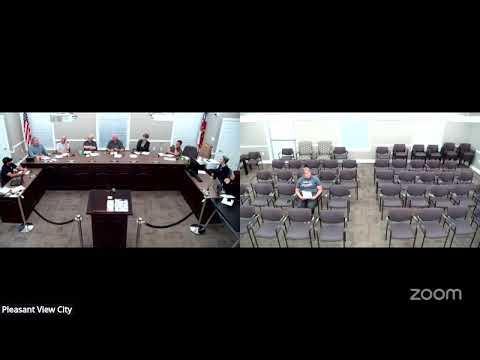
Pleasant View — Council members on Sept. 23 took up a general discussion about traffic safety and speed limits across city streets, focusing on several collector streets and a recurring crash point at 600 West and Alberta.
Mayor and council members raised the idea of standardizing speed limits on “minor collectors” (suggested 35 mph) and discussed specific streets including 500 West, 1000 West, 300 North and Shady Lane. Council members noted inconsistencies: parts of 1000 West are posted at 30 mph in one segment and 40 mph in another; 300 North remains signed at 25 mph despite being drivable at higher speeds; and Shady Lane’s alignment and sidewalk locations prompted debate over appropriate limits.
Council members also discussed the intersection of 600 West and Alberta, which staff reported has seen 33 crashes since the roadway orientation changed about a decade ago (about 3 per year). Council members said many crashes appear to be caused by drivers failing to stop or being distracted; some members argued a roundabout would not address distracted driving and noted winter weather and truck routing complicate engineering fixes.
Council instructed staff to gather available traffic‑study data (the city previously commissioned studies on some corridors), to obtain updated traffic counts and to return with road‑by‑road recommendations instead of adopting a blanket speed‑limit change. Police noted that, under existing procedures, the department can adjust posted limits by up to five miles per hour without a full engineering study but that larger changes or systemwide revisions generally require counts and engineering justification. Council directed staff to bring back recommendations and existing study findings for further action.