Get Full Government Meeting Transcripts, Videos, & Alerts Forever!
Get email alerts on the Broadband Utopia topic
No spam. Unsubscribe anytime.
Morgan City hears Utopia broadband update; network reports 1,190 subscribers and is described as self‑sustaining
Summary
A Utopia representative updated Morgan City Council on the municipal fiber network’s local take rate, finances and services, saying the system serves 1,190 local subscribers, covers its operating costs from subscriber revenue and required no additional city payments to date.
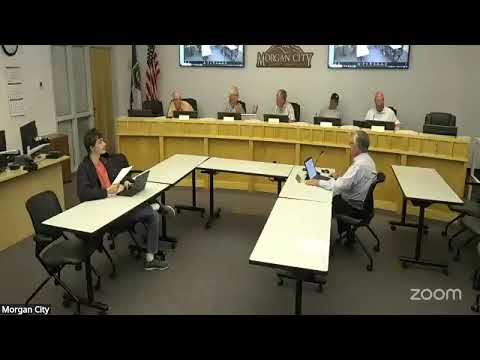
Roger Timmerman, a Utopia representative, gave Morgan City Council a 30‑minute update on the municipal fiber network during the Sept. 23 meeting, summarizing subscriber growth, finances and service features.
Timmerman told the council Utopia’s Morgan project now has 1,190 residential subscribers and that network revenues cover operations and debt service, which he described as making the system “sustainable” without additional cost to the city. He said the bonds issued at the project’s start required about $169,000 a year in debt service when priced, and that actual market terms were close to that estimate.
The presentation framed Utopia as an “open access” fiber network that hosts multiple retail providers. Timmerman said customers can choose from many providers on a single physical network and that the system offers symmetrical speeds up to 10 gigabits for addresses in the city. He noted a newly introduced 2.5‑gigabit tier and that some customers purchase a 10‑gig service.
Council members and staff asked about competition and technology. Timmerman said fixed wireless and satellite services have not materially reduced Utopia’s Morgan subscriber base; he also said satellite options like Starlink remain more expensive and less reliable than fiber for served neighborhoods.
Timmerman described additional services enabled by the fiber, including smart‑city sensors, air‑quality monitoring and wildfire camera deployments, and he said Utopia works with schools and public agencies on connectivity and bids. He and other speakers emphasized local economic benefits: Timmerman presented back‑of‑envelope savings estimates comparing typical competing Internet plans and said Utopia customers collectively save residents and businesses several hundred thousand dollars per year in aggregate.
Garrett Richens, a private applicant later in the meeting, and other speakers praised the availability and reliability of fiber for remote work and business uses. Gary Crane, introduced during the presentation as an early organizer, was recognized for his role connecting cities and building support for the network.
Councilmembers asked about take‑rate targets and financial contingencies. Timmerman said the original financing assumed a particular subscriber threshold (the slides referenced roughly 470 residential subscribers as one benchmark), and that the mix of residential and business customers matters for revenue; he said Morgan exceeded the original benchmarks.
The presentation included maps and slides showing coverage in Morgan, permitted uses supported by the network, recent investments in back‑office systems and tools for service providers, and ongoing plans for additional smart‑city deployments.
The council did not take action on the presentation. Timmerman asked for feedback and thanked the council before leaving.
Why it matters: Council members and city staff heard detailed fiscal and operational information about an asset that the city facilitates but does not operate directly; the presentation addressed local economic impacts, public safety use cases and technology choices that affect planning, public‑works coordination and future city services.