Get Full Government Meeting Transcripts, Videos, & Alerts Forever!
Get email alerts on the Subdivision Code Update topic
No spam. Unsubscribe anytime.
Planning commission reviews draft updates to Riverdale subdivision chapter; discusses timelines and public‑hearing limits
Summary
Consultant and staff reviewed proposed rewrite of the city subdivision code (RCC 10‑21). Commissioners discussed a single unified subdivision process, state statute constraints on review cycles and public hearings, land‑use authority allocations, and recommended maximum timeframes and extension policies.
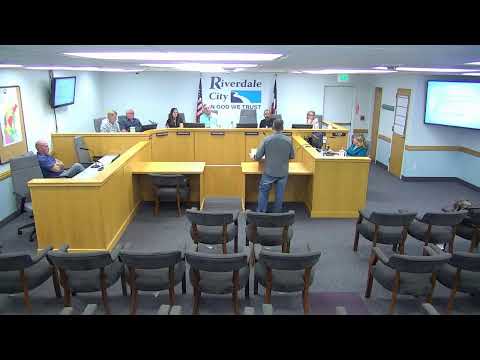
Riverdale’s planning commission spent the Sept. 23 meeting reviewing proposed updates to the city subdivision regulations (RCC 10‑21) as part of a broader Title 10 code rewrite. The commission heard from consultant Mike Hansen (Hanson Planning Group) and city staff about the draft language and key policy choices.
The draft seeks to consolidate subdivision procedures into a single process that would accommodate multiple project types while remaining compliant with recent state statutory changes affecting single‑family and similar residential subdivision review. Consultants and staff asked the commission for guidance on several specific points: whether to keep pre‑application meetings mandatory, how many review cycles to allow, whether to require or make optional a public hearing, which body should act as the land‑use authority at each stage, and how long preliminary approvals should remain valid before expiring.
Consultant Mike Hansen summarized the state’s recent changes and the practical effect: for single‑family and similar residential subdivisions the statute effectively limits preliminary review cycles and allows up to one public hearing. Hansen explained that some municipalities have kept separate, parallel subdivision processes to comply with state law; others have consolidated to a single process for clarity. He said his team recommends a single process but noted the drafting must explicitly respect the state’s limitation that single‑family proposals may receive at most one public hearing.
Commissioners and staff discussed timelines at length. Staff proposed a 30‑day turnaround for the city to provide a written response each time an application is submitted. The commission debated how long applicants should have to return a revised application. Several commissioners voiced support for faster cycles than some other cities adopt; the group coalesced around a 90‑day shelf life for preliminary approval and an extension menu rather than an open‑ended extension. Under the discussion, applicants would have 90 days to convert an approved preliminary plat to a final plat; extensions would be discretionary, drawn from a short menu (for example 0/30/60/90 days) with a maximum extension that would generally not exceed 90 additional days.
The body also discussed land‑use authority: the draft assigns preliminary plat approval to the planning commission while making final plat approval an administrative (staff) action, with an application review committee (engineering, public works, fire marshal, city attorney and planning staff) assigned to technical review. Commissioners indicated that preliminary decisions are a significant exercise of land‑use authority and that a joint review with the city council and a legal review would be appropriate before finalizing the chapter.
Other draft topics discussed included standardizing definitions and building a public use table that clearly lists permitted, conditional and prohibited uses by zone. Hansen showed example definition sources and use‑table prototypes and said the project team will return with consolidated flowcharts and revised timelines. Staff and the consultant recommended bringing the city council into a joint session before finalizing the subdivision chapter and considering a third‑party legal review because of the statute’s complexity and litigation risk.
Commissioners asked staff to return a cleaned‑up flowchart, a clarified table showing which applications require one public hearing and where the state’s single‑hearing constraint applies, and proposed language for preliminary expiration and extension procedures. The commission did not take a final vote on the chapter at this meeting and directed staff and the consultant to incorporate the discussed changes and to schedule further discussion, including a joint session with the city council.