Get Full Government Meeting Transcripts, Videos, & Alerts Forever!
Get email alerts on the Development Agreement 3 Bridges topic
No spam. Unsubscribe anytime.
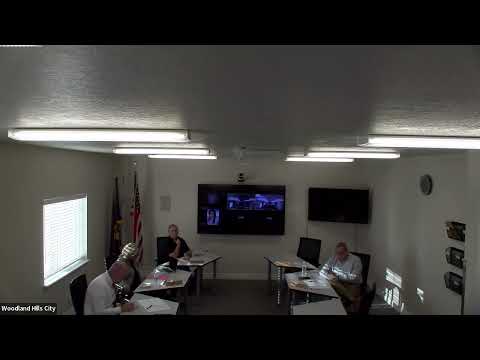
Woodland Hills council adopts development agreement with 3 Bridges after public review
Summary
The Woodland Hills City Council approved a development agreement with developer 3 Bridges that includes a water storage tank, drainage work, mailbox upgrades and parcel-specific density changes; council members tied approval to final legal edits and conditions.
The Woodland Hills City Council on a recorded vote approved a development agreement with 3 Bridges that allows the developer access through the roundabout to serve a new resort-style project and commits the developer to fund water and drainage infrastructure and to expand community mail facilities.
City officials and the developer’s counsel said the agreement aims to balance the developer’s request for access and higher density on specific parcels with infrastructure improvements the city would otherwise fund. Heather (in-house counsel working with Vantage Development on behalf of 3 Bridges) told the council that 3 Bridges agreed to provide a new water storage tank and drainage mitigation on the developer’s land and to rebuild mailboxes with added capacity.
In public comment, residents pressed the council on water availability, mailbox design and traffic impacts. Scott Abbott asked whether the agreement gives water to the developer; Ted, Woodland Hills public works director, said surplus water would be available for purchase only if the city has surplus and emphasized the city’s interlocal sharing arrangement with Salem City. Resident Lynn Bennett asked why the tank size was listed as a range; city staff said the final tank will be sized for the city’s build-out needs and the agreement commits funding for the tank and associated work.
Key provisions and council discussion - Water storage: The agreement requires the developer to contribute to a water storage tank for the city. Early drafts discussed a 550,000-gallon tank; staff told the council the project will be sized to 800,000 gallons for the city’s build-out needs. Ted said the tank and the purchase of surplus water are subject to availability and state water law requirements. - Drainage: 3 Bridges agreed to build drainage improvements on its parcel to address runoff that affects Woodland Hills and neighboring jurisdictions; the city will inspect and require performance guarantees. - Mailboxes: The developer will fund rebuilt mail facilities “at least double” current capacity, and the design will be subject to site-plan review and U.S. Postal Service input, the council was told. - Access and density: The developer seeks access into its property through the roundabout and limited density increases on parcels it owns or controls. City staff emphasized the agreement is specific to the parcels named and does not create a new citywide zoning category. Heather and the city attorney agreed to refine language so overlay zone terms apply fully if adjacent parcels are acquired. - Wildlife and mitigation: 3 Bridges representatives said they have been working with the Department of Wildlife Resources (DWR) and that DWR has done tracking and meetings; residents urged continued formal coordination and public reporting of DWR findings. - Traffic study: City staff said the project’s traffic analysis found the roundabout would maintain a Level of Service A under existing, development and long-range scenarios; estimated peak-hour delay at the roundabout rises from roughly 3.5 seconds today to about six seconds under build-out projections. The traffic study recommended adding turn lanes at nearby intersections and identified 1280 South as likely needing stop control and turn lanes as the area develops.
Public safeguards and conditions Council members and city staff said the ordinance adopting the development agreement will be subject to final legal edits and conditions, including the incorporation of overlay-zone terms for an additional adjacent parcel if it is acquired, performance bonds or warranties for construction of the tank and drainage works, and site-plan review for mailboxes, lighting and parking. Staff also said the agreement uses an interlocal water-share arrangement with Salem City so water serving the project would be Salem’s public water system and therefore subject to Salem’s operation and billing rules.
Action and next steps Councilmember Kinston moved to adopt the development agreement as revised and conditioned; the motion was seconded and adopted by roll call. Councilmembers who recorded votes supported adoption and the motion carried. The council directed city legal staff to finalize clearing language and conditions before the ordinance becomes final.
The council’s approval does not change zoning citywide; staff emphasized the agreement’s density concessions apply only to the parcels named in the development agreement and to any adjoining parcel specifically incorporated by the terms of the agreement.
Residents and the developer will have further site-plan and technical reviews before construction begins. The agreement sets performance and inspection requirements and requires remedy or warranty periods before the infrastructure is accepted as city property.