Get Full Government Meeting Transcripts, Videos, & Alerts Forever!
Get email alerts on the Traffic Calming topic
No spam. Unsubscribe anytime.
Rockwall County adopts neighborhood speed-hump policy requiring 60% resident support
Summary
The commissioners approved a new procedure for neighborhood speed-hump requests that requires a 60% petition threshold, engineering study and defined removal rules.
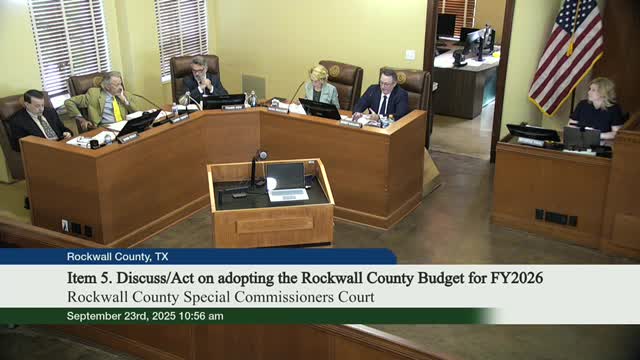
Rockwall County commissioners on Sept. 23 adopted a formal speed-hump procedure to govern requests from neighborhoods for traffic-calming measures.
Under the policy the county will accept petitions requesting a traffic-calming device only after an initial threshold of resident support: 60% of affected property owners must sign a petition to initiate review. The policy calls for an engineering study by the county's Environmental Development Services department to determine whether a speed hump or other traffic-calming option is warranted.
Commissioner Stacy, who sponsored the policy, told the court the proposal borrows elements from other Texas counties and sets a high bar so measures are not installed for one-off complaints. Commissioner Lichty said petitions that offer to cost-share or fully fund installation would be prioritized.
The court voted 5-0 to approve the speed-hump policy. The policy also includes a process for removal: taking down a speed hump requires the same 60% petition threshold.
Why it matters: The policy creates a clear, documented path for residents seeking traffic-calming measures while limiting ad-hoc installs and ensuring county engineering review.
Process summary - Initiating petition requires signatures from at least 60% of affected property owners. - County will conduct engineering analysis to determine appropriate treatment; high-traffic or collector roads are excluded from typical speed-hump installations. - Removal also requires a 60% petition in favor of removal.
Ending: Residents seeking traffic-calming are advised to organize a neighborhood petition and work with their precinct commissioner and the county's development services department to initiate the study.