Get Full Government Meeting Transcripts, Videos, & Alerts Forever!
Get email alerts on the Hemp Regulation Age Verification topic
No spam. Unsubscribe anytime.
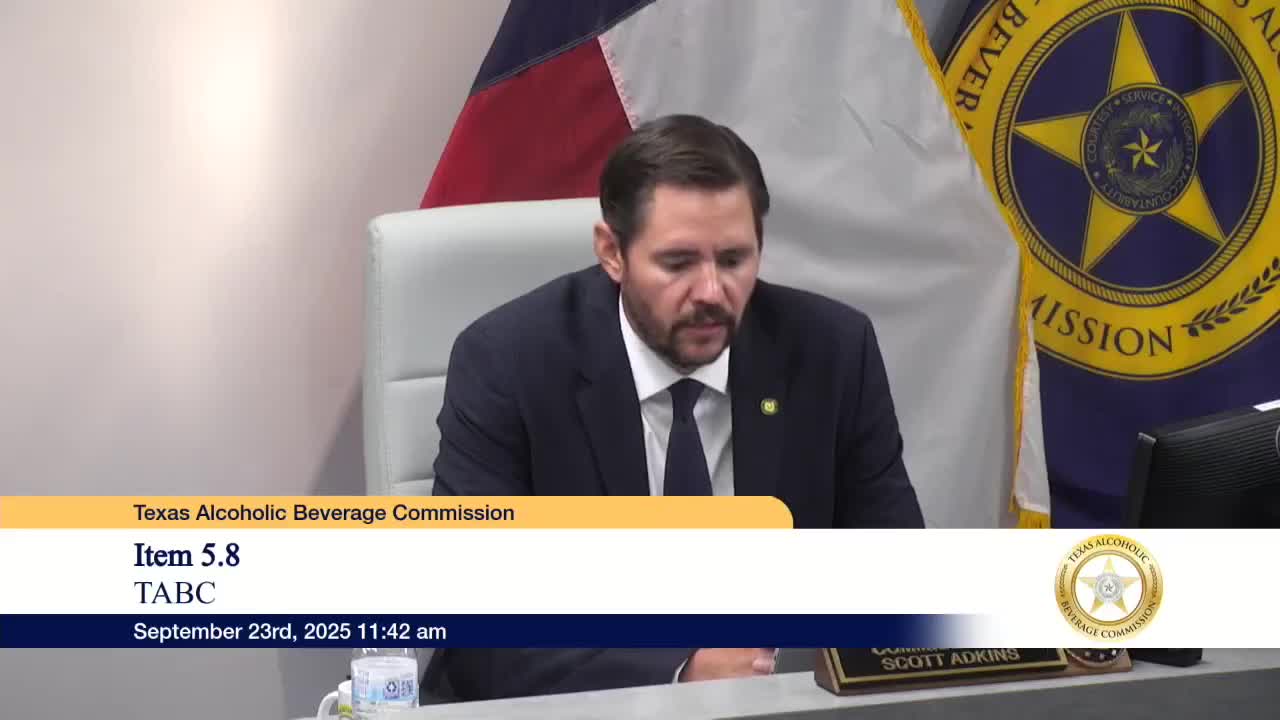
TABC adopts emergency rules banning sale of consumable hemp products to minors, requires ID checks
Summary
The Texas Alcoholic Beverage Commission adopted emergency rules implementing Gov. Abbott’s executive order to prohibit sales of consumable hemp products to anyone under 21 and to require government‑issued ID verification; enforcement begins Oct. 1.
The Texas Alcoholic Beverage Commission on Sept. 23 voted to adopt emergency rules that bar retail sales of consumable hemp products to people under 21 and require verification of a purchaser’s age with government‑issued identification.
General Counsel James Person told commissioners the rules implement Governor Greg Abbott’s Sept. 10 executive order GA‑56 and rely on the commission’s statutory authority under the Alcoholic Beverage Code. “The emergency rules presented today comply with the governor’s directive and are based on existing statutory authority in sections 11.61 and 61.71 of the Alcoholic Beverage Code,” Person said. He added the rules “make it clear that businesses do not comply with those laws if they sell, offer for sale, serve, or deliver consumable hemp products to” persons under 21 or “they fail to check IDs when selling, serving, or delivering those products.”
Why it matters: The rules take effect immediately as emergency regulations and will be enforced beginning Oct. 1, giving TABC time to notify retailers and the public. The rules apply to retail sales and deliveries to consumers, not to transactions among industry wholesalers, distributors or other upper‑tier transfers.
What the rules do: The new emergency chapter (proposed as Chapter 51) contains two provisions — one prohibiting sales of consumable hemp products to minors and a second requiring mandatory age verification for consumable hemp product sales. Under the rules, a license or permit may be canceled for noncompliance. Person said there is no violation where a licensee checks a government‑issued ID and reasonably believes the buyer is 21 or older even if the buyer later proves to be underage.
Public comment and industry feedback: Commissioners heard oral comments from industry representatives and public‑health advocates during the meeting’s public comment period. Several commenters urged strict age checks and broader enforcement tools. Inkem Okeke, who identified himself as a co‑founder of Mobilize, urged automated, lab‑data based monitoring for hemp products. Betsy Jones of Texans for Safe and Drug Free Youth said public health groups should be involved in rulemaking, arguing that many hemp products are marketed and distributed in ways that increase youth access.
Opponents and advocates: Speakers at the meeting urged different approaches. Lucas Gilkey, CEO of 1 Time Hero, thanked TABC for adding an “age gate.” Public‑safety advocates Aubrey Adams and Christine Scruggs urged stricter age limits and noted concerns over youth exposure and long‑term risks. TABC staff said the emergency rules implement the governor’s direction and will be followed by regular rulemaking with public comment and industry input, planned for the commission’s November meeting.
Process and enforcement timeline: Because the rules were adopted as emergency rules, they will take effect immediately; staff said TABC will not begin enforcement until Oct. 1 to allow outreach to industry. Staff also said they will publish a substantively similar proposal through the regular rulemaking process to permit public comment and stakeholder feedback.
The vote: The commission approved adoption of new Chapter 51 emergency rules (16 TAC 51.1 and 51.2) by voice vote following a motion and second; staff recorded the votes and reported the motion passed.
Next steps: TABC staff said they will conduct outreach to licensees and industry groups to explain the new requirements and will return with a proposed regular rule package for formal rulemaking and additional public input at the November meeting.