Get Full Government Meeting Transcripts, Videos, & Alerts Forever!
Get email alerts on the Infrastructure Permits topic
No spam. Unsubscribe anytime.
Monroe accelerates permit review and rolls out multi‑year resurfacing plan
Summary
City staff reported sharply faster permit reviews this year and outlined a four‑year resurfacing program that would repave about 30.9 miles and preserve another 16 miles, with the first 9.7‑mile contract set for award next month.
Monroe — City staff told the Monroe City Council during its Sept. 16 strategic planning retreat that a retooled permit review process has cut average turnaround times to well below the targets set in 2024, and officials unveiled a multi‑year street resurfacing plan that will start with a 9.7‑mile contract expected to be awarded next month.
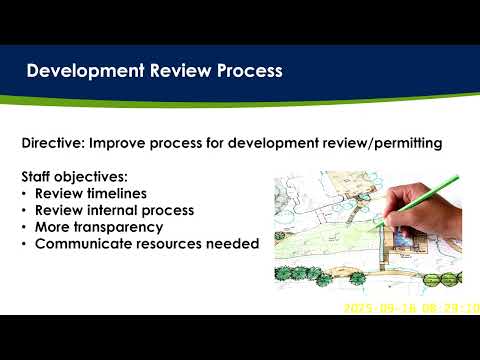
The permit review overhaul, led by staff member Jeff, set formal goals of five business days for residential plan reviews and ten days for commercial reviews. ‘‘In 2025’s first quarter we had 2,696 total reviews with a 3.42 average day to review,’’ Jeff said. He reported the CityView software expansion, fillable electronic forms and clearer submittal requirements helped achieve the improvement and cited department‑by‑department averages that in many cases were well under the goal (planning and zoning: 2.51 days; building code: 0.86 days; fire code: 2.74 days). ‘‘We are running really good on these numbers,’’ Jeff said.
City Manager Watts told council the faster reviews make Monroe more attractive to builders and developers. ‘‘They appreciate it—folks would rather come to Monroe and deal with a one‑stop shop,’’ he said at the retreat.
Why it matters: Faster plan review reduces time and uncertainty for homeowners and developers, and it is a selling point in economic development pitches. At the same time, city staff said public communication and an online Power BI dashboard now under development will give council and the public sortable, near‑real‑time permit metrics to preserve the improvements.
Street resurfacing plan: funding, scope and schedule
Public works staff presented a connected pavement preservation and resurfacing program built to raise and maintain the city’s pavement condition index. The immediate action is the award of a 2025‑26 resurfacing contract for about 9.7 miles; staff said that contract will go to council for award next month. Staff described an expected four‑year sequence that totals roughly 30.9 miles of resurfacing (resurfacing/reclamation) and 16 miles of preservation treatments over the coming fiscal years.
Key figures described by staff: - 2025‑26 resurfacing contract: 9.7 miles (to be awarded next month). - Anticipated mileages: 2026‑27 ~9.5 miles; 2027‑28 ~6 miles; 2028‑29 just under 6 miles. - Average cost cited for the most recent contract: $40.60 per square yard. - Example preservation costs: rejuvenators about $1.50 per square yard (DOT contract examples); a higher figure of $9.50 per square yard was shown as an upper benchmark from recent DOT pricing. - Aggregate plan (four fiscal years): about 30.9 miles resurfaced plus about 16 miles of preservation.
Staff said the plan targets spending roughly 85% of paving funds on resurfacing/rehabilitation and 15% on preservation treatments (crack seal, microsurfacing/cape seals, rejuvenators) to keep otherwise good streets in the A‑B condition and delay full reclamation. For the 2026/27 year staff showed an illustrative per‑project cost estimate of $969,760 at $9.50 per square yard for a portion of the program, and a 10‑year funding review will follow the 2028‑29 year in staff’s timeline.
Council and staff clarified schedule and logistics: - Bids will be issued after council adopts the annual budget; typical contracts run for one year with work occurring in fall and the following spring/summer depending on temperatures (asphalt work is generally avoided when temperatures fall to the mid‑40s). That means awarding a contract does not imply pavement will immediately be laid on the street the following two weeks. - Some reclamation work is season‑sensitive and typically scheduled when temperatures permit. - Staff said final project order and phasing will be coordinated with contractors in pre‑construction meetings and with other city projects such as culvert replacements so new pavement is not damaged by subsequent utility work.
What council directed and next steps
Council did not take a final funding vote at the retreat, but staff said it will present the 9.7‑mile contract for award next month and will bring back: (a) the Power BI permit dashboard when ready; (b) the resurfacing contract award and schedule; and (c) recommended approaches to communicate permitting and paving changes to the development community and the public.
Clarifying details and caveats
- The permit review numbers reported (departmental averages and 2025 quarterly totals) are staff’s internal performance data presented at the retreat; they reflect the period after adding CityView licenses and streamlining submittal requirements. - Resurfacing and preservation estimates were labeled ‘‘approximate’’ by staff; staff said costs and lists of streets may shift when up‑to‑date bids and condition surveys are finalized. - Preservation treatments are lower‑cost, preventive techniques (e.g., crack sealing, micro surfacing, rejuvenators) that extend pavement life; reclamation or full‑depth repairs are more expensive and used for streets in D‑F categories.
Speakers (sources)
- Jeff (staff member) — development review lead presenting the permit review statistics - City Manager Watts — city manager (identified in the meeting) - Mayor Burns — presiding mayor (identified in the meeting) - Will (staff member / engineering) — engineering staff who spoke about preservation materials (micro surfacing, rejuvenators)
Proper names
- Monroe City (government)
Clarifying details (extracted)
- Category: permit performance — 2025 Q1: 2,696 total reviews, 3.42 average days per review; Q2: 3,113 reviews, 3.10 average days. - Category: departmental averages — planning & zoning 2.51 days; building code 0.86 days; engineering services (some units) up to about 6.97 days (stormwater review) as shown in staff’s breakdown. - Category: resurfacing program — total expected 30.9 miles resurfaced + 16 miles preserved over four fiscal years; initial 9.7‑mile contract to be awarded next month; average bid price shown $40.60/sq yd; preservation examples $1.50–$9.50/sq yd depending on method.
Community relevance
- Geographies: Monroe (city); several downtown and neighborhood corridors identified for near‑term preservation/resurfacing and sidewalk work. - Impact groups: homeowners, developers, local contractors and downtown businesses (project sequencing and access), roadway users.
Searchable_tags:["permits","development review","pavement preservation","resurfacing","Monroe City"]
Ending
Council asked staff to return with the formal contract award for the 9.7‑mile package next month, to publish the permit review dashboard when complete, and to present follow‑up detail on striping and preservation phasing. Staff emphasized the program will be reviewed and rebalanced annually depending on condition surveys and actual bid prices.