Get Full Government Meeting Transcripts, Videos, & Alerts Forever!
Get email alerts on the Budget topic
No spam. Unsubscribe anytime.
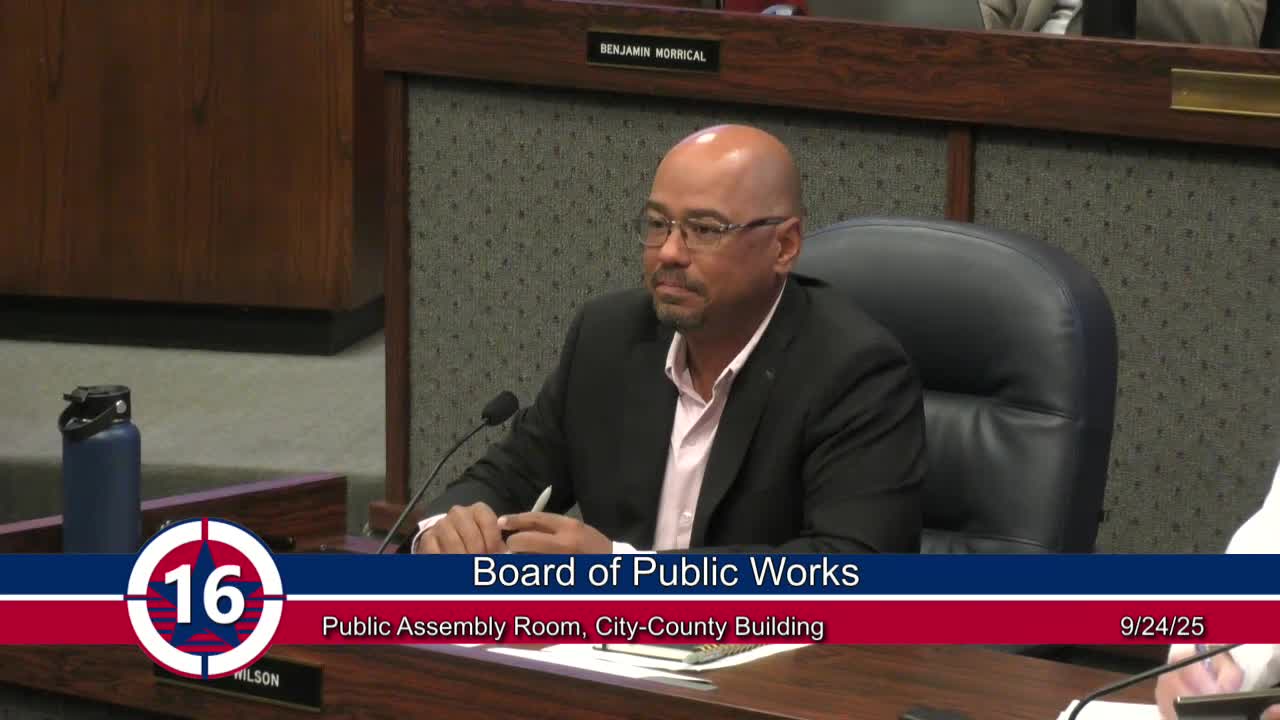
Indianapolis DPW presents $257 million 2026 budget; board asks about Vision Zero funding
Summary
The Indianapolis Department of Public Works presented a proposed $257 million 2026 budget that relies on gas and wheel taxes, user fees and grants; board members pressed officials for clarity on dedicated funds for Vision Zero safety initiatives.
The Indianapolis Department of Public Works on Sept. 24 presented a proposed $257,000,000 budget for 2026 that department officials said is driven by gas and wheel taxes, user fees for solid waste and stormwater, interlocal agreements and grants.
Margaret Wilson, assistant chief financial officer for the Department of Public Works, told the Board of Public Works the introduced budget reflects stable growth in several dedicated revenue sources and includes increases for contractual obligations, cost-of-living adjustments and a one-time operations appropriation. "This is an attempt to...break down this budget a bit more," Wilson said during the board's presentation.
The budget includes several line items board members flagged as important: a $10,000,000 allocation of COIT funds for the department's transportation capital program; a $300,000 increase for the department's Tax Drop program; and purchases and capital for fleet, including funding to acquire trucks and equipment. Wilson said DPW's grant fund total was budgeted at about $46,000,000 for 2026 compared with $51,000,000 budgeted in 2025; she described that change as an accounting adjustment tied to more specific federal funding awards rather than a cut to programs.
Sam Baras, chief financial officer for DPW, said part of the gas-tax growth in the 2026 estimate also reflects scheduled statutory increases. "The gas tax...goes up per state law every July 1 through 2027," Baras said. "It'll go from 35¢ a gallon to 36¢ a gallon." He added that actual collections are trending slightly above 2025 projections, so growth is measured from a larger base and is closer to a 2.5%–3% increase relative to expected 2025 receipts.
Wilson and staff described efforts to show the budget in multiple ways—by fund type and by programmatic service—to make it easier to track where money is spent. DPW said this is the first year it is piloting programmatic budgeting for divisions such as engineering, operations and fleet; examples named in the presentation included a potholes-and-patching program, a special-events placeholder to capture barricade and downtown preparation costs (a $50,000 placeholder), and a community-powered infrastructure program budget.
On fleet and winter operations, DPW staff said money from a spring fiscal allocation — approximately $2,000,000 — was used to purchase 14 one-ton pickup trucks with plow packages that will supplement snow response and other year-round operations. The department also described a separate $10,000,000 capital increase for transportation projects and a strip-patching allocation to support pavement repairs.
Solid-waste operations received attention in the presentation: DPW said new residential solid-waste contracts begin Jan. 1, 2026. The department named Lakeshore Recycling Services for residential collection work and cited contracts with Republic and a landfill operator (Covanta) for disposal. DPW said teams are coordinating transfer and transition activities ahead of the contract start date and budgeted for new lease truck purchases and a garage completion later in 2025.
Board members repeatedly pressed DPW for clarity on how money in the proposed budget would translate into safety investments recommended by the Vision Zero action plan. When asked whether the plan's action items or a citywide Safe Routes to School program had dedicated funding, DPW officials said the Vision Zero plan still was in development and had not been adopted; they said many safety-related projects are embedded across the capital program and that some funding has been provided through other lines (for example, fall/spring fiscal allocations for fatal-crash review recommendations). DPW said it could provide a follow-up briefing to the board on where Vision Zero-related spending is occurring and consider program codes to better identify safety spending.
Why this matters: the DPW budget sets funding for street repair, stormwater, snow response and programs that affect daily travel and safety across Indianapolis. Board members asked for clearer labelling of safety investments and a timetable for adopting Vision Zero recommendations so the public can see which projects will be funded.
This was a presentation to the board; the 2026 budget was not before the Board of Public Works for a vote at the meeting. Board members asked DPW staff to return with additional detail on Vision Zero adoption timing and to provide more granular breakdowns (for example, approximate shares for sidewalks and bicycle infrastructure embedded in street projects).