Get Full Government Meeting Transcripts, Videos, & Alerts Forever!
Get email alerts on the Public Safety Wellness topic
No spam. Unsubscribe anytime.
Sheriff's Office describes expanded wellness, peer‑support work and requests sustained funding and HR support
Summary
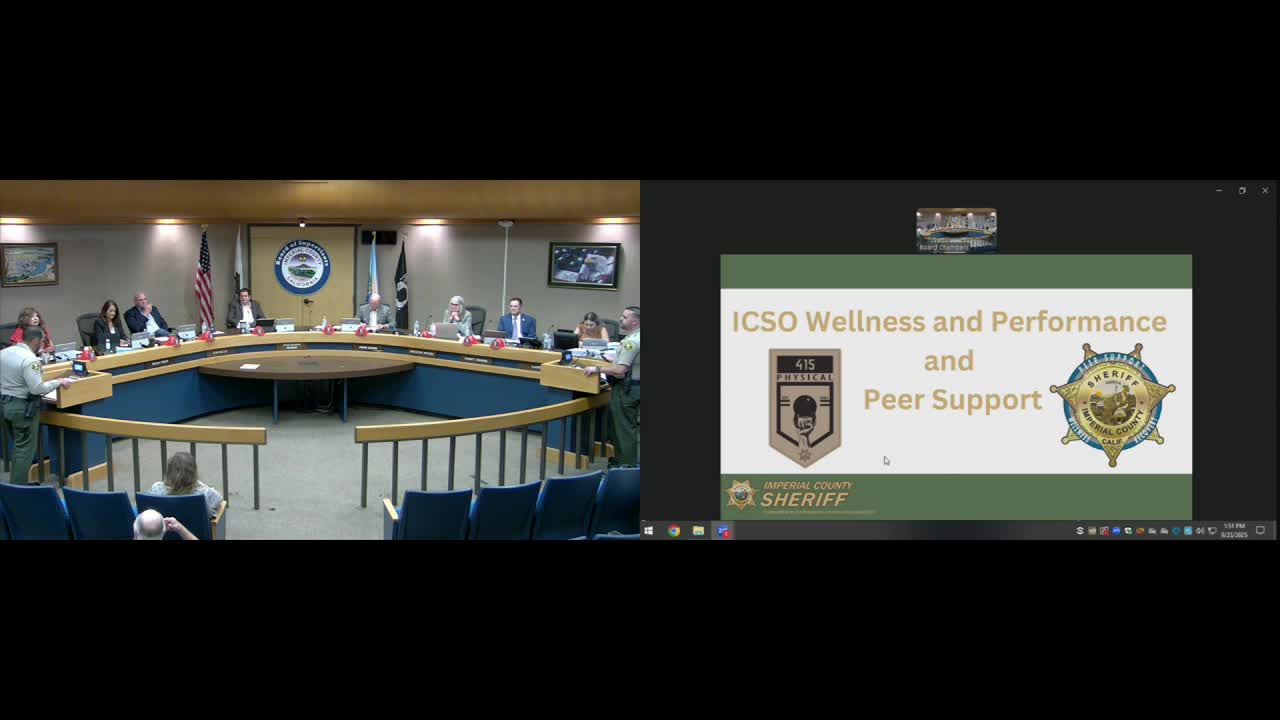
The Sheriff's Office outlined a multi‑year wellness program — peer support, fitness/nutrition, critical incident debriefing and training — and asked the Board for sustained funding, improved EAP services and a full‑time wellness coordinator.
Sheriff's Office leaders told the Imperial County Board of Supervisors on Sept. 23 that enhanced, sustained funding and institutional support are needed to sustain and expand a multi‑year wellness program for deputies and corrections staff.
Chief Deputy and wellness staff described a peer‑support program formed after a series of critical incidents in the mid‑2000s. The program now includes a peer support team, critical incident stress debriefing capability, limited wellness technology pilots (a wellness app), fitness and nutrition initiatives, family engagement events, and suicide‑prevention training. Speakers said the program has yielded benefits but remains underfunded and largely supported via grants and donations.
Presenters told the board their top needs are a culturally competent, confidential counseling provider better suited to first responders than the county's generic Employee Assistance Program (EAP), a full‑time wellness coordinator for the department, sustained funding for training and equipment (past pilots such as a wellness app cost roughly $25,000/year), and compensated on‑duty physical training time similar to arrangements in some fire departments.
Chief Deputy described efforts to register the peer support team as a 501(c)(3) to access outside funding and summarized a training program the department completed with California POST and San Diego State University to develop an organizational wellness plan. The department offered examples of public programming they have implemented, such as family days, haunted‑house events, fitness challenges and memorial services, and said more work remains to make services proactive rather than reactive.
Board members expressed support. Supervisor Peggy Price encouraged the Sheriff to continue working with the CEO's office and Human Resources to identify sustainable funding and partnerships. The sheriff's representatives said they will continue pursuing grants and requested county leadership support to institutionalize the program.