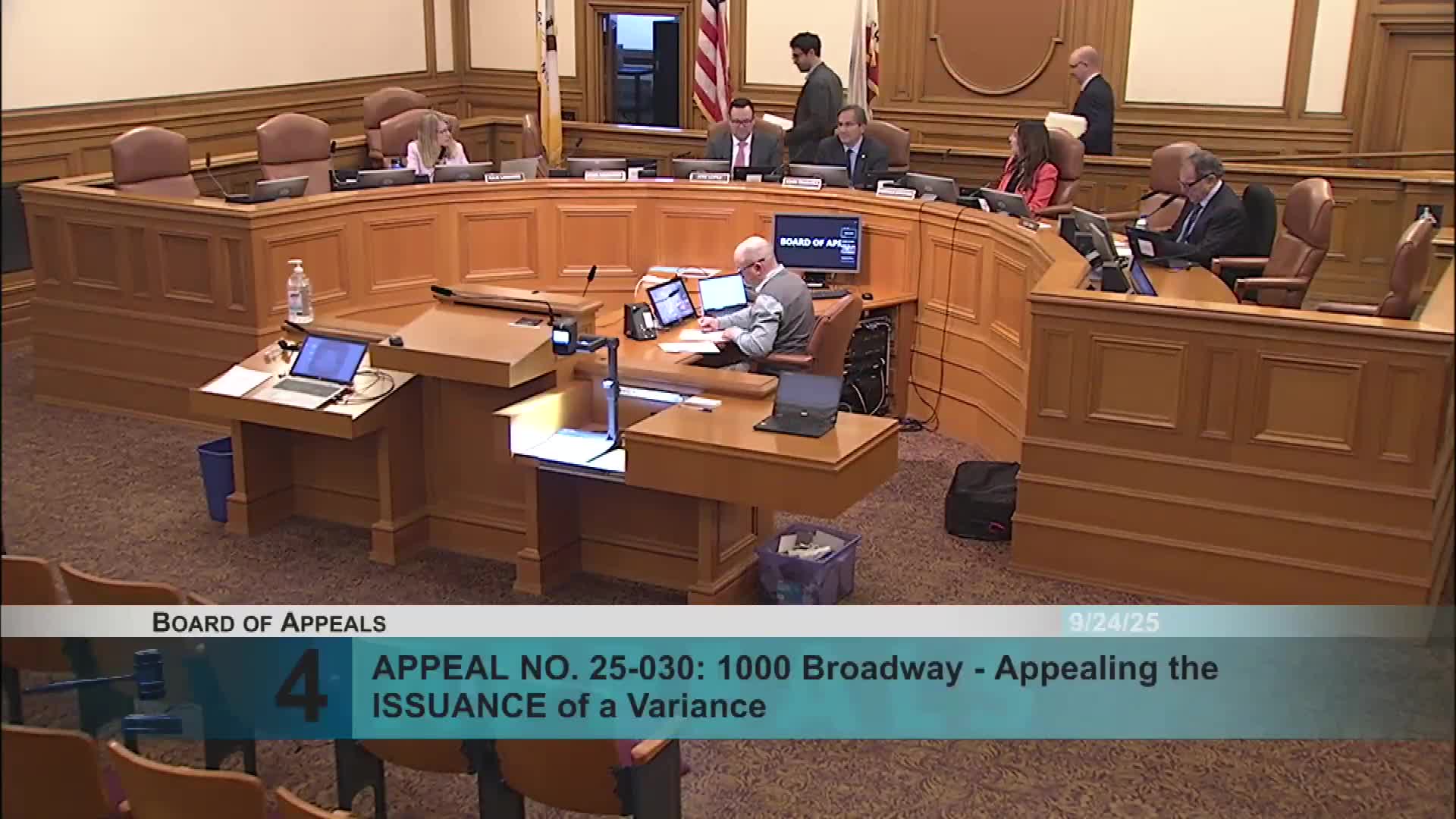
Board of Appeals upholds variance allowing 5-unit project at 1000 Broadway in Russian Hill
Loading...
Summary
The San Francisco Board of Appeals denied an appeal from a nearby homeowner and upheld a zoning administrator’s variance that allows removal of a rear yard setback and construction of three buildings with subterranean parking at 1000 Broadway.
The San Francisco Board of Appeals on Sept. 24 denied an appeal of a variance for 1000 Broadway, allowing a developer to proceed with a proposal to build three buildings and subterranean parking that together would create five dwelling units on a consolidated corner lot in the Russian Hill historic district.
The board’s decision upholds the July 25 variance granted to Russian Hill Lending LLC. President John Trezvina said he found the zoning administrator’s findings “clear” and that he had not heard anything in the appellant’s arguments “to really disturb those findings.” The motion to deny the appeal passed 4 to 0.
The appellant, Jonathan Reid, urged the board to preserve a 15-foot minimum rear yard setback and argued the proposed development is out of scale for the historic RH2 neighborhood. “My only simple request is for the board to deny the variance as is and reasonably enforce a 15 foot minimum rear yard setback for the Arizona developer in line with our expectations of every San Francisco resident,” Reid told the board. He said the project would replace a quarter lot with 23,750 square feet of construction in an area typically featuring 3,000–4,000 square-foot homes.
The project sponsor’s representative, attorney John Kevlin of Ruben, Junius & Rose, and the project team described site constraints the team said justify the variance. “The existing site is undeveloped with a greater than 30% slope and a large coastal redwood tree at its southeast corner,” Kevlin said. He told commissioners the design preserves the tree and a historic retaining wall commonly called the Homer Parker retaining wall and concentrates much of the massing below grade in a podium to reduce the apparent above-grade scale.
Corey Teague, the Planning Department’s zoning administrator, told the board the department had reviewed the proposal and the decision letter laid out why the variance findings were met. “The the variance decision letter itself, clearly laid out the project and the rationale and arguments for the findings being met,” Teague said, adding the parcel is large enough that planning treated the three contiguous parcels effectively as one lot for code purposes and that subterranean construction is common on steep lots.
Commissioners asked about density comparisons raised by the appellant. Project counsel and planning staff said the development represents three separate buildings on three parcels that share a below‑grade podium and that some density comparisons in public comments compared non‑equivalent lot configurations. Kevlin and Teague both emphasized the design intention to limit visible massing above grade and to preserve open space: the project team reported the design would provide about 42% of the lot area as open space above the podium, compared with a 30% rear‑yard requirement in code.
The board recorded no change to the requested variance findings and denied the appeal. The vote was recorded as 4–0: President John Trezvina, Commissioner Rebecca Saroyan, Commissioner Rick Swig and Vice President Jose Lopez all voted “aye.”
What happens next: with the appeal denied the developer may proceed under the granted variance and issued permits subject to any outstanding building inspections, historic‑resource mitigations and standard departmental approvals. The board’s action was limited to the variance appeal; the Planning and Building departments retain authority over any later permit compliance or construction‑phase issues.
The board heard extensive written packets and multiple on‑the‑record presentations from the appellant, the permit holder’s counsel, and Planning Department staff. The hearing record includes the zoning administrator’s decision letter and project exhibits used in the appeal briefing.
A citizen concerned about scale and preservation may still pursue civil remedies or participate in future permit review steps, but the Board of Appeals has closed its review on this variance request by denying the appeal.