Get Full Government Meeting Transcripts, Videos, & Alerts Forever!
Get email alerts on the Infrastructure Bridges Roads topic
No spam. Unsubscribe anytime.
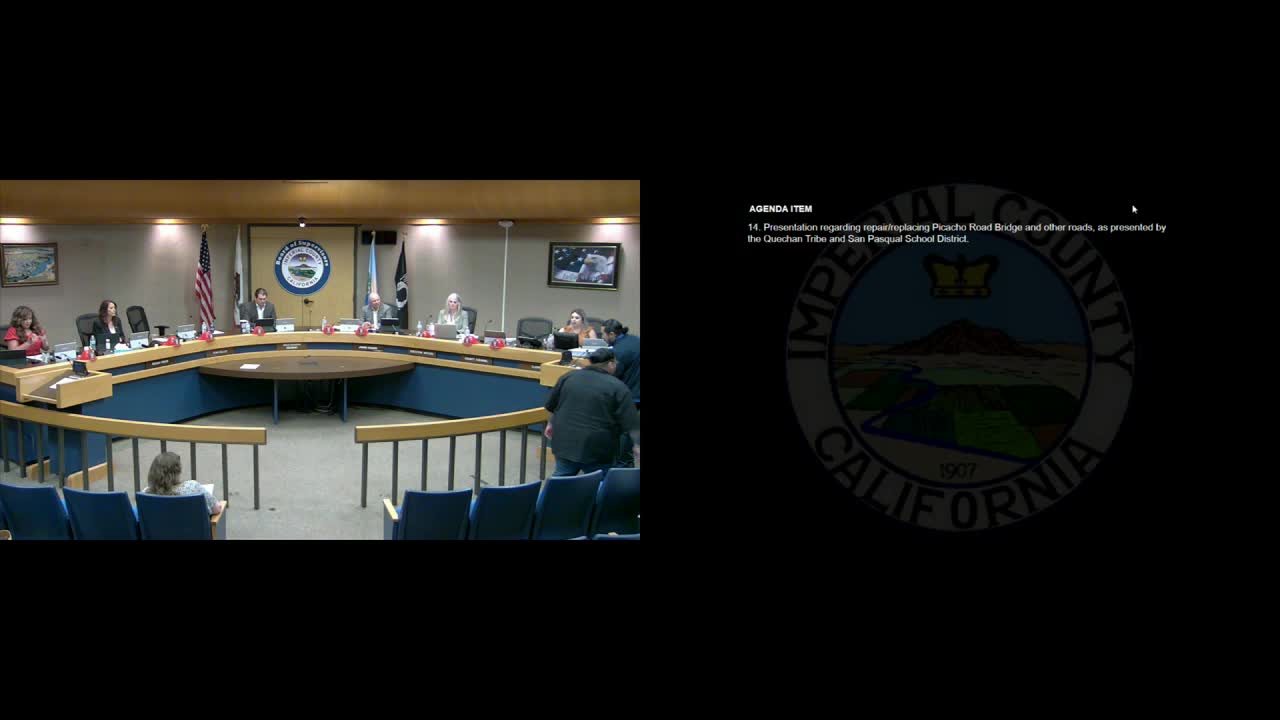
Tribal leaders, school officials and residents urge immediate action on Picacho Bridge closure and rural road repairs
Summary
Quechan tribal officials, residents and San Pasqual School representatives told the Board the Picacho Bridge closure and deteriorating rural roads are harming emergency response, school transportation and tribal economy; county staff described ongoing grant work and engineering reviews.
Leaders of the Quechan (Quechan/Quechan referenced in transcript as the Quechan/Quechan/Quechan/Quechan tribe) tribal council, school officials and multiple residents told the Imperial County Board of Supervisors on Sept. 23 that the long‑running closure and structural problems at the Picacho Bridge and widespread rural road damage are creating public‑safety and economic hardships for tribal members and neighboring communities.
Jonathan Coteen, president of the Fort Yuma Quechan tribe, described the bridge as a “lifeline” for members, employees and visitors and said the closure has lengthened commutes for work, school and medical care. Tribal council members and other speakers described delayed emergency response times, broken school buses, higher vehicle repair costs and severe impacts to casino employment and access.
Chiefs and tribal council members urged the county to prioritize temporary access or phased openings while longer‑term replacement plans proceed. Several speakers asked the board to visit the reservation and requested a regular update and collaborative planning with tribal leadership. Tribal speakers said the bridge closure limits customers and employees at Paradise Casino and affects the broader Imperial County tax base.
County staff and board members said they have been pursuing multiple strategies to reopen or replace the bridge: the county declared an emergency on related storm damage, contracted WSP (an engineering firm) to evaluate repair options, pursued a larger federal grant program (the Senate/State bridge funding referenced in the hearing), and considered interim approaches such as limiting heavy trucks and posting traffic control to protect the structure. County staff said an earlier grant application was unsuccessful (failures credited in the hearing to a large award for the Golden Gate Bridge), but the county has re‑applied and expects scoring results in November.
Public safety officials told the board the closure complicates radio interoperability, ambulance routing and mutual‑aid coordination; the Quetchan tribal police chief and the county sheriff described radio and interagency communications work as ongoing. Speakers said some school buses have been damaged by poor roads; a former San Pasqual district administrator relayed that front‑end repairs for buses can exceed $20,000.
Board members acknowledged the severity of the problems and asked staff to continue coordinating with federal and state partners, the Bureau of Reclamation and Bard Water District on right‑of‑way and funding; board members also described prior attempts to keep the bridge open and to limit heavy commercial traffic. County staff said bridge replacement will require coordination with multiple land‑title holders and federal entities, particularly where allotted or tribal lands are concerned.
No single immediate construction project was approved on Sept. 23, but the board ratified prior emergency proclamations related to storm damage and reiterated plans to pursue federal/state grants, develop engineering assessments and meet with tribal leaders to seek short‑term mitigations while replacement planning continues.