Get Full Government Meeting Transcripts, Videos, & Alerts Forever!
Get email alerts on the Lithium Development topic
No spam. Unsubscribe anytime.
Imperial County officials say Hell's Kitchen lithium project could bring jobs and tax revenue but remains stalled by litigation
Summary
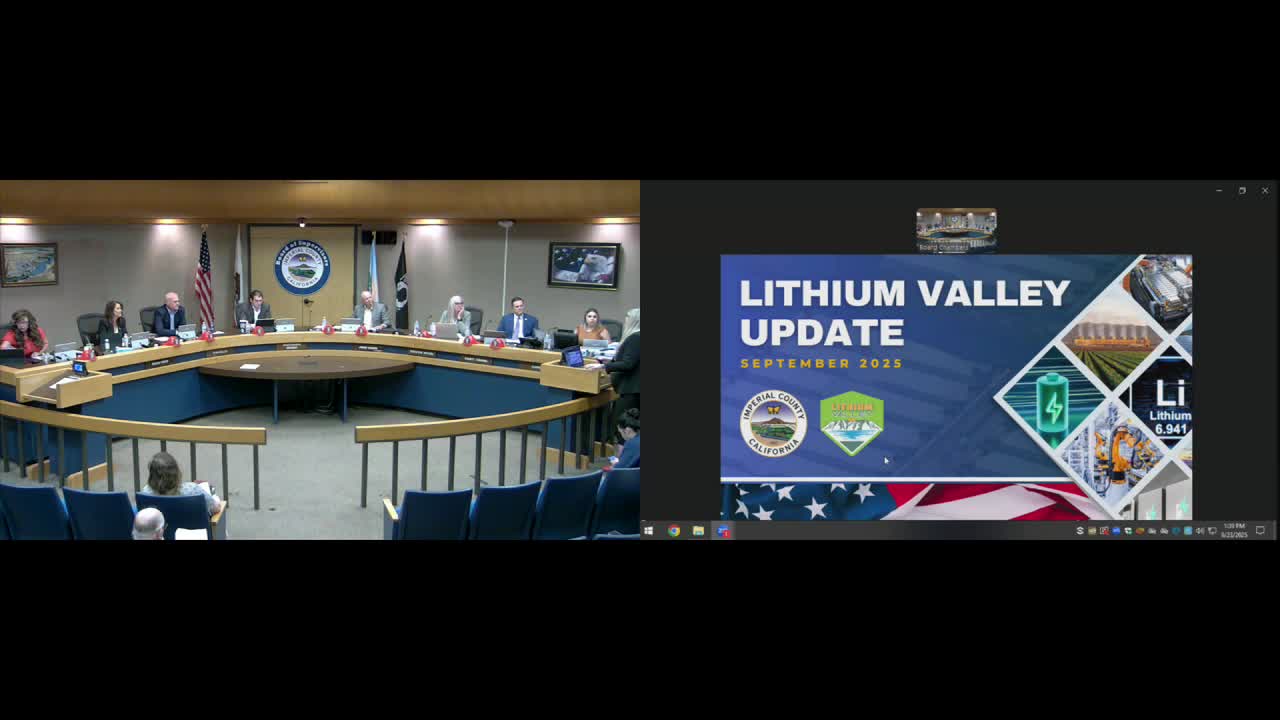
Deputy CEO Barry Bean updated the Board on the Hell's Kitchen lithium project and broader Lithium Valley effort, outlining potential jobs, tax revenue and a pending appeal that has delayed construction more than 20 months.
Deputy Chief Executive Barry Bean told the Imperial County Board of Supervisors on Sept. 23 that the Hell's Kitchen lithium extraction project could deliver significant local economic and tax benefits but remains delayed by litigation.
Bean said Hell's Kitchen could supply 50 megawatts of renewable baseload energy, produce more than 25,000 tons of lithium carbonate annually, create roughly 500 construction jobs and about 75 permanent positions. He told the board the county estimates more than $115 million in cumulative property tax revenue to the Calipatria Unified School District and tens of millions for Imperial Valley College and the Pioneers Memorial Healthcare District over a 30‑year horizon.
The project was approved by the Board and the project's environmental impact report (EIR) was certified on Jan. 23, 2024, Bean said. He described a lawsuit filed by two groups — CCV and Earthworks — that challenged the EIR, a superior court denial of that writ and an appeal to the Fourth District Court of Appeal. Bean said the litigation and related actions have delayed the permitted project some 609 days as of the Sept. 23 meeting.
Bean also addressed local policy work tied to lithium development. He described the county's lithium community benefits framework adopted Sept. 10, 2024, which would direct a portion of state excise tax revenue from lithium extraction toward county quality‑of‑life projects, tribal and cultural affairs, an endowment and workforce upskilling. Bean highlighted state law creating a lithium extraction excise tax (referred to in his presentation as SB 125) and said those funds, if realized, would be industry‑paid and could help address long‑standing local environmental needs, including Salton Sea restoration and air quality.
Bean characterized recent public proposals — such as additional environmental fees or a new joint powers authority — as requests that might effectively extract additional money from developers and warned that duplicative demands could push investment away from the county. He encouraged the community and stakeholders to support lithium development as a tool to generate revenue for local priorities, while acknowledging the county's environmental regulatory framework includes multiple state and federal agencies.
Board members and staff did not take a formal vote on the Hell's Kitchen matter during the presentation. Bean concluded by asking for support of responsible lithium development and answered clarifying questions from supervisors about timelines and the county's community benefits planning.
The County's presentation documented the legal history of Hell's Kitchen and emphasized that continued litigation is the principal cause of delay, while reiterating the county's position that the project could produce lasting tax and job benefits for Imperial County.