Get Full Government Meeting Transcripts, Videos, & Alerts Forever!
Get email alerts on the Local Manufacturing Construction Materials topic
No spam. Unsubscribe anytime.
Committee Deadlocks on Bill Requiring ‘Made in the Virgin Islands’ Materials for Public Contracts
Summary
Legislation to require locally manufactured construction materials on locally and federally funded contracts failed in committee after agency witnesses raised federal‑compliance and capacity concerns; sponsors said they will amend the bill.
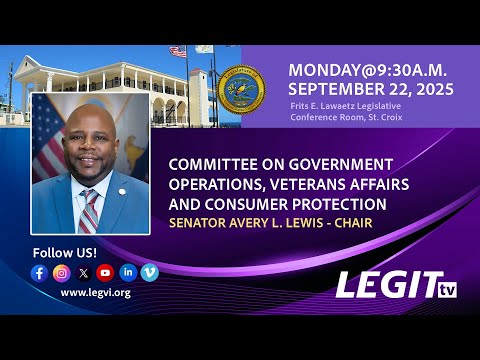
The Committee on Government Operations, Veterans Affairs and Consumer Protection deadlocked Sept. 22 on bill 36‑0102, a proposal to reenact section 236(b) of Title 31 so that government contracts using local or federal funds must, "to the greatest extent practicable," use construction materials manufactured in the U.S. Virgin Islands.
Sponsor Senator Marvin Blyden framed the bill as an economic‑development tool to create jobs, strengthen local supply chains and reduce import leakage. “If our people can produce a construction material that meets quality standards and a competitive price, they should have access to that market,” Blyden told the committee.
Nut graf: Agency witnesses — particularly the Departments of Property & Procurement and Public Works and the Virgin Islands Housing Finance Authority — supported the bill’s intent but warned the committee that federal grant rules, limited local manufacturing capacity and procurement mechanics could create conflicts or administrative burdens.
Commissioner Lisa Alejandro of Property & Procurement recommended explicit exceptions for projects where federal grant requirements would preempt the local‑preference language and asked the sponsors to refine coverage for semi‑autonomous instrumentalities (port authority, housing finance authority, etc.). Commissioner Derek Gabriel (Public Works) said many federal grants prohibit preferences for local bidders and said implementation could jeopardize federal reimbursements unless the bill is clarified with explicit “not applicable where inconsistent with grant terms” language. The Housing Finance Authority staff urged a market assessment and stronger quality control and exemption procedures before the bill could be applied to housing projects that rely heavily on federal funds.
Senators and testifiers discussed Puerto Rico’s similar law, which the First Circuit reviewed in Antilles Cement Corp. v. Fortuño (2012); legal counsel on the floor said that local legislation cannot bind federal agencies and recommended clarity in drafting to avoid conflicts with specific grant terms. The bill would allow a 15% price variance for locally produced materials; Property & Procurement cautioned that combining that variance with the territory’s existing preferred‑bidder 15% allowance could create an effective 30% price cushion unless the language is capped.
Vote at a glance: After extended testimony and questioning, the committee recorded a 3–3 tie with one member absent; the measure failed to pass in committee. Sponsor Senator Blyden said he will accept the agencies’ recommended amendments and seek to reintroduce the bill to Rules after the revisions.
Ending: Committee members urged further market analysis, a clear exemption clause for federal grants, and a transparent exemption process to ensure quality and avoid project delays. The sponsor indicated he will work with agency counsel on amended language.