Get Full Government Meeting Transcripts, Videos, & Alerts Forever!
Get email alerts on the Homelessness topic
No spam. Unsubscribe anytime.
Fort Wayne staff outline count and multi‑agency plan to address homelessness
Summary
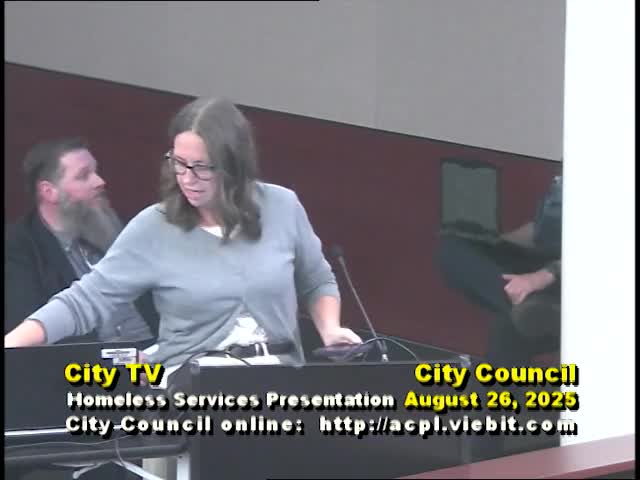
Amanda Fall, speaking at a Sept. 9 Fort Wayne Common Council committee session, presented a six‑month status report on the city—s homeless response and a multi‑phase strategy that includes encampment coordination, an expanded outreach team, shelter capacity increases and an "educated estimate" of about 2,250 people experiencing homelessness in Allen County.
Amanda Fall, speaking at a Sept. 9 Fort Wayne Common Council committee session, presented a six‑month status report on the city—s homeless services and an outline of a multi‑phase strategy to reduce unsheltered homelessness.
Fall said the position she now holds was created when Mayor Tomika L. Tucker took office and that her first priorities were to reduce homelessness, improve the local continuum of care and create a coordinated encampment response strategy. She described the presentation as a "50,000‑foot view" and said staff have launched pilot programs and triage processes to learn what works in Fort Wayne.
Fall described near‑term operational work already under way: expansion of shelter capacity, increased outreach and case management, a multi‑agency Encampment Task Force that pairs enforcement and social services, and efforts to align federal ESG (Emergency Solutions Grants) and CDBG (Community Development Block Grant) funding to housing priorities. She said the city and provider community are building a shared bed‑tracking system and exploring a data dashboard to track outreach and housing outcomes in real time.
The presentation included data from a two‑week outreach effort in July involving 20 local agencies. Fall said the count found 253 named people living unsheltered, 40 households in hotels, 47 households living in vehicles and 462 people in shelters; she added 33 additional people were noted in surveyor margins and that about 50% of people approached declined to give data. Fort Wayne Community Schools reported 1,007 households of enrolled students living doubled up. Based on those inputs and outreach notes, Fall said she—s providing an "educated estimate" of 2,250 people experiencing homelessness in the community.
Fall and councilors stressed limits and uncertainty in the figures. She said the two‑week effort did not ask where people came from in order to maximize participation and that point‑in‑time counts typically undercount people. She cautioned HUD funding is tied to official point‑in‑time counts and said Fort Wayne—s official counts have historically been lower than the numbers her team collected, which can limit HUD allocations for shelters and other services.
Councilors asked about causes, chronic homelessness and the city—s strategy for people with different needs. Fall said her survey asked a short set of questions (name, date of birth, veteran status, disability, how long homeless and where they slept the prior night). She said 75% of people living unsheltered in cars or hotels reported being homeless more than six months, a commonly used marker for chronic homelessness. Fall told Councilman David Myers that a key part of the response is "low‑barrier" access where people can be transparent about substance use or mental‑health issues and be connected immediately to housing navigation, treatment, or other services that match their needs.
Fall described an example in which the coordinated approach prevented a planned encampment closure from displacing a person who had a treatment bed becoming available in two days; city staff temporarily delayed closure so outreach could secure the treatment placement.
Fall listed several next steps she expects from the ongoing strategy: specific recommendations to bridge unsheltered homelessness to permanent housing, incentives for affordable housing, increasing emergency bed capacity and staff at provider agencies, a replicable winter plan, and timelines with funding recommendations for each phase. She also said Mayor Tucker is meeting with other mayors statewide to coordinate responses to regional inflow of people seeking services.
Councilors expressed general support for Fall—s approach. Several praised the larger count and outreach collaboration and urged the administration to pursue additional funding, including investigating whether portions of opioid settlement funds could support services for homeless people with substance‑use disorders. Council members also pressed for continued data sharing and community engagement.
During the regular session public comment period, multiple residents and street outreach volunteers repeated calls for more shelter capacity and stepped‑up outreach. Ally Sigerson, who said she has served people living outside for more than a decade, cited a 2016 class action lawsuit and federal magistrate recommendations requiring notice and an opportunity to retrieve belongings before encampment closures; she urged the city to respect those protections. Other speakers described ongoing street outreach, food and hygiene distribution and urged more proactive, rapid housing placement options.
The presentation and discussion produced no formal council action at the Sept. 9 meeting. Fall asked for the council—s continued support for cross‑sector collaboration and flexible funding as the strategy is refined.
Fall—s slides and council questions identified several concrete program metrics and constraints — the July two‑week outreach figures, shelter increases at YWCA and Carys House described as a roughly 30% expansion in capacity, the 20 participating agencies in the survey and the school district—s doubled‑up student household figure — that will shape both funding requests and system planning going forward.
Amanda Fall—s presentation and council discussion emphasized that the strategy remains in early implementation; she said the city is expanding outreach, piloting low‑barrier options and working to improve data to better match people to housing opportunities.
Ending: Fall said each phase of the strategy will include recommended timelines and funding possibilities. Councilors and community volunteers urged rapid action on shelter capacity and data systems; Fall said the administration and providers will return with specific proposals as new funding and program designs are developed.