Get email alerts on the Code Enforcement topic
No spam. Unsubscribe anytime.
Clark County Community Development outlines code-enforcement rules, complaint process and penalties
Summary
At a Community Development Learning Lab, Clark County code enforcement officers explained what the department enforces, how to file complaints (anonymous or as a party of record), timelines for compliance, and potential penalties including liens and daily fines.
Clark County Community Development presented an overview of local code-enforcement rules, complaint procedures and potential penalties during a Learning Lab session recorded by CVTV. The presentation, delivered by code enforcement officers Sydney Valera and Scott Melville, covered zoning, building and nuisance codes; environmental enforcement including erosion, wetlands and shoreline rules; how residents can file complaints; typical timelines for compliance; and possible civil penalties, liens and prosecutorial referral.
The presentation matters because enforcement affects property owners’ use of land and structures and can lead to daily fines or liens if property owners do not comply. “Our goal is to protect the safety and welfare of residents in Clark County,” said Sydney Valera, code enforcement officer, describing the department’s stated objectives of preserving community livability and property values.
Valera said code enforcement focuses on three broad categories: zoning codes (for example, unauthorized home businesses, structures in setbacks and occupied recreational vehicles), building codes (structures or remodels without permits, fences over 7 feet, reroofing or re-siding that require permits) and nuisance codes (junk and debris, inoperable vehicles, tall grass and garbage cans left out after trash day). She explained numerical thresholds used in enforcement: RVs may be occupied for up to 30 consecutive days or 60 days in a calendar year; in the urban growth area residents may have less than 1 cubic yard of debris in yard areas before it becomes a violation (2 cubic yards in rural front/side yards); grass or nuisance weeds over 12 inches are a violation in the urban growth area; and fences over 7 feet require permits. Valera said nuisance cases generally move faster through the enforcement timeline than building or zoning cases.
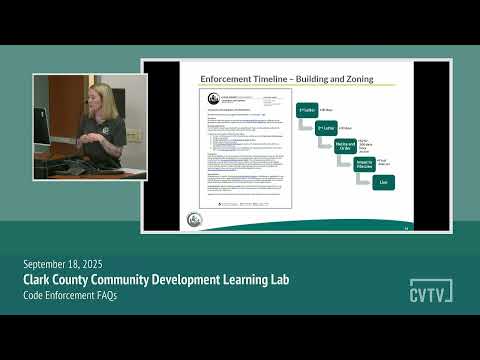
Valera described the complaint-driven process: a case typically begins with a complaint (anonymous or party of record), followed by an education/site investigation and a first violation letter with a compliance schedule. If compliance is not achieved, the department may issue a second violation letter, then a notice and order, and ultimately assess civil penalties, place a lien on the property, or refer the matter for prosecutorial action. She said civil penalties can be up to $500 per day per violation for certain building or zoning cases and nuisance fines may begin at $125 per day after a notice and order; building- or zoning-related daily fines can range from $250 to $500.
Scott Melville, National Pollutant Discharge Elimination System (NPDES) code enforcement officer, gave the department’s environmental enforcement overview, saying, “Anywhere dirt and water meet, that's where I'm gonna be.” Melville outlined the scope of environmental enforcement—erosion control, habitat protection, forest-practices requirements, wetlands, grading and shoreline work—and noted permitting thresholds and buffers. He said wetland buffers can range from about 50 feet up to 300 feet depending on wetland type; shoreline setbacks are commonly 200 feet or extend to the limit of the 100-year floodplain; grading beyond certain cubic-yard thresholds requires review or an engineered plan; and logging that removes more than 5,000 board feet for sale typically requires a permit. He also listed partner agencies with which code enforcement coordinates, including the Washington Department of Ecology, Fish and Wildlife, the Army Corps of Engineers, the Clark Conservation District and public health.
Valera explained how residents can file complaints online: anonymous complaints are possible but must describe violations visible from a roadway or other public area, because anonymous reports cannot be followed up privately; complaints filed as a party of record require a user account and are subject to public-records requests, but allow staff to follow up for additional information or obtain photos and video. She encouraged property owners who receive enforcement notices to contact code enforcement to request reasonable extensions or to confirm that a permit application is pending; the department said communication is key to avoid escalated enforcement steps.
During a question-and-answer period, a member of the audience asked whether a homeowner is responsible for trash dumped on their property; Valera responded that the property owner is responsible for removal, though the county sheriff’s office can investigate illegal dumping and abatement vouchers may be available in some cases. A separate question about a neighbor building a motocross track prompted officers to say that multiple code areas could apply—zoning, grading and habitat/ wetlands—depending on visibility from public areas and the volume of grading or proximity to habitat features.
The session included before-and-after photos showing nuisance cleanups and closed with an announcement that the next Learning Lab (on the property tax-exemption program from the assessor’s office) is scheduled for Oct. 16 at 11 a.m.
Valera and Melville presented the session as informational; no formal actions or policy changes were made at the Learning Lab.
AI generated
The text on this page is AI generated. Summaries, highlights, analysis, and video transcripts are all produced from the original source material.
AI can make mistakes, so if you spot one, and we will fix it for everyone.
Note: the source content is unaltered by us. Any content source we link to, be it a video, an audio recording, or a document, is presented exactly as its publisher released it. That publisher is usually a government body, sometimes an individual official or another organisation.