Get Full Government Meeting Transcripts, Videos, & Alerts Forever!
Get email alerts on the Housing Rezoning topic
No spam. Unsubscribe anytime.
Lake Oswego planners begin rezoning-for-housing review to add capacity for roughly 2,000 units
Summary
Staff presented an overview of the Rezoning for Housing project (PP25-0001), explaining that the city's 2023 Housing Needs Analysis identified a 20-year need of almost 2,000 housing units and a zoning capacity shortfall of about 640 units; staff requested a $210,000 DLCD planning grant and outlined a phased schedule through September 2027.
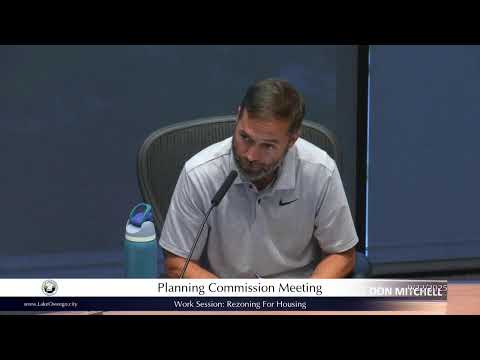
Michael McNamee, the city’s project manager in the Community Development Department, outlined the Rezoning for Housing project (PP25-0001) at the Lake Oswego City Planning Commission meeting on Sept. 22, 2025, saying the effort will examine the city’s mixed-use, commercial and other nonresidential zones for their potential to accommodate more housing.
McNamee said the city’s 2023 Housing Needs Analysis identified an estimated need for nearly 2,000 housing units through 2043 and a deficit of roughly 640 units under existing zoning capacity. Without zoning changes, the analysis found the city would need about 86 additional acres to meet that demand.
The project is one of 13 strategies in the city’s Housing Production Strategy adopted in 2024. Staff requested a $210,000 planning grant through the State Department of Land Conservation and Development (DLCD), which can provide a consultant directly; DLCD is expected to announce its decision in October. Project kickoff is tentatively scheduled for January 2026, with consultant work completed by DLCD’s biennium end in June 2027 and a target for adoption of any zoning and comprehensive plan amendments in September 2027.
The project will use a phased approach that begins with nonresidential and mixed-use areas and may later consider residential upzoning only if capacity from the first phase is insufficient. McNamee identified several focus clusters for early study, including Cruise Way, Boones Ferry/First Addition (Lake Grove), the former Marylhurst University/Marys Woods campus area, and mixed-use corridors north of Old Town. He said industrial areas and portions of Boones Ferry Road likely are not appropriate for residential use and would be excluded.
McNamee described the planned process: consultant selection (if DLCD supplies a consultant), a rezoning background report assessing existing conditions, an opportunities-and-constraints summary identifying redevelopable parcels, alternatives showing zoning concepts and capacity analysis, and then draft zoning map, comprehensive plan and Community Development Code text amendments for commission and council consideration.
During questions, McNamee said rezoning would not force property owners to sell, noting: “Rezoning would not force a property owner to sell. It would just change what could be done with that property.” He also said rezoning alone cannot compel construction: “We’re required to add the capacity. Obviously, we can’t force anyone to build the actual housing.”
Commissioners pressed on incentives and likely housing types. McNamee said the city would pursue a mix of strategies to encourage development of lower-cost and income-restricted housing, including exploring public–private partnerships, tax exemptions and, in the Foothills district, possible use of tax-increment financing to support income-restricted units. He cautioned that financing and the broader economy are limiting factors that the city cannot control.
Commissioners discussed balancing employment and commercial land needs with housing capacity and asked that business groups, the Chamber of Commerce and municipal departments be included in outreach. McNamee noted related work under way, including a forthcoming code audit and new state mandates (including HB 2138) that will add staff workload.
If DLCD does not award the grant, McNamee said the city would attempt to advance the work using internal staff but would likely need to scale the project back because of other statutory requirements and projects. The commission was asked to familiarize itself with the project and expect extensive public outreach and multiple future briefings and hearings, including a public hearing next month on a specific Cruise Way Place zone change.
Next steps: DLCD grant decision in October; consultant selection and contract in fall 2025 if funded; project kickoff in January 2026 with staged deliverables through 2027. The commission will receive updates at key junctures and will hold hearings on any draft amendments.