Get Full Government Meeting Transcripts, Videos, & Alerts Forever!
Get email alerts on the Employee Speech Policy topic
No spam. Unsubscribe anytime.
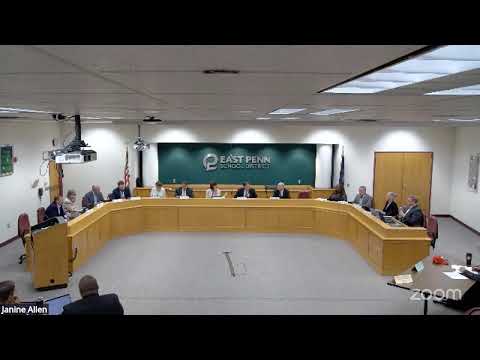
East Penn board gives first reading to multiple policy updates; lengthy debate over employee free‑speech rule
Summary
The East Penn School District board considered a package of policy updates at first reading Sept. 22, including federal grant-management rules and an updated employee freedom-of-speech policy that several board members called vague and recommended be clarified with cross references to disciplinary procedures and solicitor review.
The East Penn School District Board of School Directors on Sept. 22 held a first reading of several policy updates, including federal fiscal-management rules, updates to Title IX-related language and a revised policy on employees' freedom of speech that drew sustained questioning from multiple board members.
Administrators packaged the policies in sections. Doctor Cobolitis presented the first group, describing updates to “uniform administrative requirements, cost principles, and audit requirements for federal awards that directly impact how school districts manage federal grants.” He said the revisions aim to “improve flow and structure, incorporate statutory requirements and administrative priorities, and update terminology and definitions.”
The changes to fiscal-management policies prompted a handful of implementation questions from the board. Doctor Cobolitis estimated “a handful, 5 or 6” employees would be directly responsible for overseeing federal grants, while additional staff might be affected indirectly.
The heaviest discussion centered on a new policy titled Freedom of Speech by Employees. Board members repeatedly described the policy language as vague. Miss Bowman asked whether the changes were driven by PSBA or court decisions; Cobolitis and others said the text reflected PSBA guidance and recent case law. Doctor Whitney said the policy lacks a clear process for initial handling of complaints. “What strikes me ... is that there isn't a clear process,” Whitney said, adding that issues would “end up before the solicitor” only after administrative investigation. Several members pressed for explicit cross-references to existing employee-discipline policies and for greater clarity about who would make determinations at the administrative level.
Board members singled out several phrases in the draft—words such as “loyalty” and “impairing harmony”—as especially problematic because of their subjectivity. Mister Smith called “loyalty” difficult to define and asked whether the board could remove the term; other members suggested alternatives such as “integrity.” Mister Kelly and others said broad terms could invite inconsistent enforcement. Administrators said they would consult PSBA and the solicitor and consider clearer language for the second reading.
Other policy updates reviewed at first reading included revisions to conduct and discipline procedures to align with the code of professional practice and Title IX regulations, and an updated policy on service animals in schools that specifies the permissible and impermissible inquiries districts may make about an individual’s need for a service animal. The board concluded the first-reading reviews and scheduled second readings for a future meeting.
No policy adoption votes were taken; the session concluded the first-reading step and administrators agreed to bring clarified language or cross-references back for second reading.