Get Full Government Meeting Transcripts, Videos, & Alerts Forever!
Get email alerts on the Education Policy Portrait Of Graduate topic
No spam. Unsubscribe anytime.
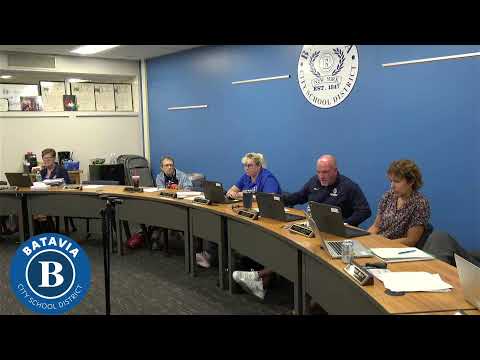
BOCES specialist outlines New York's 'Portrait of a Graduate' proposal to Batavia board
Summary
A BOCES school improvement specialist briefed the Batavia board on a multi-year plan from the New York State Education Department to adopt a Portrait of a Graduate, change credit and assessment rules, and move toward one statewide diploma with seals and endorsements.
Stephanie Burns, a school improvement specialist at the regional BOCES, told the Batavia City School District Board of Education that the New York State Department of Education and the Board of Regents are proposing a multi-year transformation of high school graduation requirements centered on a new Portrait of a Graduate.
Burns said the Portrait — already adopted by the Board of Regents — defines six attributes students should demonstrate: academically prepared, creative and innovative, critical thinker, effective communicator, globally aware, and reflective. She said the changes propose (1) adopting the Portrait statewide, (2) redefining credits and nesting them within the Portrait attributes, (3) sunsetting current assessment-based diploma requirements as a barrier while continuing to offer Regents exams to meet federal ESSA testing requirements, and (4) consolidating to one high school diploma with seals and endorsements replacing the current “advanced designation.”
Burns described the initiative as a phased rollout: planning is complete, the district is entering installation and initial implementation phases, and full implementation is planned to scale by fall 2029. She said the state will provide rubrics and expects K–12 alignment so the Portrait attributes will be taught and assessed across grade levels. Burns said many elements (seals, CTE, internships, capstones) already exist in local schools and could be used as alternate pathways for students to show proficiency.
Board members asked how the changes would affect course rigor and special programs. Burns said courses would remain “the same caliber” and that the state will provide rubrics to create a level playing field across districts; she also said districts will retain local control to design seals and endorsements. Burns noted federal Every Student Succeeds Act (ESSA) requirements mean the state will continue to administer Regents exams in ELA, math and science for accountability, even if passing them is not required for a diploma under the proposed model.
Burns emphasized that much remains undecided and that no district action is required now. She invited district staff and board members to provide feedback to the state and said she would collect regional input for the State Education Department. The transcript records questions about funding; Burns said funding was discussed at early Regents meetings, that state officials have raised funding concerns, and that the timeline could be extended if the department deems it necessary.
The presentation was informational; the board did not vote on policy at the meeting. Burns provided district board members with a state-produced flyer and FAQs, and she said additional guidance and rubrics will be posted as the state finalizes implementation details.