Get Full Government Meeting Transcripts, Videos, & Alerts Forever!
Get email alerts on the Downtown Revitalization topic
No spam. Unsubscribe anytime.
Developer revises Boca Raton downtown campus plan; public raises concerns over Memorial Park and green space
Summary
Developer Tara Frisbie presented a lower-density redesign of a proposed downtown public–private campus that reduces housing and commercial space while adding parks and recreation features; the project drew both praise for added green space and criticism from residents and a petition drive seeking referendum on use of public land.
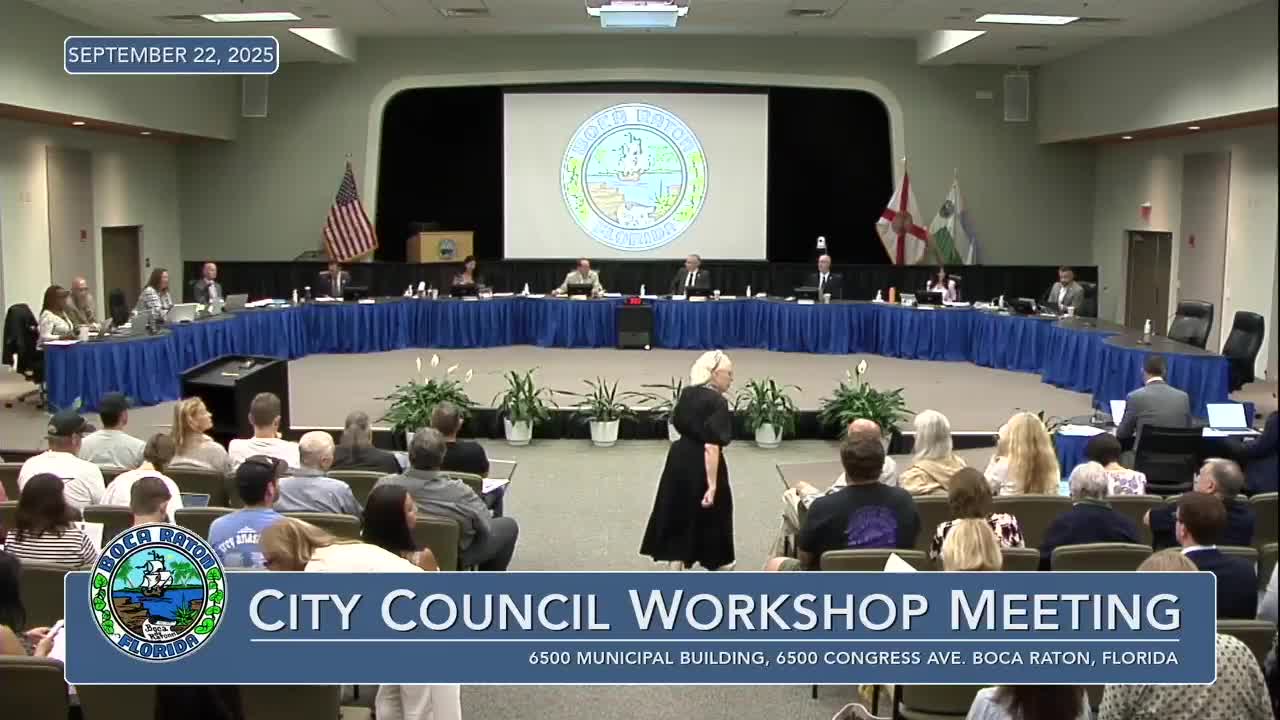
Boca Raton city officials and a developer unveiled a revised design Sept. 22 for a proposed public–private redevelopment of the downtown campus that reduces building heights and residential density while emphasizing parks and family amenities, but residents attending the City Council workshop urged the council to preserve Memorial Park as public land.
The presentation by the developer team from Tara Frisbie described changes that shrink proposed residential units from prior plans “just over 900” to about 740 units and reduce office and retail footprints. The developer said the updated plan increases on-site usable recreational space compared with today’s layout and adds a memorial, a children’s playground, a community center, a new city hall site and a mobility hub near the Brightline station. "We are listening and slowing down this process," Mr. Frisbie said, adding that the team supports sending the final proposal to a referendum so “the public has the final say.”
The developer highlighted specific design moves intended to preserve and expand western green space in the downtown, including keeping five banyan trees near City Hall, removing a previously proposed office building next to the trees and replacing an office site with a memorial park. The revised plan, the developer said, eliminates a hotel use and cuts total retail from roughly 140,000 square feet to under 100,000 and proposes about 250,000 square feet of office space. He described a multipurpose field roughly 300 by 200 feet, a reimagined playground (designed to be shaded and safer than the existing playground under transmission lines) and the possibility of reopening the children’s museum by relocating the historic Singing Pines building adjacent to the playground.
Why it matters: supporters say concentrating new residential and commercial uses near transit and civic spaces can fund public facilities without burdening taxpayers; opponents say the downtown’s Memorial Park and recreation facilities already serve residents and should remain public land. Public commenters at the workshop — including neighborhood groups, longtime residents and youth speakers — urged the council not to lease or give public parkland to a private developer and pressed for an immediate public vote on land disposition.
What the revised plan would change and preserve - Residential units: developer said prior iterations dropped from about 1,100 to just over 900, and the latest plan reduces to approximately 740 units. Office and retail were reduced in parallel. - Parks and recreation: the developer said the plan would preserve more usable, on-site recreation and green space than exists today, citing a current baseline of just over 7.5 acres of existing usable rec space (softball fields, playground, tennis courts, skate park, shuffleboard) and a proposed plan that yields “just over 8 acres” of usable on-site recreation space (excluding green roofs from the calculation). - Memorial Park: the revised plan shows a larger memorial/reflective area west of Second Avenue with a dedicated monument; the developer explicitly said he would not relocate five mature banyan trees and would preserve them in place. - Children’s museum and Singing Pines: the developer proposed relocating the historic Singing Pines building next to a new playground as part of an effort to reopen the children’s museum; city staff noted the museum closed before the pandemic after two nonprofits operating it withdrew and that significant building repairs would be required. - Tennis and sports facilities: the developer presented options that keep tennis in the downtown; the plan showed eight clay courts in one illustration but acknowledged flexibility. City recreation staff told council members the department’s recommendation is to retain 10 courts in a single location for league play, and Meadows Park was discussed as an alternative site if the campus cannot accommodate 10 courts.
Public engagement, analysis and next steps The developer announced additional public engagement sessions: an open house Sept. 29 at the Studio at Meisner Park from 4–7 p.m. and another meeting Oct. 6 at the 6500 building. The development team also launched a website, 1boca.com, and said it would add a way to indicate whether respondents are Boca Raton residents after public feedback.
City staff said independent fiscal and economic analyses are under way. The city has under contract PFM, a fiscal consultant, to complete a fiscal impact analysis and economic impact study; the city’s deputy manager and CFO said those reports are in progress and would be provided before any final development agreement is approved. Staff also confirmed that the city clerk transmitted an initiative petition submitted Aug. 26 to the Palm Beach County Supervisor of Elections for signature verification on Aug. 28 and that the supervisor of elections is the official verifying voter signature sufficiency under the city charter.
Public reaction at the workshop More than a dozen residents spoke during the public comment period. Speakers included long‑time residents and student advocates who emphasized the parks and ballfields’ role for children, veterans and neighborhood life. John Perlman, who said he submitted more than 5,000 signatures to the city on Aug. 26, told the council he and others expect the city charter’s verification process to be followed and said residents had asked the council to suspend further action pending certification. "Save Boca and the citizens who love our city stopped it," Perlman said, referring to an attempt to move ahead quickly without required studies; he and others urged the council to place any disposition of parkland to a public vote.
City and staff responses Mayor Scott Singer and staff emphasized the process is ongoing and that the council has committed to allowing a public vote on disposition of public land. City attorney and clerk staff explained the charter procedure for initiative petitions and that the supervisor of elections must verify signatures before the clerk certifies the petition’s sufficiency. Staff reiterated that required studies (fiscal impact, economic analysis, appraisal and environmental reviews) would be completed before a final development agreement and that additional public input sessions are scheduled.
Open questions and points of debate - Parking and traffic: multiple residents asked how additional downtown residents and visitors would park and how the city would mitigate expected traffic increases. The developer said the plan uses a mix of on-street and structured parking and aims to encourage transit, biking and walking. No final parking program was approved. - Recreation master plan: council members and staff said citywide recreation planning (a recreation master plan and related capital improvements) needs to be completed to guide decisions about moving or consolidating fields and courts. That plan remains in development; staff said a consolidated overview of planned capital projects will be presented in coming weeks. - Environmental impacts: residents raised concerns about relocating fields to Sugar Sand Park, noting protected species habitat (gopher tortoises and other wildlife) and the need for environmental studies before approving relocations.
What the council asked staff and developer to do Council members asked the developer to refine the plan in response to public input and for staff to provide more detail about finance, programming for the Singing Pines building, parking strategies and the recreation master plan. Council members also asked the developer to plan alternatives (for example, tennis courts downtown versus at Meadows Park) so the public charrettes can weigh tradeoffs.
Ending note The developer said the revised plan is intended to generate revenue to fund new civic facilities without a direct tax increase, and reiterated support for a referendum. The council and staff emphasized that no final redevelopment or land disposition decisions have been made; required independent analyses and petition verification are ongoing and the public will have additional opportunities to comment at scheduled meetings and charrettes.