Get Full Government Meeting Transcripts, Videos, & Alerts Forever!
Get email alerts on the County Health Outcomes topic
No spam. Unsubscribe anytime.
Commission members review county health data; report finds gender breakdowns limited
Summary
The commission reviewed county and state health data on women and marginalized genders, finding limited gender breakdowns and gaps for nonbinary and transgender populations.
Commissioners discussed available health data for women and marginalized genders in Monroe County and identified substantial gaps in gender-specific measurements.
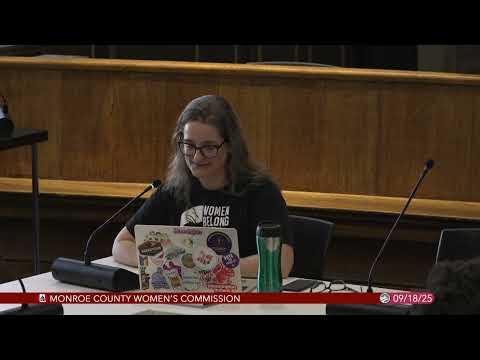
Vice Chair Julie Hardesty summarized sources she reviewed, including the Monroe County Community Health Assessment (2021), County Health Rankings & Roadmaps (2025), Indiana Department of Health data on heart disease and stroke, the Human Rights Campaign health care equity index (2024), and the Institute for Health Metrics and Evaluation county profile (2016). Hardesty said many commonly used county data sources do not break outcomes down by gender beyond a male/female binary.
Hardesty cited several quantitative findings she could locate: "65 percent of female Medicare enrollees do get mammograms every year in Monroe County," and the Monroe County Community Health Assessment survey from 2021 had "almost 75 percent of its responses from women." She said older IHME county profiles indicated female life expectancy around 82 years in 2014, while more recent County Health Rankings data show overall life expectancy in Monroe County at about 78.5 years as of 2024. Hardesty added that suicide-rate reporting in the county does include male and female breakdowns for 2017–2021, with female suicide counts in the single digits and substantially lower than male rates.
Commissioners noted the lack of local data on nonbinary and transgender health outcomes. Hardesty said the Human Rights Campaign index documents where facilities responded to surveys and that Planned Parenthood of Indiana ranked highly among respondents, while IU Health Bloomington Hospital "did not rate well overall for LGBTQ+ inclusive policies" in Human Rights Campaign research referenced by the commission.
The commission’s data subcommittee and the group’s data dashboard work were referenced as next steps; Hardesty said she would share links and a summary with staff for the minutes and to support the data subcommittee’s work.
No formal action was taken; members discussed potential sources and the need to refine data collection and the commission’s rubric to ensure inclusivity beyond a binary gender framework.