Get Full Government Meeting Transcripts, Videos, & Alerts Forever!
Get email alerts on the Public Meetings Field Trips topic
No spam. Unsubscribe anytime.
Draft governance handbook recommends notice and limits for council off‑site visits under Oregon law
Summary
Policy analysts presented draft handbook guidance advising public notice when a quorum of council or a committee will attend off‑site meetings, recommending participants avoid deliberation on matters likely to come before council and noting that Oregon law exempts purely factual site visits from public meeting requirements.
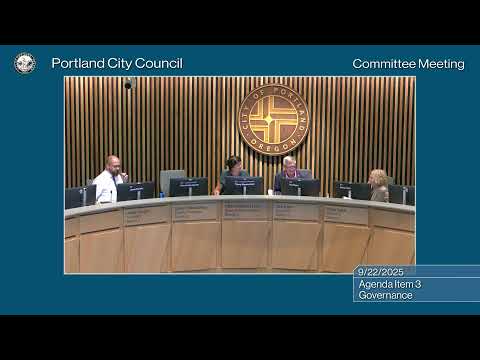
Craig Cook and Aubrey Chen, policy analysts working with the Governance Committee, presented drafts and comparative research on Sept. 22 for how a council governance handbook might treat off‑site meetings and site visits.
Cook said the office reviewed practices in Oregon jurisdictions and asked the city attorney for guidance on the state’s public meetings law and related ethics rules. The presenters told the committee that Oregon law exempts site visits and on‑site inspections from the definition of a public meeting and also excludes communications that are purely factual or educational in nature, provided the discussions contain no deliberation or decision on city business.
Based on that framework, the analysts offered draft recommendations: notify council operations and the city clerk in advance when a quorum of the full council or a committee is expected to attend an off‑site meeting so the city can issue public notice; avoid discussing items that may come before committees or council while on the trip; and treat public participation and virtual access as special considerations (most surveyed jurisdictions do not provide virtual access and few facilitate public participation on trips). “If council does want to take this further and create a field trip policy for yourselves, council operations is happy to work with the city attorney to draft a formal policy,” Cook said.
Council members raised scenarios where ceremonial remarks at ribbon cuttings might risk crossing into deliberation. Councilor Dunphy said the legal boundary can be unclear and will require city attorney input; Robert Taylor, the city attorney, cautioned that social or ceremonial events are not subject to the public‑meetings rules unless they “morph into deliberations.”
Several councilors supported keeping the handbook recommendations as a flexible set of best practices while treating the Oregon Government Ethics Commission guidance and the public meetings law as the mandatory floor. The committee asked staff to include practical scenarios in the handbook (for example, what to do when a quorum attends a public event and constituents raise matters relevant to council business).
No formal policy was adopted at the meeting. Staff said they will continue drafting handbook language, circulate it for feedback and engage the city attorney’s office before proposing any formal council policy.