Get Full Government Meeting Transcripts, Videos, & Alerts Forever!
Get email alerts on the Council Operations topic
No spam. Unsubscribe anytime.
Council operations manager outlines role, staffing and confidentiality practices
Summary
Dana Richardson, Portland’s new council operations manager, described efforts to align council operations with the city clerk, district administrators and committee staff, clarified the office’s confidential handling of sponsor information, and flagged workload pressures from multiple committees.
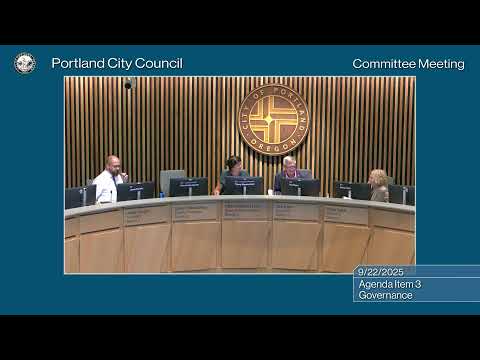
Dana Richardson, the council operations manager for the City of Portland, told the Governance Committee on Sept. 22 that her office is working to standardize processes across council offices and with the city clerk to reduce confusion about motions, agendas and post‑hearing dispositions.
Richardson said the council operations team provides “strategic, nonpartisan support” and acts as “the backbone” for council work, coordinating with the clerk and with four district administrators to improve visibility into agendas, align briefing forms and clarify who follows up on questions raised during hearings. “When we are working… the default is to keep that information confidential so that the sponsor has the control over the sharing of the information,” Richardson said.
The memo and Richardson’s remarks sought to address mismatches between the chair’s spoken motions and the clerk’s recorded dispositions, and to standardize types of motions used in meetings. She said her office has three policy analysts who work primarily with committees, a coordinator (named Shuly), a communications staffer and four district administrators who report to council operations. Richardson said the district coordinators spend significant time scheduling and supporting constituent responses and estimated their core workload at roughly 75–80 percent of capacity.
Committee members thanked Richardson for the work and raised capacity concerns. Councilor Dunphy said the committee structure and number of meetings places heavy demands on staff; Richardson confirmed the workload is substantial and noted an additional policy analyst is budgeted but she is delaying recruitment until committee structure decisions settle. “I know I’ve got two of my analysts in the room… it is a lot,” she said.
Members also flagged several areas for follow up. Councilors asked the office to continue identifying structural misalignments across committees, to feed recommendations into the governance handbook effort and to surface operational fixes publicly and privately as appropriate. Richardson encouraged councilors and staff to use council operations as a point of contact for process questions and said the office is tracking when chairs need different agenda orders and when materials are produced late.
The discussion covered, but did not decide, whether the council should re‑examine boundaries between administrative and legislative authority on items such as parking hours; Richardson and council members suggested that legal staff will be involved when needed. No formal motions or votes were recorded on staffing or committee structure during the meeting.
Committee members also proposed using the governance committee as a forum for a structured prioritization process tied to the upcoming budget, including a possible questionnaire for councilors and outside facilitation for relationship‑building and strategic planning. Richardson offered council operations’ support for drafting materials and coordinating follow‑up work.