Get Full Government Meeting Transcripts, Videos, & Alerts Forever!
Get email alerts on the School Finance topic
No spam. Unsubscribe anytime.
Elyria City schools warn of multimillion-dollar shortfall; 4.9-mill levy set for Nov. 4 ballot
Summary
Treasurer Colleen Apolt told the Elyria City School District board the district faces falling state revenue, rising costs and shrinking reserves; the board has placed a 4.9-mill, 10-year operating levy (Issue 17) on the Nov. 4 ballot and must cut millions from the budget if voters reject it.
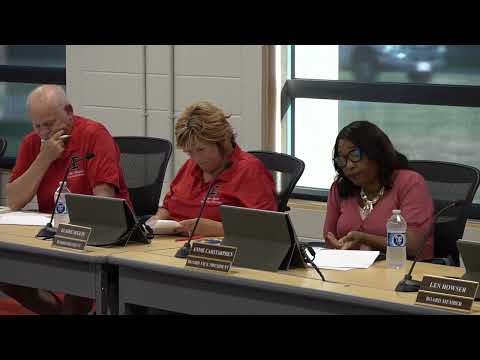
Elyria City School District Treasurer Colleen Apolt told the board Sept. 17 that the district faces a sharp gap between rising expenses and slowing revenue, and reiterated the district’s plan to ask voters on Nov. 4 to approve a 4.9‑mill, 10‑year operating levy (Issue 17).
Apolt said the state’s new requirement to submit a budget and three‑year forecast changed how the district files reports, but did not change the main conclusion: without additional revenue or cuts, the district’s finances are not sustainable. “For this fiscal year we are at a 29% cash balance; 30% is my recommendation,” Apolt said. “When it goes to next year, we drop down to 18% cash balance because we are deficit spending.”
The nut of the presentation: expenses are rising faster than revenues. Apolt cited an 18% increase in health insurance costs, transportation inflation and other expense pressures; she said revenues have risen about 1.85% annually over the past five years, while the district projects revenue to decline roughly 0.4% going forward. State funding is a major driver — she said the district expects about $2.2 million less state funding than previously estimated.
Apolt described several technical drivers behind the drop in state funding, saying the state still uses base‑year figures from 2022 and is increasing local capacity assumptions so districts with higher local property values receive reduced state reimbursements. Reading from a legislative estimate, she said the Legislative Service Commission calculated that eliminating a rollback on new levies would save the state more than $1.3 billion annually — a change that, Apolt said, results in reduced reimbursements to school districts.
Those changes are already showing up in the district’s operating numbers. Apolt reported fiscal‑year 2026 expenditures of about $93.6 million against projected revenues near $88 million, producing a deficit that reduces reserves and cash‑on‑hand days from a recent 86‑day estimate to about 65 days. She said the district currently has roughly $500,000 in delinquent property taxes and that, absent new revenue or significant cuts, an auditor could flag the district for fiscal caution in 2026.
To address the gap, the district has placed Issue 17 — a 4.9‑mill operating levy for 10 years — on the Nov. 4 ballot. Apolt said the board has already passed two resolutions to put the levy on the ballot. She told the board the district needs to cut roughly $3 million in expenses in addition to the levy to balance the budget for the 2026–27 school year; if the levy fails, the district would need to cut about $9 million.
Apolt emphasized that some cost savings are already occurring through attrition and position absorption when staff retire. She also said the district will continue negotiations on collective bargaining agreements and is reviewing health plan options to contain future cost growth.
The board did not alter the levy placement during the Sept. 17 meeting; members asked clarifying questions and then approved routine financial and appropriations items later in the agenda. Apolt said she will file the forecast in the format required by the Ohio Department of Education and continues to present a longer five‑year view to the board for planning, even though the state format is for three years.
Board President Elaine Seguin and several board members thanked Apolt for the presentation and asked about implementation items such as proposed cuts, the timetable for negotiations and the public information campaign related to the levy. Apolt said specific cuts are being identified and will be brought to the board as the district finalizes options.
If voters approve Issue 17 on Nov. 4, the levy money is intended to maintain current educational programs; if it fails, Apolt said the district will have to advance a larger set of reductions. The district’s treasurer repeatedly framed the numbers as contingent: they depend on final state funding, local tax collections and the outcome of the Nov. 4 ballot measure. The board received the presentation and proceeded with scheduled votes on financial and personnel items later in the meeting.
Ending: The board’s next steps include filing the forecast with the Ohio Department of Education, continuing budget‑reduction planning and public outreach on Issue 17 ahead of the Nov. 4 election.