Get Full Government Meeting Transcripts, Videos, & Alerts Forever!
Get email alerts on the Corrections Meeting Decisions topic
No spam. Unsubscribe anytime.
DeKalb County corrections advisory board approves juvenile electronic monitoring policy, narrows community-service requirement and OKs staff training
Summary
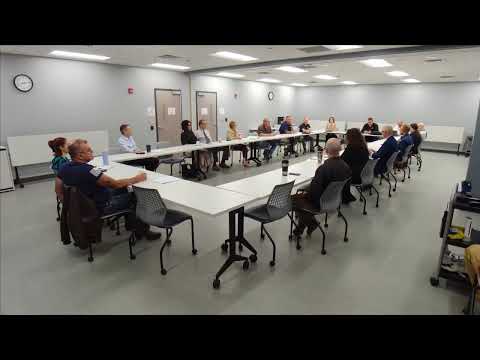
The DeKalb County Corrections Advisory Board on an administratively focused agenda approved a new juvenile alternative-to-detention policy, voted to change how community service is applied for program participants, and adopted a defensive-tactics training requirement for staff, while also approving routine year-end budget transfers.
The DeKalb County Corrections Advisory Board on an administratively focused agenda approved a new juvenile alternative-to-detention policy, voted to change how community service is applied for program participants, and adopted a defensive-tactics training requirement for staff, while also approving routine year-end budget transfers.
The board approved a policy identified in the meeting as Policy No. 7-012-0 to permit use of electronically monitored home detention (EMHD) during the short period between initial detention and the first court hearing. Presenters said EMHD is intended as an additional supervision option to avoid long transports to out-of-county juvenile facilities and reduce burden on the sheriff’s office; the board voted to adopt the policy as presented.
Why it matters: Board members and juvenile probation staff described limited local juvenile bed capacity and lengthy transports to distant facilities. The new policy offers a supervised alternative during the critical prehearing period that staff said will require adherence to existing due-process timelines (including court hearings required within the statutory timeframe after detention).
What the board discussed and decided - Juvenile alternative-to-detention policy (Policy No. 7-012-0): Presenters described EMHD as a narrowly tailored, prehearing tool run in conjunction with juvenile probation and community corrections. Juvenile probation officers Kelly Mattis and Kelly Heath were cited as part of the operational plan. The board moved and seconded adoption of the policy; the motion carried. Meeting remarks emphasized that use of EMHD still triggers the same court hearing requirements that accompany any restriction on liberty.
- Community-service requirement: Staff recommended removing the standing requirement that every participant complete a set number of weekly community-service hours. Instead, community service would be required only in specific circumstances: when a participant is unemployed, when a judge specifically orders it at sentencing, or when used as a sanction for program rule violations. Staff and several board members said the program currently lacks sufficient staff and supervision capacity to safely and effectively monitor a large-scale community-service requirement. The board moved to change the participation agreement accordingly; the motion carried, with board members asking staff to continue seeking resources to restore broader programming in the future.
- Defensive-tactics training and policy manual update: The board approved adding a requirement that specified staff complete defensive-tactics training and periodic recertification. The change applies to residential and case-management staff and was presented as a routine update to the agency policy manual; the board approved the two pages in the packet describing the requirement.
- Financial transfers and operational updates: Staff presented a routine financial summary and asked the board to approve a set of relatively small transfers (items listed a–h in the meeting packet) intended to close out grant-year bookkeeping and address facility repairs (including walk-in freezer and kitchen repairs), HVAC needs, and access-control hardware tied to the program’s recent relocation to the Choice Building at the Kroger Plaza. The board moved and approved the transfers.
Other discussion and context - Budget pressures and possible out-of-county referrals: Staff and board members discussed state grant reductions that the presenters described as “around 9%” compared with the prior year. Board members raised the possibility of accepting residential referrals from other counties if neighboring programs close, and staff outlined questions that would need answers before taking out-of-county referrals (screening and removal processes, guarantees about retaining beds for DeKalb County cases, timing for returning residents to their county of origin). No formal vote or intergovernmental agreement was taken; the discussion was exploratory.
- Program operations and participants: Staff reported the residential program had six participants at the time of the meeting — including four DeKalb Central High School students and others awaiting intake — and outlined upcoming programming (high-skills training classes, conferences on education and mental health, and staff training on topics such as teen suicide awareness and stress reduction).
Votes at a glance - Approve transfers listed a–h (year-end/grant transfers to cover operating and repair needs): Motion moved and seconded; outcome: approved. - Adopt Policy No. 7-012-0 (juvenile alternative to detention/EMHD): Motion moved and seconded; outcome: approved. - Modify participation agreement to narrow mandatory community service to unemployed participants, court-ordered service or sanctions: Motion moved and seconded; outcome: approved. - Approve defensive-tactics training requirement and corresponding policy manual pages (packet corner number shown as 3020001): Motion moved and seconded; outcome: approved.
Who spoke (selected): Michelle (Community Corrections staff) presented the financial summary and operational updates; juvenile probation officers Kelly Mattis and Kelly Heath were identified as part of implementation for juvenile monitoring; several board members (including Michael, who chaired the prior meeting, and Don Fader) participated in votes; Sheriff Thomas and judges were referenced during discussion of transports and hearing timelines.
What’s next: Staff said they will continue to pursue additional county funding decisions currently pending at the county council and will return with budget amendments as needed. Board members asked staff to explore partnerships (for example, with United Way and other community organizations) to expand supervised community-service opportunities if resources allow.
The board scheduled its next meeting for Dec. 5, 2025, at 7:30 a.m.