Get Full Government Meeting Transcripts, Videos, & Alerts Forever!
Get email alerts on the Convention Center Expansion topic
No spam. Unsubscribe anytime.
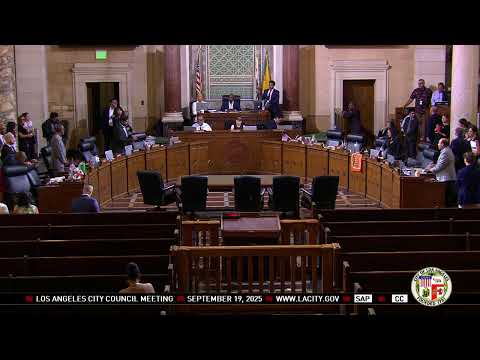
City Council advances modified Los Angeles Convention Center expansion after heated debate
Summary
The Los Angeles City Council voted to advance a revised expansion of the Los Angeles Convention Center, approving modifications that set project figures, oversight and reporting requirements while councilmembers and members of the public warned about schedule, cost and long-term impacts on the city general fund.
The Los Angeles City Council voted on Sept. 19, 2025, to advance a revised expansion of the Los Angeles Convention Center, approving motions that set updated project figures, require quarterly compliance reports and direct the mayor’s office to pursue expedited construction steps ahead of the 2028 Olympics.
City Administrator Rosé Matzemou told the council the administration had negotiated cost reductions and updated assumptions with the developer and city departments. “Combining these revisions … reduce[d] the total project cost by more than $500,000,000 and move the general-fund impact from $111,000,000 in the August report to $89,000,000 today,” Matzemou said during the council presentation. She added that total financing including capitalized interest would push the face amount above $3 billion and that the city’s assumed average debt-service burden is roughly $171,000,000 per year at current assumptions.
The administration and council members repeatedly framed the choice as weighing large potential economic and job benefits against multi‑decade financial commitments. Supporters at the meeting — including unions, hotel and business groups — said the expansion would create construction jobs, long-term union positions and increased visitor spending. Union leaders said the plan would produce thousands of construction jobs and hundreds of permanent jobs tied to larger conventions.
Opponents, including Councilmember (first referenced in the meeting record as) Yaroslovsky, warned that the schedule and financing carry major risks and would require the city to divert general-fund resources for decades. Yaroslovsky urged a more cautious approach and recommended staged upgrades to reduce near-term pressure on general-fund obligations; she noted the committee of budget and finance had recommended a cheaper alternative and staged work to protect city services.
The council heard lengthy public comment. Dozens of speakers — business owners, neighborhood groups and union representatives — urged approval, emphasizing job creation and competitiveness for major events including the 2028 Olympics. Other community speakers and several council members cautioned that the schedule to be ready for the Olympics leaves little margin for delay and that some projected revenue streams (notably digital highway signage) now face legal and legislative constraints, reducing expected ad revenue.
Key financial and schedule points presented to the council: the administration’s “direct” project cost was presented at about $2.62 billion for preconstruction and construction line items; construction cost assumptions were reduced after departmental review, lowering the estimated near‑term general‑fund impact; updated debt‑service assumptions used a 4.6% interest-rate forecast; projected dedicated revenues (event receipts, parking and on‑site signage) were estimated to average about $120,000,000 annually over 30 years, with an additional estimated net tax gain from broader economic activity. Even so, the administration said the project would leave an average net general‑fund impact of about $89,000,000 per year over the 30‑year modeling window and a peak general‑fund obligation projected near $147,000,000 in the first year the city begins debt‑service payments.
Administration staff and Los Angeles Department of Water & Power (LADWP) representatives answered council questions about underground utility work and coordination with other major city and regional infrastructure projects. LADWP officials said the department has identified costs for relocating or protecting needed transmission and distribution infrastructure and committed to working with the city and the developer to reduce schedule risk, while acknowledging the work will require close interagency coordination.
After debate the council approved a package of motions and modifications that (1) set updated cost and financing figures as amended in council motions, (2) require quarterly public compliance reports from the City Administrative Officer (CAO)/City Attorney’s office on local-hire and other commitments, and (3) authorized proceeding with project approvals and financing steps as modified by the council. Supporters said prompt action was needed to make the city competitive for major conventions and to capture jobs; opponents said the city should stage work and protect funding for public services and homelessness programs.
The council’s action does not erase schedule or cost risks. The administration warned the project must meet strict timelines to be ready well before summer 2028 and that delays or external changes (for example, changes to state law limiting off-site digital signage) could reduce revenues or increase reliance on the general fund. Councilmembers adopted language directing frequent public reporting and stronger local-hire and monitoring provisions.
Votes at a glance - Motion instructing the City Administrative Officer/City Attorney to provide quarterly public compliance reports and to direct emergency hiring steps if the city faces workforce shortfalls (referred to as 15E in the council record): approved 13–0. - Motion to revise project figures and replace several numeric line items in the project authorization (referred to as 15B in the council record): approved 11–2. - Motion from Councilmembers (referred to in the record as) Jurado and Price modifying project language (referred to as 15C): approved 13–0. - Motion to advance project approvals and send the item for immediate action (recorded as “send immediately”): approved 13–0.
What it means next The council’s approval directs the administration to move forward with the amended financing and project documents while providing the council with quarterly compliance reporting on local hiring, contracting and project schedule. The administration said staff will return with bond-authorizing ordinances, final contract documents and other implementing actions on a schedule set by the council. The project carries material schedule, construction and revenue risks that the council and administration said they will monitor closely.
Sources and limits This article is based on the council’s Sept. 19, 2025, public meeting record and on statements made on the public record by City Administrator Rosé Matzemou, LADWP staff and multiple councilmembers. Financial figures and projections cited in this story are those the city presented to the council during the meeting. Where the meeting record included transcription errors or implausible numeric readings, the article uses the city’s official presentation figures and the numbers read into the record by city staff.