Get Full Government Meeting Transcripts, Videos, & Alerts Forever!
Get email alerts on the Minor Subdivision Resubdivision topic
No spam. Unsubscribe anytime.
Livingston Parish committee reopens minor‑subdivision rules amid drainage and floodplain concerns
Summary
The Livingston Parish Ordinance Committee held a public hearing on Sept. 3 on a proposed ordinance tightening rules for minor subdivisions and resubdivisions. Residents, drainage officials and surveyors urged clearer language, protections for older landowners and stronger drainage and floodplain review; no vote was taken.
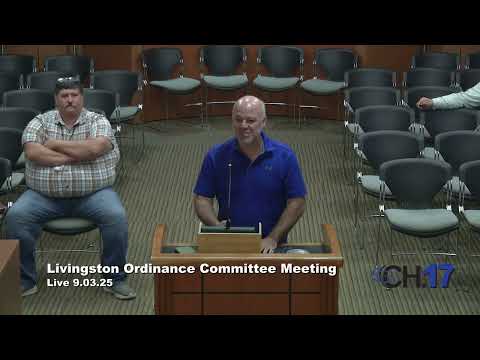
The Livingston Parish Ordinance Committee on Sept. 3 reopened public hearings on a proposed ordinance to change the rules for minor subdivisions and resubdivisions, focusing public attention on drainage, floodplain mitigation and protections for family land transfers.
Supporters and critics said the draft ordinance addresses an ongoing “loophole” in which multiple minor resubmissions allow large cumulative development without detailed drainage review, but they warned that some provisions could burden older landowners or small-scale family transfers.
Committee members, planning staff, representatives of Drainage District 1 and residents discussed several changes under consideration: lowering or changing the lot-count threshold that triggers detailed studies, requiring drainage documentation at permit stage, tying certain reviews to federal floodplain requirements for projects of a specified size, and adding family‑partition exceptions.
“This ordinance absolutely goes a long way to help preserving those those things as well,” said Jamie Seal, a surveyor with Quality Engineering and Surveying, who represented Drainage District 1 and urged tighter documentation of natural drainage and steps to prevent developers from blocking natural sloughs. Seal said the district has found developments that were approved as minor resubs that later created flood and maintenance burdens for taxpayers.
Committee members and speakers identified several recurring issues: a recent spike in minor‑resub applications (a planning‑department figure cited 41 total applications since the ordinance was first discussed), confusion in draft language about whether the threshold is 6, 7 or 9 lots, and how the current two‑year window between resubmissions can allow repeated subdivision in stages. A commenter summarized the pattern as: applicants obtain a minor resub for up to the allowed number of lots, wait until homes are built over time, then apply again to create additional lots.
Speakers urged preserving low‑cost options for ordinary homeowners who subdivide small parcels for family transfers or to build a single home. Several said banks sometimes require smaller lots for lending, and participants warned that a blanket requirement for costly drainage or traffic studies could impose undue expense. One commenter noted the $5,000 resub fee in the existing process and contrasted a lower‑cost desktop drainage review with a full drainage‑impact study that can cost “$15,000.”
Multiple speakers urged tying parish review to existing federal floodplain guidance. A commenter, citing the Community Rating System (CRS) work, said FEMA requirements call for base flood elevation data on projects of 5 acres or more and recommended the ordinance explicitly require that data when applicable.
Several technical suggestions surfaced: require clearing permits and documentation tied to any land‑disturbing activity; require a desktop review using LIDAR and FEMA maps before construction; record and name unnamed laterals so future maintenance responsibility is clear; and consider utility‑availability criteria (electric, water, sewer) as part of larger subdivision proposals.
Residents with family farms asked the committee to include or coordinate a separate family‑partition provision so routine intra‑family transfers (for example, carving off an acre for a child) are not subjected to the same studies aimed at commercial developers. Jeanette Clark and Melissa Jones, among others, cited similar ordinances — including Hammond and Youngsville — as models that allow family partitions or longer windows between resubmissions.
No formal motion or vote occurred at the Sept. 3 meeting. Committee staff asked speakers to submit written suggestions by 9 a.m. the next day so the sponsor could review proposed changes; the committee chair said he would synthesize the input and prepare revised language for the next ordinance meeting.
The discussion brought planning and drainage staff into public view as part of the review process: planning department staff (identified in the hearing as Scooter Keane) and the parish’s drainage officials said some areas are already reviewed by gravity drainage districts, while other rural tracts lack district coverage and therefore need additional desktop or site‑specific review. Drainage District 1 urged the parish to require documentation that would prevent developers from blocking natural drainage ways and shifting maintenance costs to taxpayers.
The committee did not adopt any ordinance amendments at the hearing. Members said they will circulate revised wording for further comment before returning the item to committee or the full council.