Get Full Government Meeting Transcripts, Videos, & Alerts Forever!
Get email alerts on the Opioid Funding And Services topic
No spam. Unsubscribe anytime.
Escambia County opioid funds, grants and treatment data reviewed; $1.7 million available for new awards
Summary
Board reviewed opioid-abatement fund balances, a forthcoming McKenzie settlement payment, the NOFA application timeline and community treatment metrics including a 92% retention figure for people receiving services through the CORE network.
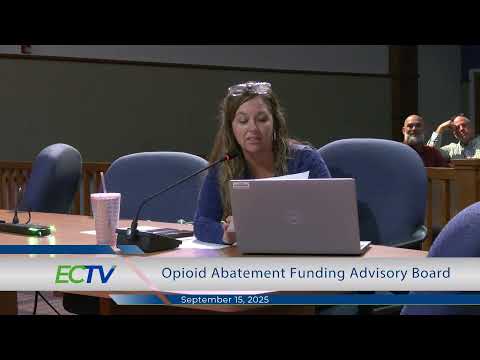
The Escambia County board overseeing opioid abatement spending reviewed the program's available funds and grant pipeline and heard progress reports from local treatment and outreach providers.
Opioid-abatement program staff told the board the county has received $5,369,663.88 in settlement payments to date and has obligated $3,647,362.36, leaving “just over $1,700,000.0” available to award for the current fiscal year. The staff member said the county's last payment arrived on Jan. 28, 2025, and that the next payment is expected around January or February 2026.
The board was also notified of an expected McKenzie settlement payment of about $129,000, which staff said is expected in September and will “come back before you guys to accept those funds” and later be sent to the Board of County Commissioners for final acceptance.
Why this matters: The remaining balance and the incoming settlement affect which local nonprofits and programs receive grants from opioid-abatement funds. At the meeting, staff outlined a timetable for reviewing a new round of grant applications and said funds are already being reimbursed to some prior awardees.
Board business and grant timetable
Staff reported that four nonprofit awardees from the 2024–25 Notice of Funding Availability (NOFA) have started submitting reimbursement requests and have received payments. Two awardees that are working on property purchases or construction were described as preparing reimbursement requests "real soon." The FY 2025–26 NOFA deadline fell the prior Friday; staff said 10 applications were received and listed applicants as Young Psychotherapy PLLC; Brightbridge Ministry; EMS Core; Health and Hope; Hope Above Fear; Lakeview AIM/CAP program; Ministry Village; Offensive; REAP; and YMCA (noting the YMCA is partnering with Community Health).
Staff said the review committee will score applications with a revised deadline and meet to finalize scores on Tuesday, Oct. 7, and that staff will notify applicants who advance on Friday, Oct. 10. The board was given two options for the next step: consider applications at the next board meeting (proposed Oct. 13) or receive materials in advance and meet the following week (proposed Oct. 20). The board later scheduled its next regular meeting for Oct. 27 at 10 a.m.
Treatment and outreach data presented
A Community Health program representative said the county's CORE-network reporting shows the CORE sites are fully onboarded and that community health is now reporting data on each patient with a substance-use diagnosis. The speaker reported 3,021 patients in community health's substance-use dataset for the July 2024–June 2025 reporting year and described that group as a broad pool that includes people in early (“precontemplative”) stages of change.
The speaker gave the network's retention figure as about 92% — a point one board member described as “shocking.” The Community Health presenter then clarified the state definition used for retention: a patient who at some point entered a medication-assisted treatment (MAT) program and continues to receive care across any service line is counted as retained even if they are not currently receiving MAT medication. The presenter said that narrower, structured data flagging shows 256 people actively participating in the CORE program's additional services; another subset consists of people identified with opioid use disorder (the speaker cited a 376 figure, then corrected and referenced other subcounts during discussion). The presenter said 165 individuals were currently taking MAT medication and 179 patients in the reporting period came in from EMS.
Harm-reduction outreach
A Lakeview outreach program representative reported ongoing street outreach at least twice a week during the reporting period: distribution of 86 boxes of naloxone (Narcan), 72 packs of fentanyl test strips, management kits, seven rapid hepatitis C tests and 10 rapid HIV tests. Staff also said Lakeview had begun a small test run of xylazine test strips, noting xylazine is increasingly mixed with fentanyl in the local supply.
Lakeview staff described outreach to nightclub operators to train staff and make naloxone and test strips available in on-premises locations; the speaker said one nightclub owner was “really interested in having fentanyl” testing supplies available for staff to use if someone collapses.
Local medical examiner data
A speaker identified as Denise representing CDAC delivered an interim medical examiner summary focused on fentanyl. Denise said 103 deaths were attributed to fentanyl in the latest local report and that the highest age group for overdose deaths was 35–50, with the next-highest group being 50 and above. Denise added there has been a spike in overdoses among the 10–19 age group in other local data sources and said she would try to provide updated figures at the next meeting.
Meeting actions and next steps
The board approved the minutes from its July meeting by voice vote at the start of the session. Staff said they will present the incoming McKenzie settlement for formal acceptance when the payment arrives and then forward the acceptance to the Board of County Commissioners. The review committee will complete NOFA scoring by the Oct. 7 deadline; staff will notify applicants on Oct. 10, and award recommendations will be brought to the board at a subsequent meeting.
Documented remarks and definitions
At one point a board member asked what the program considered “formalized” care; the Community Health presenter said formalized care refers to appointments and services provided by named CORE providers (Keisha Tran, Ryan Bianco and Sean Ryan were listed as CORE providers) and to program flags in the structured dataset.
The staff presentation and the provider updates illustrate the mix of prevention, harm-reduction outreach and treatment services that local opioid-abatement funds support. Several board members and presenters emphasized the program's goal of sustaining engagement so that patients can enter formalized treatment when they choose.
Ending
Staff will bring the McKenzie settlement acceptance to the board after payment is received, and the board will consider NOFA award recommendations at a future meeting following the committee's scoring and applicant notifications.